

518
11 The Rates of Chemical Reactions
[C]
[A]
[B]
[B] 0
[A] 0
[C] 0
Concentration
t 50
Time
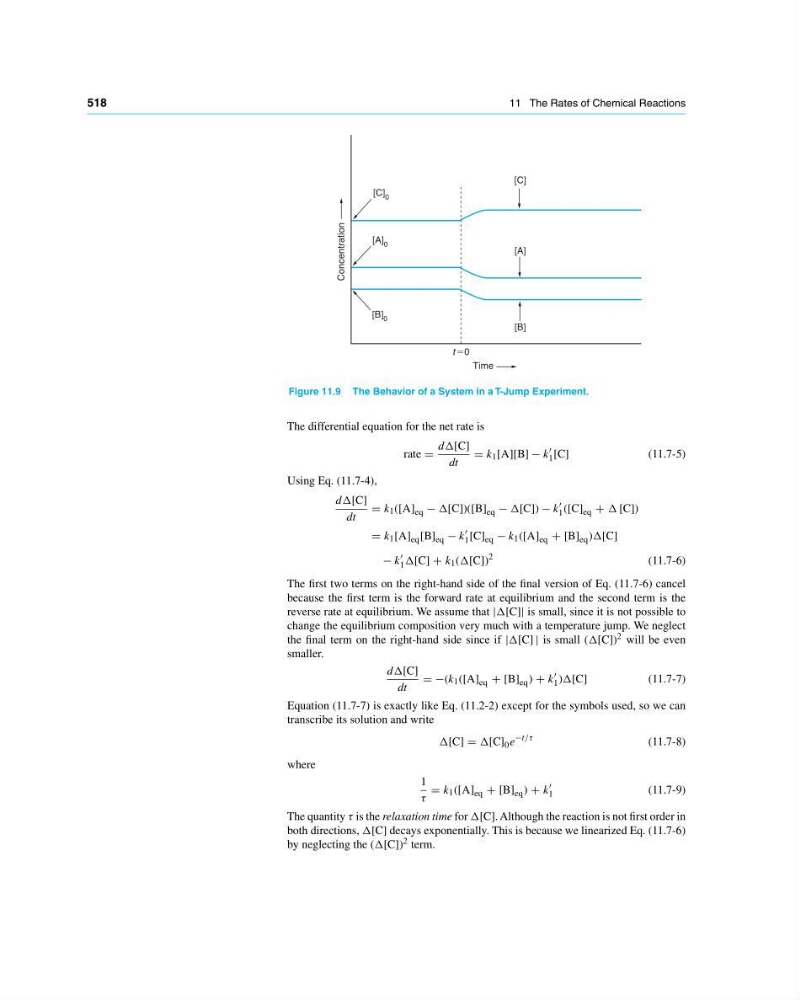
Figure 11.9 The Behavior of a System in a T-Jump Experiment.
The differential equation for the net rate is
rate
d∆[C]
dt
k 1 [A][B] − k
1 [C]
(11.7-5)
Using Eq. (11.7-4),
d∆[C]
dt
k 1 ([A] eq − ∆[C])([B] eq − ∆[C]) − k
1 ([C] eq + ∆ [C])
k 1 [A] eq [B] eq − k
1 [C] eq − k 1 ([A] eq + [B] eq )∆[C]
− k
1 ∆[C] + k 1 (∆[C])
2
(11.7-6)
The first two terms on the right-hand side of the final version of Eq. (11.7-6) cancel
because the first term is the forward rate at equilibrium and the second term is the
reverse rate at equilibrium. We assume that |∆[C]| is small, since it is not possible to
change the equilibrium composition very much with a temperature jump. We neglect
the final term on the right-hand side since if |∆[C] | is small (∆[C]) 2 will be even
smaller.
d∆[C]
dt
−(k 1 ([A] eq + [B] eq ) + k
1 )∆[C]
(11.7-7)
Equation (11.7-7) is exactly like Eq. (11.2-2) except for the symbols used, so we can
transcribe its solution and write
∆[C] ∆[C] 0 e
−t/τ
(11.7-8)
where
1
τ
k 1 ([A] eq + [B] eq ) + k
1
(11.7-9)
The quantity τ is the relaxation time for ∆[C]. Although the reaction is not first order in
both directions, ∆[C] decays exponentially. This is because we linearized Eq. (11.7-6)
by neglecting the (∆[C]) 2 term.