

496
11 The Rates of Chemical Reactions
Determination of Reaction Order Using the Half-Life
You can carry out several experiments with different initial concentrations at the same
temperature. If the half-life of the reaction is independent of concentration the reaction
is first order. To test for other orders we take the natural logarithm of both sides of
Eq. (11.2-18) to obtain
ln (t 1/2 ) ln
2 n−1 − 1
(n − 1)k f
− (n − 1) ln([A] 0 ) (n 1, n 0)
(11.2-21)
To use Eq. (11.2-21), one could construct a plot of ln(t 1/2 ) versus ln([A] 0 ). A straight
line should result, with slope equal to −(n − 1) and with intercept equal to the first term
on the right-hand side of Eq. (11.2-21). Instead of carrying out different experiments,
one can also take the data for a single experiment and regard different times during
the experiment as “initial” times. The reverse reaction must be negligible for the entire
experiment.
E X A M P L E 11.6
For the gas-phase reaction at 300 ◦ C:
C 2 F 4 − →
1
2
cyclo-C 4 F 8
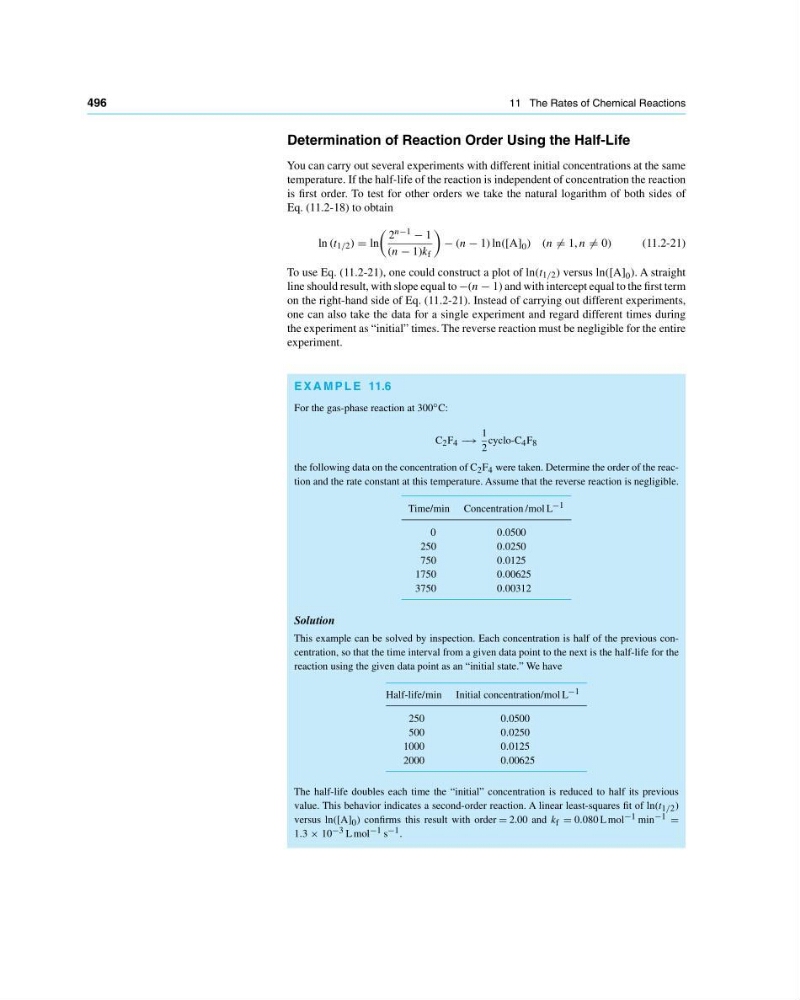
the following data on the concentration of C 2 F 4 were taken. Determine the order of the reaction and the rate constant at this temperature. Assume that the reverse reaction is negligible.
Time/min Concentration /mol L −1
0
0 .0500
250
0.0250
750
0.0125
1750
0.00625
3750
0.00312
Solution
This example can be solved by inspection. Each concentration is half of the previous concentration, so that the time interval from a given data point to the next is the half-life for the
reaction using the given data point as an “initial state.” We have
Half-life/min Initial concentration/mol L −1
250
0.0500
500
0.0250
1000
0.0125
2000
0.00625
The half-life doubles each time the “initial” concentration is reduced to half its previous
value. This behavior indicates a second-order reaction. A linear least-squares fit of ln(t 1/2 )
versus ln([A] 0 ) confirms this result with order 2.00 and k f 0.080 L mol −1 min −1
1.3 × 10 −3 L mol −1 s −1 .