

9.3 The Velocity Probability Distribution
395
If h(u) is a function of u, its mean value is given by
h(u)
u 2
u 1
h(u)f (u)du
(9.3-4)
E X A M P L E 9.2
If all values of u between u 1 and u 2 are equally probable, then
f (u)
1
u 2 − u 1
Find the value of < u 2 > if u 1 0 and u 2 2.
Solution
< u 2 >
1
u 2 − u 1
2
0
u 2 du
1
2
1
3
(2 3 − 0)
8
6
4
3
1.333 · · ·
Derivation of the Probability Distribution for Our
Model System
We now seek a formula that represents the probability distribution for the molecular
states in our model system. Because there are no forces on the molecules inside the box
we assert that all positions inside the box are equally probable and focus on the probability distribution for molecular velocities. We begin with a reasonable (but unproved)
assumption: The probability distribution of each velocity component is independent of
the other velocity components. The validity of this assumption must be tested by comparing our results with experiment. Consider a velocity with components v x , v y , and
v z . Let the probability that v x lies between v
x (a particular value of v x ) and v
x + dv x
be given by
(probability) f (v
x )dv x
(9.3-5)
Because the effects of gravity are assumed to be negligible there is no physical difference between any two directions. The probability distributions for v y and v z must
be given by the same function as that for v x . Let v
y , and v
z be particular values of v y
and v z . The probability that v x lies between v
x and v
x + dv x , that v y is in the range
between v
y and v
y + dv y , and that v z lies between v
z and v
z + dv z is given by
(probability) g(v
x , v
y , v
z )dv x dv y dv z g(v
)d
3 v
(9.3-6)
where v is the vector with components v
x , v
y , and v
z and where we abbreviate
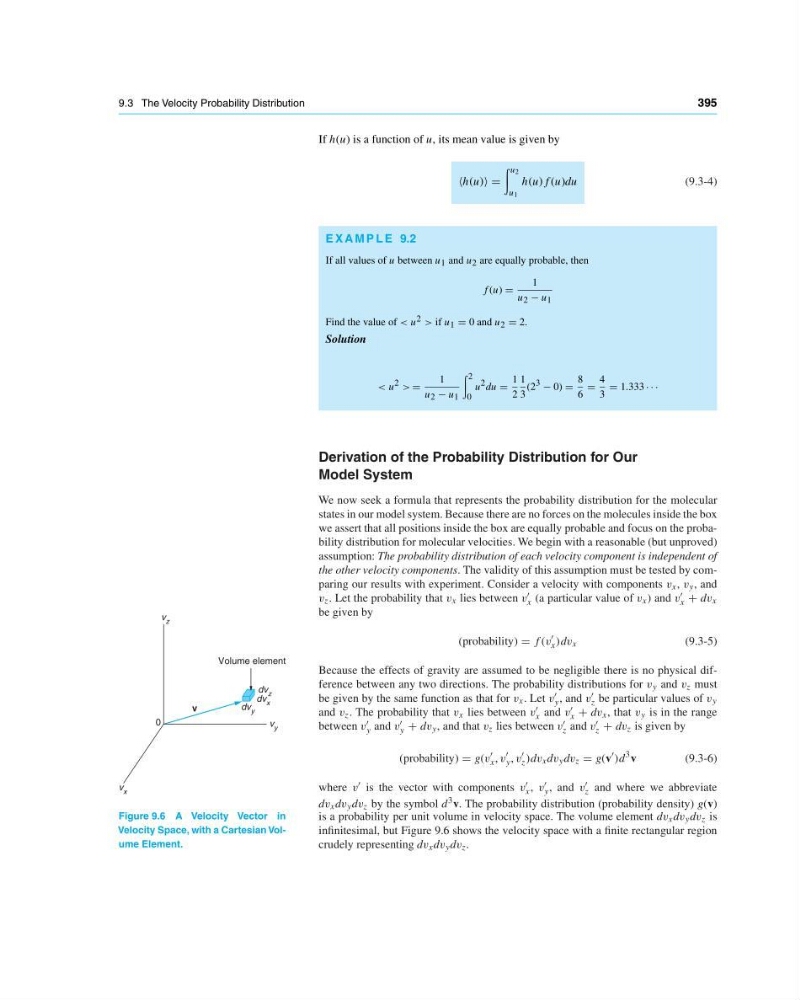
dv x dv y dv z by the symbol d 3 v. The probability distribution (probability density) g(v)
is a probability per unit volume in velocity space. The volume element dv x dv y dv z is
infinitesimal, but Figure 9.6 shows the velocity space with a finite rectangular region
crudely representing dv x dv y dv z .
v z
v x
v y
dv y
dv x
dv z
Volume element
v
0
Figure 9.6 A Velocity Vector in
Velocity Space, with a Cartesian Volume Element.
395
If h(u) is a function of u, its mean value is given by
h(u)
u 2
u 1
h(u)f (u)du
(9.3-4)
E X A M P L E 9.2
If all values of u between u 1 and u 2 are equally probable, then
f (u)
1
u 2 − u 1
Find the value of < u 2 > if u 1 0 and u 2 2.
Solution
< u 2 >
1
u 2 − u 1
2
0
u 2 du
1
2
1
3
(2 3 − 0)
8
6
4
3
1.333 · · ·
Derivation of the Probability Distribution for Our
Model System
We now seek a formula that represents the probability distribution for the molecular
states in our model system. Because there are no forces on the molecules inside the box
we assert that all positions inside the box are equally probable and focus on the probability distribution for molecular velocities. We begin with a reasonable (but unproved)
assumption: The probability distribution of each velocity component is independent of
the other velocity components. The validity of this assumption must be tested by comparing our results with experiment. Consider a velocity with components v x , v y , and
v z . Let the probability that v x lies between v
x (a particular value of v x ) and v
x + dv x
be given by
(probability) f (v
x )dv x
(9.3-5)
Because the effects of gravity are assumed to be negligible there is no physical difference between any two directions. The probability distributions for v y and v z must
be given by the same function as that for v x . Let v
y , and v
z be particular values of v y
and v z . The probability that v x lies between v
x and v
x + dv x , that v y is in the range
between v
y and v
y + dv y , and that v z lies between v
z and v
z + dv z is given by
(probability) g(v
x , v
y , v
z )dv x dv y dv z g(v
)d
3 v
(9.3-6)
where v is the vector with components v
x , v
y , and v
z and where we abbreviate
dv x dv y dv z by the symbol d 3 v. The probability distribution (probability density) g(v)
is a probability per unit volume in velocity space. The volume element dv x dv y dv z is
infinitesimal, but Figure 9.6 shows the velocity space with a finite rectangular region
crudely representing dv x dv y dv z .
v z
v x
v y
dv y
dv x
dv z
Volume element
v
0
Figure 9.6 A Velocity Vector in
Velocity Space, with a Cartesian Volume Element.