

396
9 Gas Kinetic Theory: The Molecular Theory of Dilute Gases at Equilibrium
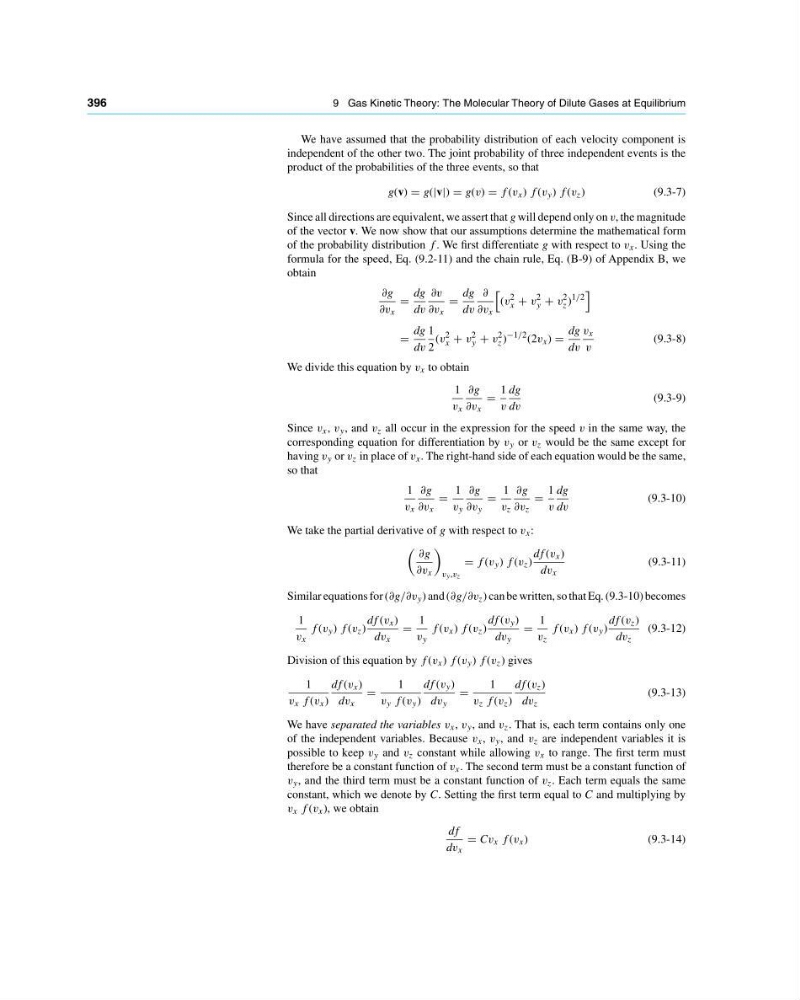
We have assumed that the probability distribution of each velocity component is
independent of the other two. The joint probability of three independent events is the
product of the probabilities of the three events, so that
g(v) g(|v|) g(v) f (v x ) f (v y ) f (v z )
(9.3-7)
Since all directions are equivalent, we assert that g will depend only on v, the magnitude
of the vector v. We now show that our assumptions determine the mathematical form
of the probability distribution f . We first differentiate g with respect to v x . Using the
formula for the speed, Eq. (9.2-11) and the chain rule, Eq. (B-9) of Appendix B, we
obtain
∂g
∂v x
dg
dv
∂v
∂v x
dg
dv
∂
∂v x
(v
2
x + v
2
y + v
2
z )
1/2
dg
dv
1
2
(v
2
x + v
2
y + v
2
z )
−1/2 (2v x )
dg
dv
v x
v
(9.3-8)
We divide this equation by v x to obtain
1
v x
∂g
∂v x
1
v
dg
dv
(9.3-9)
Since v x , v y , and v z all occur in the expression for the speed v in the same way, the
corresponding equation for differentiation by v y or v z would be the same except for
having v y or v z in place of v x . The right-hand side of each equation would be the same,
so that
1
v x
∂g
∂v x
1
v y
∂g
∂v y
1
v z
∂g
∂v z
1
v
dg
dv
(9.3-10)
We take the partial derivative of g with respect to v x :
∂g
∂v x
v y ,v z
f (v y ) f (v z )
df (v x )
dv x
(9.3-11)
Similar equations for (∂g/∂v y ) and (∂g/∂v z ) can be written, so that Eq. (9.3-10) becomes
1
v x
f (v y ) f (v z )
df (v x )
dv x
1
v y
f (v x ) f (v z )
df (v y )
dv y
1
v z
f (v x ) f (v y )
df (v z )
dv z
(9.3-12)
Division of this equation by f (v x ) f (v y ) f (v z ) gives
1
v x f (v x )
df (v x )
dv x
1
v y f (v y )
df (v y )
dv y
1
v z f (v z )
df (v z )
dv z
(9.3-13)
We have separated the variables v x , v y , and v z . That is, each term contains only one
of the independent variables. Because v x , v y , and v z are independent variables it is
possible to keep v y and v z constant while allowing v x to range. The first term must
therefore be a constant function of v x . The second term must be a constant function of
v y , and the third term must be a constant function of v z . Each term equals the same
constant, which we denote by C. Setting the first term equal to C and multiplying by
v x f (v x ), we obtain
df
dv x
Cv x f (v x )
(9.3-14)
9 Gas Kinetic Theory: The Molecular Theory of Dilute Gases at Equilibrium
We have assumed that the probability distribution of each velocity component is
independent of the other two. The joint probability of three independent events is the
product of the probabilities of the three events, so that
g(v) g(|v|) g(v) f (v x ) f (v y ) f (v z )
(9.3-7)
Since all directions are equivalent, we assert that g will depend only on v, the magnitude
of the vector v. We now show that our assumptions determine the mathematical form
of the probability distribution f . We first differentiate g with respect to v x . Using the
formula for the speed, Eq. (9.2-11) and the chain rule, Eq. (B-9) of Appendix B, we
obtain
∂g
∂v x
dg
dv
∂v
∂v x
dg
dv
∂
∂v x
(v
2
x + v
2
y + v
2
z )
1/2
dg
dv
1
2
(v
2
x + v
2
y + v
2
z )
−1/2 (2v x )
dg
dv
v x
v
(9.3-8)
We divide this equation by v x to obtain
1
v x
∂g
∂v x
1
v
dg
dv
(9.3-9)
Since v x , v y , and v z all occur in the expression for the speed v in the same way, the
corresponding equation for differentiation by v y or v z would be the same except for
having v y or v z in place of v x . The right-hand side of each equation would be the same,
so that
1
v x
∂g
∂v x
1
v y
∂g
∂v y
1
v z
∂g
∂v z
1
v
dg
dv
(9.3-10)
We take the partial derivative of g with respect to v x :
∂g
∂v x
v y ,v z
f (v y ) f (v z )
df (v x )
dv x
(9.3-11)
Similar equations for (∂g/∂v y ) and (∂g/∂v z ) can be written, so that Eq. (9.3-10) becomes
1
v x
f (v y ) f (v z )
df (v x )
dv x
1
v y
f (v x ) f (v z )
df (v y )
dv y
1
v z
f (v x ) f (v y )
df (v z )
dv z
(9.3-12)
Division of this equation by f (v x ) f (v y ) f (v z ) gives
1
v x f (v x )
df (v x )
dv x
1
v y f (v y )
df (v y )
dv y
1
v z f (v z )
df (v z )
dv z
(9.3-13)
We have separated the variables v x , v y , and v z . That is, each term contains only one
of the independent variables. Because v x , v y , and v z are independent variables it is
possible to keep v y and v z constant while allowing v x to range. The first term must
therefore be a constant function of v x . The second term must be a constant function of
v y , and the third term must be a constant function of v z . Each term equals the same
constant, which we denote by C. Setting the first term equal to C and multiplying by
v x f (v x ), we obtain
df
dv x
Cv x f (v x )
(9.3-14)