

7.3 Chemical Equilibrium in Solutions
323
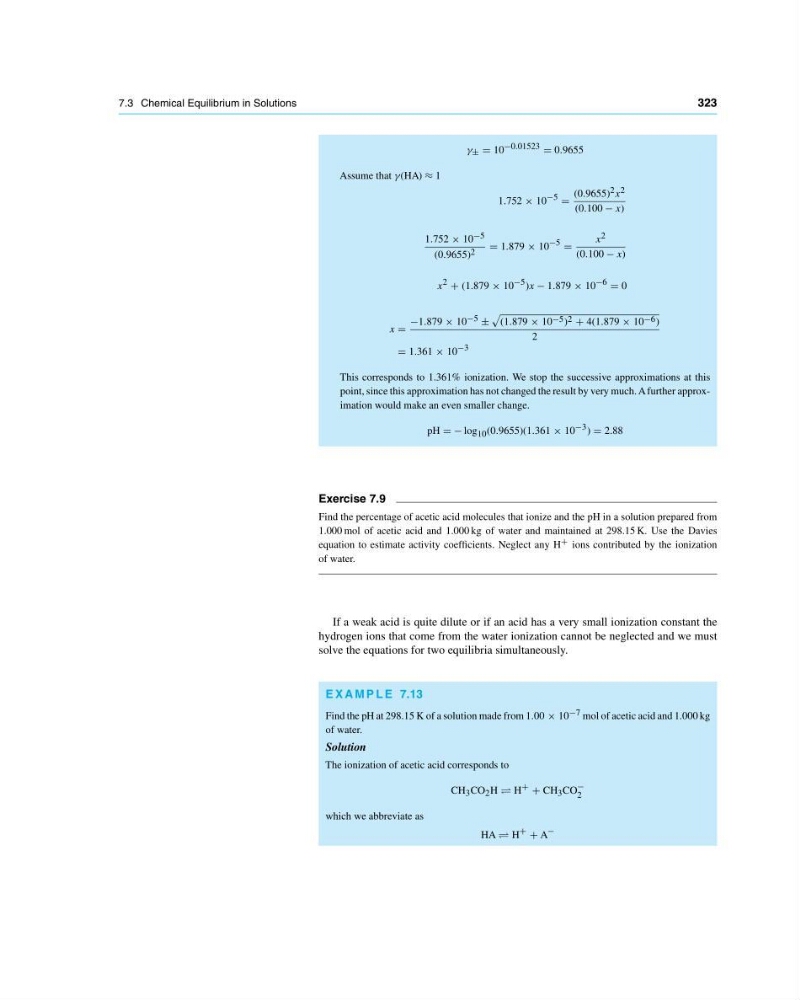
γ ± 10 −0.01523 0.9655
Assume that γ(HA) ≈ 1
1.752 × 10 −5
(0.9655) 2 x 2
(0.100 − x)
1.752 × 10 −5
(0.9655) 2 1.879 × 10 −5
x 2
(0.100 − x)
x 2 + (1.879 × 10 −5 )x − 1.879 × 10 −6 0
x
−1.879 × 10 −5 ±
(1.879 × 10 −5 ) 2 + 4(1.879 × 10 −6 )
2
1.361 × 10 −3
This corresponds to 1.361% ionization. We stop the successive approximations at this
point, since this approximation has not changed the result by very much. A further approximation would make an even smaller change.
pH − log 10 (0.9655)(1.361 × 10 −3 ) 2.88
Exercise 7.9
Find the percentage of acetic acid molecules that ionize and the pH in a solution prepared from
1.000 mol of acetic acid and 1.000 kg of water and maintained at 298.15 K. Use the Davies
equation to estimate activity coefficients. Neglect any H + ions contributed by the ionization
of water.
If a weak acid is quite dilute or if an acid has a very small ionization constant the
hydrogen ions that come from the water ionization cannot be neglected and we must
solve the equations for two equilibria simultaneously.
E X A M P L E 7.13
Find the pH at 298.15 K of a solution made from 1.00 × 10 −7 mol of acetic acid and 1.000 kg
of water.
Solution
The ionization of acetic acid corresponds to
CH 3 CO 2 H H + + CH 3 CO
−
2
which we abbreviate as
HA H + + A −
323
γ ± 10 −0.01523 0.9655
Assume that γ(HA) ≈ 1
1.752 × 10 −5
(0.9655) 2 x 2
(0.100 − x)
1.752 × 10 −5
(0.9655) 2 1.879 × 10 −5
x 2
(0.100 − x)
x 2 + (1.879 × 10 −5 )x − 1.879 × 10 −6 0
x
−1.879 × 10 −5 ±
(1.879 × 10 −5 ) 2 + 4(1.879 × 10 −6 )
2
1.361 × 10 −3
This corresponds to 1.361% ionization. We stop the successive approximations at this
point, since this approximation has not changed the result by very much. A further approximation would make an even smaller change.
pH − log 10 (0.9655)(1.361 × 10 −3 ) 2.88
Exercise 7.9
Find the percentage of acetic acid molecules that ionize and the pH in a solution prepared from
1.000 mol of acetic acid and 1.000 kg of water and maintained at 298.15 K. Use the Davies
equation to estimate activity coefficients. Neglect any H + ions contributed by the ionization
of water.
If a weak acid is quite dilute or if an acid has a very small ionization constant the
hydrogen ions that come from the water ionization cannot be neglected and we must
solve the equations for two equilibria simultaneously.
E X A M P L E 7.13
Find the pH at 298.15 K of a solution made from 1.00 × 10 −7 mol of acetic acid and 1.000 kg
of water.
Solution
The ionization of acetic acid corresponds to
CH 3 CO 2 H H + + CH 3 CO
−
2
which we abbreviate as
HA H + + A −