

324
7 Chemical Equilibrium
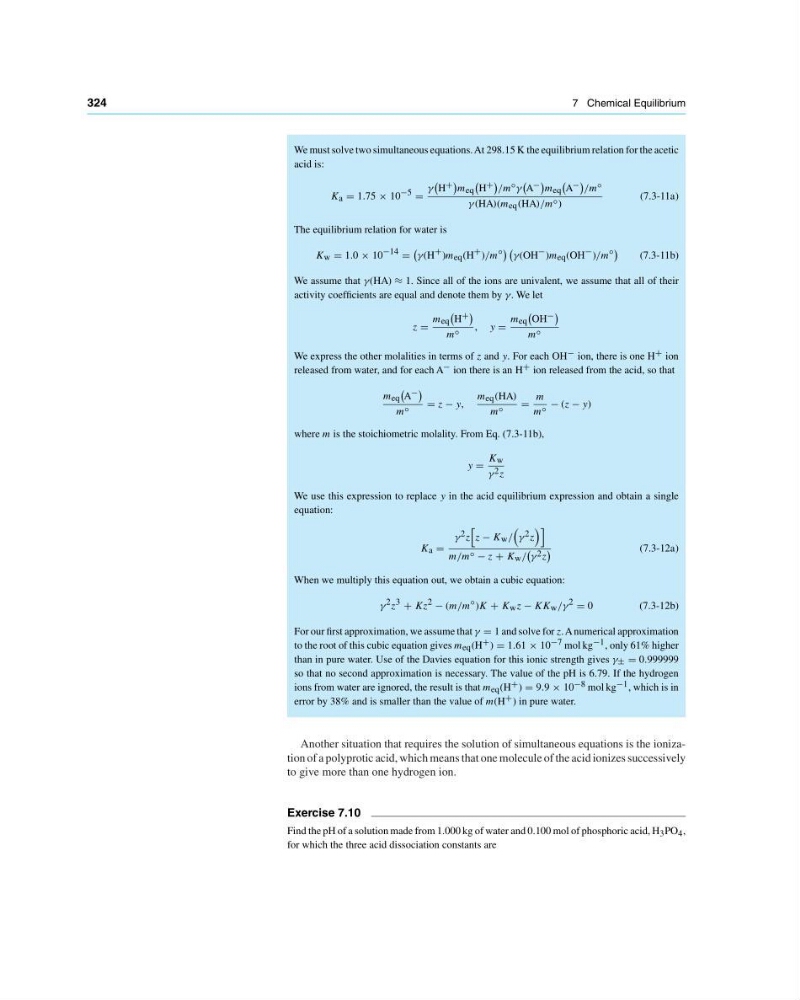
We must solve two simultaneous equations. At 298.15 K the equilibrium relation for the acetic
acid is:
K a 1.75 × 10 −5
γ
H +
m eq
H +
/m ◦ γ
A −
m eq
A −
/m ◦
γ(HA)(m eq (HA)/m ◦ )
(7.3-11a)
The equilibrium relation for water is
K w 1.0 × 10 −14
γ(H + )m eq (H + )/m ◦
γ(OH − )m eq (OH − )/m ◦
(7.3-11b)
We assume that γ(HA) ≈ 1. Since all of the ions are univalent, we assume that all of their
activity coefficients are equal and denote them by γ. We let
z
m eq
H +
m ◦ , y
m eq
OH −
m ◦
We express the other molalities in terms of z and y. For each OH − ion, there is one H + ion
released from water, and for each A − ion there is an H + ion released from the acid, so that
m eq
A −
m ◦
z − y,
m eq (HA)
m ◦
m
m ◦ − (z − y)
where m is the stoichiometric molality. From Eq. (7.3-11b),
y
K w
γ 2 z
We use this expression to replace y in the acid equilibrium expression and obtain a single
equation:
K a
γ 2 z
z − K w /
γ 2 z
m/m ◦ − z + K w /
γ 2 z
(7.3-12a)
When we multiply this equation out, we obtain a cubic equation:
γ 2 z 3 + Kz 2 − (m/m ◦ )K + K w z − KK w /γ 2 0
(7.3-12b)
For our first approximation, we assume that γ 1 and solve for z. A numerical approximation
to the root of this cubic equation gives m eq (H + ) 1.61 × 10 −7 mol kg −1 , only 61% higher
than in pure water. Use of the Davies equation for this ionic strength gives γ ± 0.999999
so that no second approximation is necessary. The value of the pH is 6.79. If the hydrogen
ions from water are ignored, the result is that m eq (H + ) 9.9 × 10 −8 mol kg −1 , which is in
error by 38% and is smaller than the value of m(H + ) in pure water.
Another situation that requires the solution of simultaneous equations is the ionization of a polyprotic acid, which means that one molecule of the acid ionizes successively
to give more than one hydrogen ion.
Exercise 7.10
Find the pH of a solution made from 1.000 kg of water and 0.100 mol of phosphoric acid, H 3 PO 4 ,
for which the three acid dissociation constants are
7 Chemical Equilibrium
We must solve two simultaneous equations. At 298.15 K the equilibrium relation for the acetic
acid is:
K a 1.75 × 10 −5
γ
H +
m eq
H +
/m ◦ γ
A −
m eq
A −
/m ◦
γ(HA)(m eq (HA)/m ◦ )
(7.3-11a)
The equilibrium relation for water is
K w 1.0 × 10 −14
γ(H + )m eq (H + )/m ◦
γ(OH − )m eq (OH − )/m ◦
(7.3-11b)
We assume that γ(HA) ≈ 1. Since all of the ions are univalent, we assume that all of their
activity coefficients are equal and denote them by γ. We let
z
m eq
H +
m ◦ , y
m eq
OH −
m ◦
We express the other molalities in terms of z and y. For each OH − ion, there is one H + ion
released from water, and for each A − ion there is an H + ion released from the acid, so that
m eq
A −
m ◦
z − y,
m eq (HA)
m ◦
m
m ◦ − (z − y)
where m is the stoichiometric molality. From Eq. (7.3-11b),
y
K w
γ 2 z
We use this expression to replace y in the acid equilibrium expression and obtain a single
equation:
K a
γ 2 z
z − K w /
γ 2 z
m/m ◦ − z + K w /
γ 2 z
(7.3-12a)
When we multiply this equation out, we obtain a cubic equation:
γ 2 z 3 + Kz 2 − (m/m ◦ )K + K w z − KK w /γ 2 0
(7.3-12b)
For our first approximation, we assume that γ 1 and solve for z. A numerical approximation
to the root of this cubic equation gives m eq (H + ) 1.61 × 10 −7 mol kg −1 , only 61% higher
than in pure water. Use of the Davies equation for this ionic strength gives γ ± 0.999999
so that no second approximation is necessary. The value of the pH is 6.79. If the hydrogen
ions from water are ignored, the result is that m eq (H + ) 9.9 × 10 −8 mol kg −1 , which is in
error by 38% and is smaller than the value of m(H + ) in pure water.
Another situation that requires the solution of simultaneous equations is the ionization of a polyprotic acid, which means that one molecule of the acid ionizes successively
to give more than one hydrogen ion.
Exercise 7.10
Find the pH of a solution made from 1.000 kg of water and 0.100 mol of phosphoric acid, H 3 PO 4 ,
for which the three acid dissociation constants are