

322
7 Chemical Equilibrium
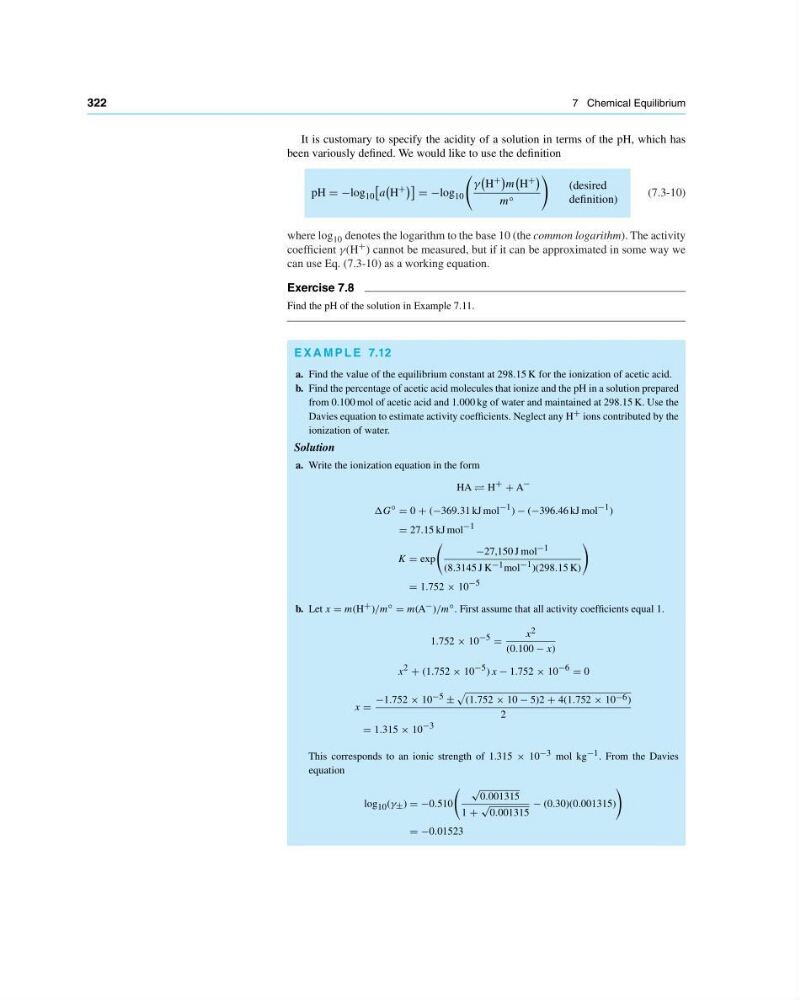
It is customary to specify the acidity of a solution in terms of the pH, which has
been variously defined. We would like to use the definition
pH −log 10
a
H + −log 10
γ
H +
m
H +
m ◦
(desired
definition)
(7.3-10)
where log 10 denotes the logarithm to the base 10 (the common logarithm). The activity
coefficient γ(H + ) cannot be measured, but if it can be approximated in some way we
can use Eq. (7.3-10) as a working equation.
Exercise 7.8
Find the pH of the solution in Example 7.11.
E X A M P L E 7.12
a. Find the value of the equilibrium constant at 298.15 K for the ionization of acetic acid.
b. Find the percentage of acetic acid molecules that ionize and the pH in a solution prepared
from 0.100 mol of acetic acid and 1.000 kg of water and maintained at 298.15 K. Use the
Davies equation to estimate activity coefficients. Neglect any H + ions contributed by the
ionization of water.
Solution
a. Write the ionization equation in the form
HA H + + A −
∆G ◦ 0 + (−369.31 kJ mol −1 ) − (−396.46 kJ mol −1 )
27.15 kJ mol −1
K exp
−27,150 J mol −1
(8.3145 J K −1 mol −1 )(298.15 K)
1.752 × 10 −5
b. Let x m(H + )/m ◦ m(A − )/m ◦ . First assume that all activity coefficients equal 1.
1.752 × 10 −5
x 2
(0.100 − x)
x 2 + (1.752 × 10 −5 ) x − 1.752 × 10 −6 0
x
−1.752 × 10 −5 ±
(1.752 × 10 − 5)2 + 4(1.752 × 10 −6 )
2
1.315 × 10 −3
This corresponds to an ionic strength of 1.315 × 10 −3 mol kg −1 . From the Davies
equation
log 10 (γ ± ) −0.510
√
0.001315
1 +
√
0.001315
− (0.30)(0.001315)
−0.01523
7 Chemical Equilibrium
It is customary to specify the acidity of a solution in terms of the pH, which has
been variously defined. We would like to use the definition
pH −log 10
a
H + −log 10
γ
H +
m
H +
m ◦
(desired
definition)
(7.3-10)
where log 10 denotes the logarithm to the base 10 (the common logarithm). The activity
coefficient γ(H + ) cannot be measured, but if it can be approximated in some way we
can use Eq. (7.3-10) as a working equation.
Exercise 7.8
Find the pH of the solution in Example 7.11.
E X A M P L E 7.12
a. Find the value of the equilibrium constant at 298.15 K for the ionization of acetic acid.
b. Find the percentage of acetic acid molecules that ionize and the pH in a solution prepared
from 0.100 mol of acetic acid and 1.000 kg of water and maintained at 298.15 K. Use the
Davies equation to estimate activity coefficients. Neglect any H + ions contributed by the
ionization of water.
Solution
a. Write the ionization equation in the form
HA H + + A −
∆G ◦ 0 + (−369.31 kJ mol −1 ) − (−396.46 kJ mol −1 )
27.15 kJ mol −1
K exp
−27,150 J mol −1
(8.3145 J K −1 mol −1 )(298.15 K)
1.752 × 10 −5
b. Let x m(H + )/m ◦ m(A − )/m ◦ . First assume that all activity coefficients equal 1.
1.752 × 10 −5
x 2
(0.100 − x)
x 2 + (1.752 × 10 −5 ) x − 1.752 × 10 −6 0
x
−1.752 × 10 −5 ±
(1.752 × 10 − 5)2 + 4(1.752 × 10 −6 )
2
1.315 × 10 −3
This corresponds to an ionic strength of 1.315 × 10 −3 mol kg −1 . From the Davies
equation
log 10 (γ ± ) −0.510
√
0.001315
1 +
√
0.001315
− (0.30)(0.001315)
−0.01523