

308
7 Chemical Equilibrium
c.
T ∆
⎛
⎝
−
G ◦
m − H ◦
m,298 ◦
T
⎞
⎠ (298.15 K)2(213.795 J K −1 mol −1 )
− 2
197.653 J K −1 mol −1
− 205.147 J K −1 mol −1
(298.15 K)(−0.172863 kJ K −1 mol −1 )
−51.539 kJ mol −1
∆G ◦ ∆H ◦
298 − T ∆
⎛
⎝
−
G ◦
m − H ◦
m,298 ◦
T
⎞
⎠
−565.990 kJ mol −1 + 51.539 kJ mol −1
−514.451 kJ mol −1
Exercise 7.1
a. Using Gibbs energy changes of formation from Table A.8, calculate ∆G ◦ at 298.15 K for the
reaction
PCl 5 (g) PCl 3 (g) + Cl 2 (g)
b. Calculate ∆H ◦ and ∆S ◦ at 298.15 K for the same reaction.
c. Calculate ∆G ◦ at 298.15 K for the same reaction using Eq. (7.1-15). Compare with the answer
of part a.
d. Calculate ∆G ◦ at 298.15 K for the same reaction using values of −(G ◦
m − H ◦
m,298 )/T and
the value of ∆H ◦ .
The Gibbs Energy Change at Fixed Composition
Using the identity that a sum of logarithms is equal to the logarithm of a product, we
write Eq. (7.1-12) in the form
∂G
∂ξ
T ,P
∆G ◦ + RT ln(Q)
(7.1-16)
where
Q a
v 1
1 a
v 2
2 · · · a
v c
c
c
i1
a
v i
i
(7.1-17)
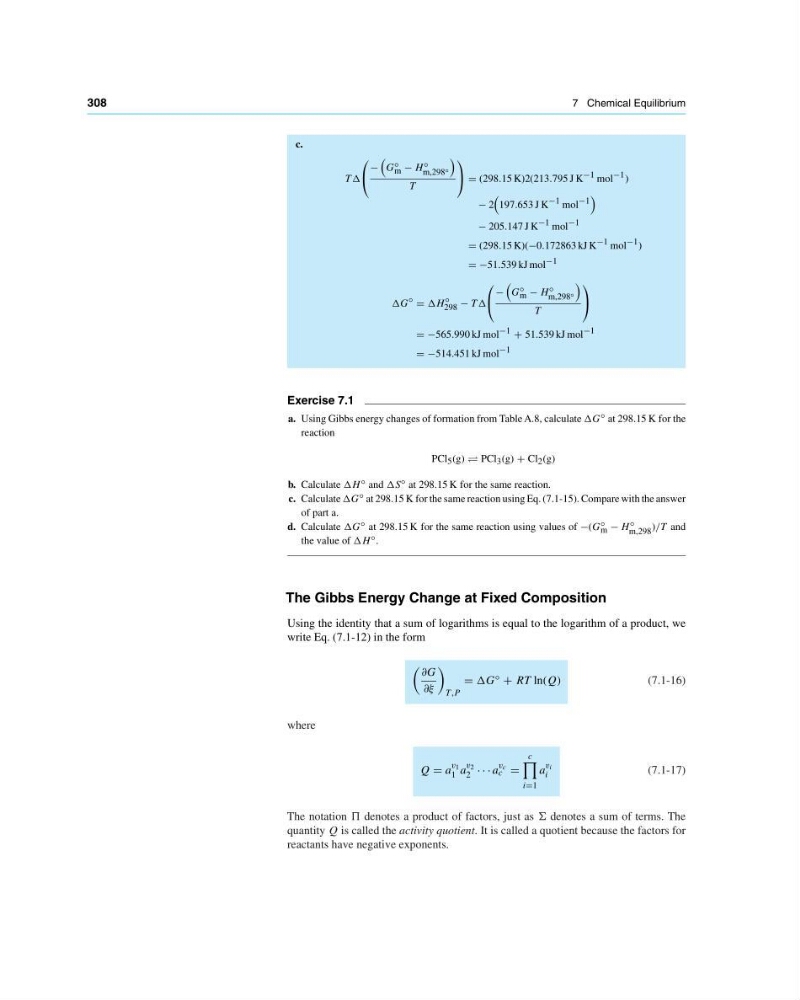
The notation Π denotes a product of factors, just as Σ denotes a sum of terms. The
quantity Q is called the activity quotient. It is called a quotient because the factors for
reactants have negative exponents.
7 Chemical Equilibrium
c.
T ∆
⎛
⎝
−
G ◦
m − H ◦
m,298 ◦
T
⎞
⎠ (298.15 K)2(213.795 J K −1 mol −1 )
− 2
197.653 J K −1 mol −1
− 205.147 J K −1 mol −1
(298.15 K)(−0.172863 kJ K −1 mol −1 )
−51.539 kJ mol −1
∆G ◦ ∆H ◦
298 − T ∆
⎛
⎝
−
G ◦
m − H ◦
m,298 ◦
T
⎞
⎠
−565.990 kJ mol −1 + 51.539 kJ mol −1
−514.451 kJ mol −1
Exercise 7.1
a. Using Gibbs energy changes of formation from Table A.8, calculate ∆G ◦ at 298.15 K for the
reaction
PCl 5 (g) PCl 3 (g) + Cl 2 (g)
b. Calculate ∆H ◦ and ∆S ◦ at 298.15 K for the same reaction.
c. Calculate ∆G ◦ at 298.15 K for the same reaction using Eq. (7.1-15). Compare with the answer
of part a.
d. Calculate ∆G ◦ at 298.15 K for the same reaction using values of −(G ◦
m − H ◦
m,298 )/T and
the value of ∆H ◦ .
The Gibbs Energy Change at Fixed Composition
Using the identity that a sum of logarithms is equal to the logarithm of a product, we
write Eq. (7.1-12) in the form
∂G
∂ξ
T ,P
∆G ◦ + RT ln(Q)
(7.1-16)
where
Q a
v 1
1 a
v 2
2 · · · a
v c
c
c
i1
a
v i
i
(7.1-17)
The notation Π denotes a product of factors, just as Σ denotes a sum of terms. The
quantity Q is called the activity quotient. It is called a quotient because the factors for
reactants have negative exponents.