

7.1 Gibbs Energy Changes and the Equilibrium Constant
309
Exercise 7.2
Carry out the steps to obtain Eqs. (7.1-16) and (7.1-17).
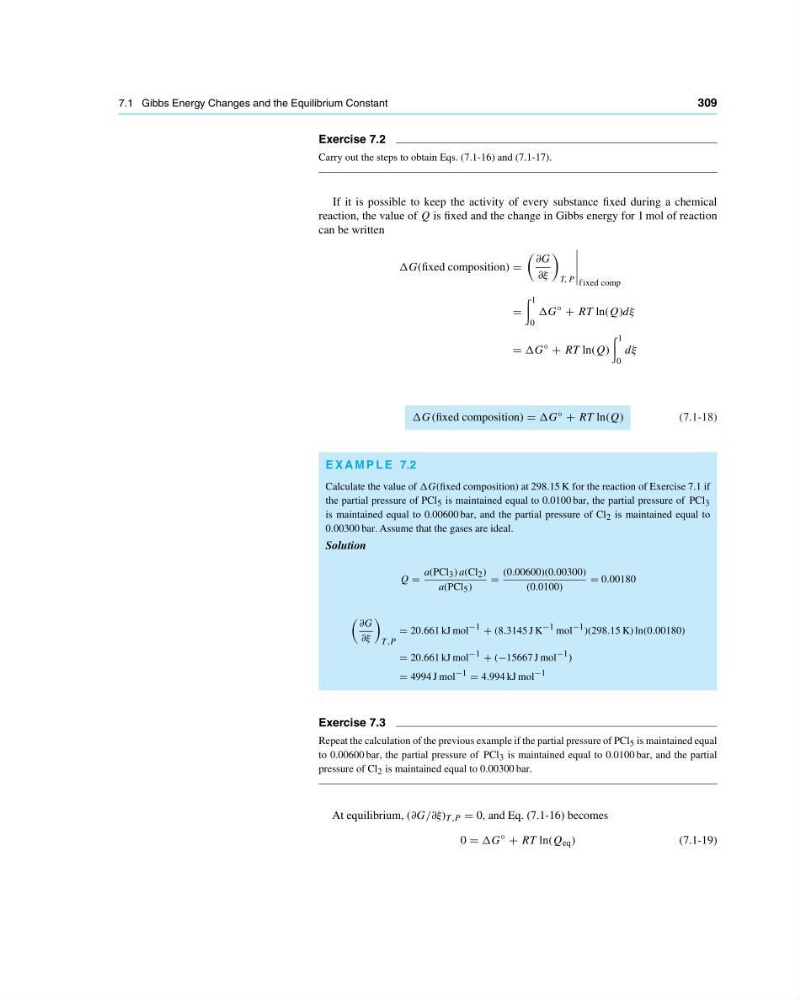
If it is possible to keep the activity of every substance fixed during a chemical
reaction, the value of Q is fixed and the change in Gibbs energy for 1 mol of reaction
can be written
∆G(fixed composition)
∂G
∂ξ
T, P
f ixed comp
1
0
∆G
◦
+ RT ln(Q)dξ
∆G
◦
+ RT ln(Q)
1
0
dξ
∆G(fixed composition) ∆G ◦ + RT ln(Q)
(7.1-18)
E X A M P L E 7.2
Calculate the value of ∆G(fixed composition) at 298.15 K for the reaction of Exercise 7.1 if
the partial pressure of PCl 5 is maintained equal to 0.0100 bar, the partial pressure of PCl 3
is maintained equal to 0.00600 bar, and the partial pressure of Cl 2 is maintained equal to
0.00300 bar. Assume that the gases are ideal.
Solution
Q
a(PCl 3 ) a(Cl 2 )
a(PCl 5 )
(0.00600)(0.00300)
(0.0100)
0.00180
∂G
∂ξ
T ,P
20.661 kJ mol −1 + (8.3145 J K −1 mol −1 )(298.15 K) ln(0.00180)
20.661 kJ mol −1 + (−15667 J mol −1 )
4994 J mol −1 4.994 kJ mol −1
Exercise 7.3
Repeat the calculation of the previous example if the partial pressure of PCl 5 is maintained equal
to 0.00600 bar, the partial pressure of PCl 3 is maintained equal to 0.0100 bar, and the partial
pressure of Cl 2 is maintained equal to 0.00300 bar.
At equilibrium, (∂G/∂ξ) T ,P 0, and Eq. (7.1-16) becomes
0 ∆G
◦
+ RT ln(Q eq )
(7.1-19)
309
Exercise 7.2
Carry out the steps to obtain Eqs. (7.1-16) and (7.1-17).
If it is possible to keep the activity of every substance fixed during a chemical
reaction, the value of Q is fixed and the change in Gibbs energy for 1 mol of reaction
can be written
∆G(fixed composition)
∂G
∂ξ
T, P
f ixed comp
1
0
∆G
◦
+ RT ln(Q)dξ
∆G
◦
+ RT ln(Q)
1
0
dξ
∆G(fixed composition) ∆G ◦ + RT ln(Q)
(7.1-18)
E X A M P L E 7.2
Calculate the value of ∆G(fixed composition) at 298.15 K for the reaction of Exercise 7.1 if
the partial pressure of PCl 5 is maintained equal to 0.0100 bar, the partial pressure of PCl 3
is maintained equal to 0.00600 bar, and the partial pressure of Cl 2 is maintained equal to
0.00300 bar. Assume that the gases are ideal.
Solution
Q
a(PCl 3 ) a(Cl 2 )
a(PCl 5 )
(0.00600)(0.00300)
(0.0100)
0.00180
∂G
∂ξ
T ,P
20.661 kJ mol −1 + (8.3145 J K −1 mol −1 )(298.15 K) ln(0.00180)
20.661 kJ mol −1 + (−15667 J mol −1 )
4994 J mol −1 4.994 kJ mol −1
Exercise 7.3
Repeat the calculation of the previous example if the partial pressure of PCl 5 is maintained equal
to 0.00600 bar, the partial pressure of PCl 3 is maintained equal to 0.0100 bar, and the partial
pressure of Cl 2 is maintained equal to 0.00300 bar.
At equilibrium, (∂G/∂ξ) T ,P 0, and Eq. (7.1-16) becomes
0 ∆G
◦
+ RT ln(Q eq )
(7.1-19)