

7.1 Gibbs Energy Changes and the Equilibrium Constant
307
Values of standard-state Gibbs energy changes of formation for a number of substances
are included in Table A.8 of Appendix A, and larger tables are available. This table
also includes values of the function −(G ◦
m − H m,298 ◦ )/T , which can also be used to
calculate ∆G ◦ for a reaction, as is done in Example 7.1. This function generally varies
more slowly with temperature than does ∆ f G ◦ . If a value of ∆G ◦ is needed for a
temperature that is not included in the table, interpolation of this function usually gives
better accuracy than does interpolation in a table of ∆ f G ◦ values.
The Gibbs energy change of a constant-temperature reaction can also be calculated
from
∆G ∆H − T ∆S
(7.1-15)
where the enthalpy change is calculated from enthalpy changes of formation, using Eq.
(2.7-12), and the entropy change for a reaction is calculated from third-law (“absolute”)
entropies, using Eq. (3.5-7).
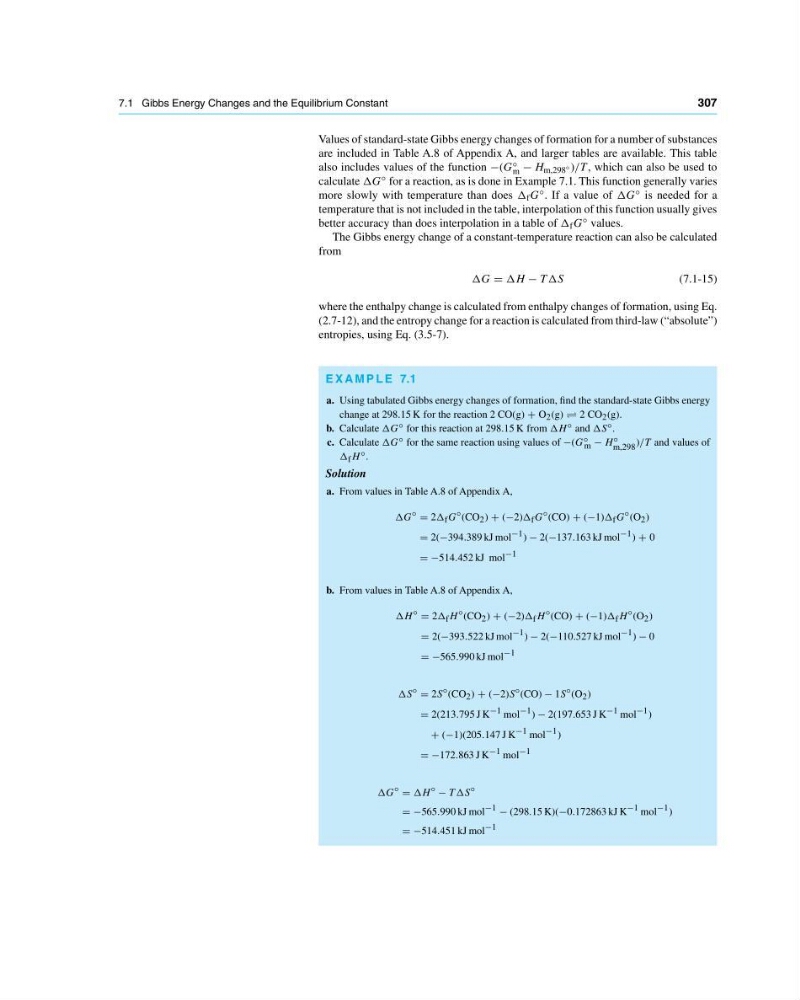
E X A M P L E 7.1
a. Using tabulated Gibbs energy changes of formation, find the standard-state Gibbs energy
change at 298.15 K for the reaction 2 CO(g) + O 2 (g) 2 CO 2 (g).
b. Calculate ∆G ◦ for this reaction at 298.15 K from ∆H ◦ and ∆S ◦ .
c. Calculate ∆G ◦ for the same reaction using values of −(G ◦
m − H ◦
m,298 )/T and values of
∆ f H ◦ .
Solution
a. From values in Table A.8 of Appendix A,
∆G ◦ 2∆ f G ◦ (CO 2 ) + (−2)∆ f G ◦ (CO) + (−1)∆ f G ◦ (O 2 )
2(−394.389 kJ mol −1 ) − 2(−137.163 kJ mol −1 ) + 0
−514.452 kJ mol −1
b. From values in Table A.8 of Appendix A,
∆H ◦ 2∆ f H ◦ (CO 2 ) + (−2)∆ f H ◦ (CO) + (−1)∆ f H ◦ (O 2 )
2(−393.522 kJ mol −1 ) − 2(−110.527 kJ mol −1 ) − 0
−565.990 kJ mol −1
∆S ◦ 2S ◦ (CO 2 ) + (−2)S ◦ (CO) − 1S ◦ (O 2 )
2(213.795 J K −1 mol −1 ) − 2(197.653 J K −1 mol −1 )
+ (−1)(205.147 J K −1 mol −1 )
−172.863 J K −1 mol −1
∆G ◦ ∆H ◦ − T ∆S ◦
−565.990 kJ mol −1 − (298.15 K)(−0.172863 kJ K −1 mol −1 )
−514.451 kJ mol −1
307
Values of standard-state Gibbs energy changes of formation for a number of substances
are included in Table A.8 of Appendix A, and larger tables are available. This table
also includes values of the function −(G ◦
m − H m,298 ◦ )/T , which can also be used to
calculate ∆G ◦ for a reaction, as is done in Example 7.1. This function generally varies
more slowly with temperature than does ∆ f G ◦ . If a value of ∆G ◦ is needed for a
temperature that is not included in the table, interpolation of this function usually gives
better accuracy than does interpolation in a table of ∆ f G ◦ values.
The Gibbs energy change of a constant-temperature reaction can also be calculated
from
∆G ∆H − T ∆S
(7.1-15)
where the enthalpy change is calculated from enthalpy changes of formation, using Eq.
(2.7-12), and the entropy change for a reaction is calculated from third-law (“absolute”)
entropies, using Eq. (3.5-7).
E X A M P L E 7.1
a. Using tabulated Gibbs energy changes of formation, find the standard-state Gibbs energy
change at 298.15 K for the reaction 2 CO(g) + O 2 (g) 2 CO 2 (g).
b. Calculate ∆G ◦ for this reaction at 298.15 K from ∆H ◦ and ∆S ◦ .
c. Calculate ∆G ◦ for the same reaction using values of −(G ◦
m − H ◦
m,298 )/T and values of
∆ f H ◦ .
Solution
a. From values in Table A.8 of Appendix A,
∆G ◦ 2∆ f G ◦ (CO 2 ) + (−2)∆ f G ◦ (CO) + (−1)∆ f G ◦ (O 2 )
2(−394.389 kJ mol −1 ) − 2(−137.163 kJ mol −1 ) + 0
−514.452 kJ mol −1
b. From values in Table A.8 of Appendix A,
∆H ◦ 2∆ f H ◦ (CO 2 ) + (−2)∆ f H ◦ (CO) + (−1)∆ f H ◦ (O 2 )
2(−393.522 kJ mol −1 ) − 2(−110.527 kJ mol −1 ) − 0
−565.990 kJ mol −1
∆S ◦ 2S ◦ (CO 2 ) + (−2)S ◦ (CO) − 1S ◦ (O 2 )
2(213.795 J K −1 mol −1 ) − 2(197.653 J K −1 mol −1 )
+ (−1)(205.147 J K −1 mol −1 )
−172.863 J K −1 mol −1
∆G ◦ ∆H ◦ − T ∆S ◦
−565.990 kJ mol −1 − (298.15 K)(−0.172863 kJ K −1 mol −1 )
−514.451 kJ mol −1