

4.6 Euler’s Theorem and the Gibbs–Duhem Relation
189
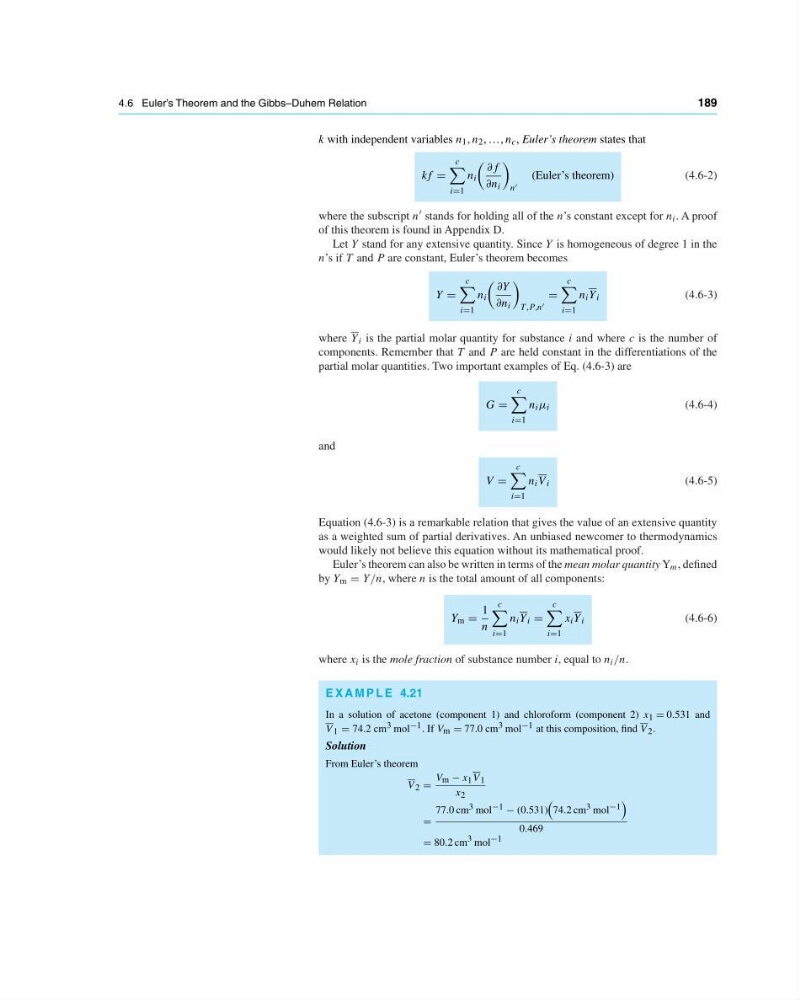
k with independent variables n 1 , n 2 , …, n c , Euler’s theorem states that
kf
c
i1
n i
∂f
∂n i
n
(Euler’s theorem)
(4.6-2)
where the subscript n stands for holding all of the n’s constant except for n i . A proof
of this theorem is found in Appendix D.
Let Y stand for any extensive quantity. Since Y is homogeneous of degree 1 in the
n’s if T and P are constant, Euler’s theorem becomes
Y
c
i1
n i
∂Y
∂n i
T ,P,n
c
i1
n i Y i
(4.6-3)
where Y i is the partial molar quantity for substance i and where c is the number of
components. Remember that T and P are held constant in the differentiations of the
partial molar quantities. Two important examples of Eq. (4.6-3) are
G
c
i1
n i µ i
(4.6-4)
and
V
c
i1
n i V i
(4.6-5)
Equation (4.6-3) is a remarkable relation that gives the value of an extensive quantity
as a weighted sum of partial derivatives. An unbiased newcomer to thermodynamics
would likely not believe this equation without its mathematical proof.
Euler’s theorem can also be written in terms of the mean molar quantity Y m , defined
by Y m Y/n, where n is the total amount of all components:
Y m
1
n
c
i1
n i Y i
c
i1
x i Y i
(4.6-6)
where x i is the mole fraction of substance number i, equal to n i /n.
E X A M P L E 4.21
In a solution of acetone (component 1) and chloroform (component 2) x 1 0.531 and
V 1 74.2 cm 3 mol −1 . If V m 77.0 cm 3 mol −1 at this composition, find V 2 .
Solution
From Euler’s theorem
V 2
V m − x 1 V 1
x 2
77.0 cm 3 mol −1 − (0.531)
74.2 cm 3 mol −1
0.469
80.2 cm 3 mol −1
189
k with independent variables n 1 , n 2 , …, n c , Euler’s theorem states that
kf
c
i1
n i
∂f
∂n i
n
(Euler’s theorem)
(4.6-2)
where the subscript n stands for holding all of the n’s constant except for n i . A proof
of this theorem is found in Appendix D.
Let Y stand for any extensive quantity. Since Y is homogeneous of degree 1 in the
n’s if T and P are constant, Euler’s theorem becomes
Y
c
i1
n i
∂Y
∂n i
T ,P,n
c
i1
n i Y i
(4.6-3)
where Y i is the partial molar quantity for substance i and where c is the number of
components. Remember that T and P are held constant in the differentiations of the
partial molar quantities. Two important examples of Eq. (4.6-3) are
G
c
i1
n i µ i
(4.6-4)
and
V
c
i1
n i V i
(4.6-5)
Equation (4.6-3) is a remarkable relation that gives the value of an extensive quantity
as a weighted sum of partial derivatives. An unbiased newcomer to thermodynamics
would likely not believe this equation without its mathematical proof.
Euler’s theorem can also be written in terms of the mean molar quantity Y m , defined
by Y m Y/n, where n is the total amount of all components:
Y m
1
n
c
i1
n i Y i
c
i1
x i Y i
(4.6-6)
where x i is the mole fraction of substance number i, equal to n i /n.
E X A M P L E 4.21
In a solution of acetone (component 1) and chloroform (component 2) x 1 0.531 and
V 1 74.2 cm 3 mol −1 . If V m 77.0 cm 3 mol −1 at this composition, find V 2 .
Solution
From Euler’s theorem
V 2
V m − x 1 V 1
x 2
77.0 cm 3 mol −1 − (0.531)
74.2 cm 3 mol −1
0.469
80.2 cm 3 mol −1