

190
4 The Thermodynamics of Real Systems
The Gibbs–Duhem Relation
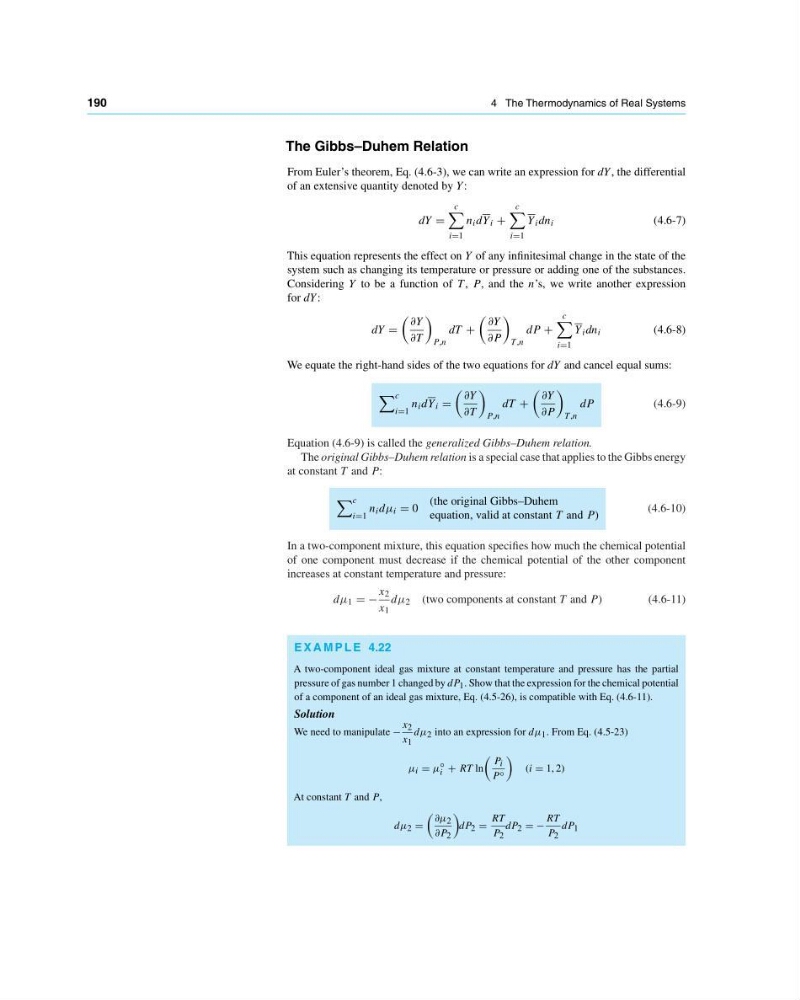
From Euler’s theorem, Eq. (4.6-3), we can write an expression for dY , the differential
of an extensive quantity denoted by Y :
dY
c
i1
n i dY i +
c
i1
Y i dn i
(4.6-7)
This equation represents the effect on Y of any infinitesimal change in the state of the
system such as changing its temperature or pressure or adding one of the substances.
Considering Y to be a function of T , P, and the n’s, we write another expression
for dY :
dY
∂Y
∂T
P,n
dT +
∂Y
∂P
T ,n
dP +
c
i1
Y i dn i
(4.6-8)
We equate the right-hand sides of the two equations for dY and cancel equal sums:
c
i1
n i dY i
∂Y
∂T
P,n
dT +
∂Y
∂P
T ,n
dP
(4.6-9)
Equation (4.6-9) is called the generalized Gibbs–Duhem relation.
The original Gibbs–Duhem relation is a special case that applies to the Gibbs energy
at constant T and P:
c
i1
n i dµ i 0
(the original Gibbs–Duhem
equation, valid at constant T and P)
(4.6-10)
In a two-component mixture, this equation specifies how much the chemical potential
of one component must decrease if the chemical potential of the other component
increases at constant temperature and pressure:
dµ 1 −
x 2
x 1
dµ 2 (two components at constant T and P)
(4.6-11)
E X A M P L E 4.22
A two-component ideal gas mixture at constant temperature and pressure has the partial
pressure of gas number 1 changed by dP 1 . Show that the expression for the chemical potential
of a component of an ideal gas mixture, Eq. (4.5-26), is compatible with Eq. (4.6-11).
Solution
We need to manipulate −
x 2
x 1
dµ 2 into an expression for dµ 1 . From Eq. (4.5-23)
µ i µ ◦
i + RT ln
P i
P ◦
(i 1, 2)
At constant T and P,
dµ 2
∂µ 2
∂P 2
dP 2
RT
P 2
dP 2 −
RT
P 2
dP 1
4 The Thermodynamics of Real Systems
The Gibbs–Duhem Relation
From Euler’s theorem, Eq. (4.6-3), we can write an expression for dY , the differential
of an extensive quantity denoted by Y :
dY
c
i1
n i dY i +
c
i1
Y i dn i
(4.6-7)
This equation represents the effect on Y of any infinitesimal change in the state of the
system such as changing its temperature or pressure or adding one of the substances.
Considering Y to be a function of T , P, and the n’s, we write another expression
for dY :
dY
∂Y
∂T
P,n
dT +
∂Y
∂P
T ,n
dP +
c
i1
Y i dn i
(4.6-8)
We equate the right-hand sides of the two equations for dY and cancel equal sums:
c
i1
n i dY i
∂Y
∂T
P,n
dT +
∂Y
∂P
T ,n
dP
(4.6-9)
Equation (4.6-9) is called the generalized Gibbs–Duhem relation.
The original Gibbs–Duhem relation is a special case that applies to the Gibbs energy
at constant T and P:
c
i1
n i dµ i 0
(the original Gibbs–Duhem
equation, valid at constant T and P)
(4.6-10)
In a two-component mixture, this equation specifies how much the chemical potential
of one component must decrease if the chemical potential of the other component
increases at constant temperature and pressure:
dµ 1 −
x 2
x 1
dµ 2 (two components at constant T and P)
(4.6-11)
E X A M P L E 4.22
A two-component ideal gas mixture at constant temperature and pressure has the partial
pressure of gas number 1 changed by dP 1 . Show that the expression for the chemical potential
of a component of an ideal gas mixture, Eq. (4.5-26), is compatible with Eq. (4.6-11).
Solution
We need to manipulate −
x 2
x 1
dµ 2 into an expression for dµ 1 . From Eq. (4.5-23)
µ i µ ◦
i + RT ln
P i
P ◦
(i 1, 2)
At constant T and P,
dµ 2
∂µ 2
∂P 2
dP 2
RT
P 2
dP 2 −
RT
P 2
dP 1