

188
4 The Thermodynamics of Real Systems
P R O B L E M S
Section 4.5: Multicomponent Systems
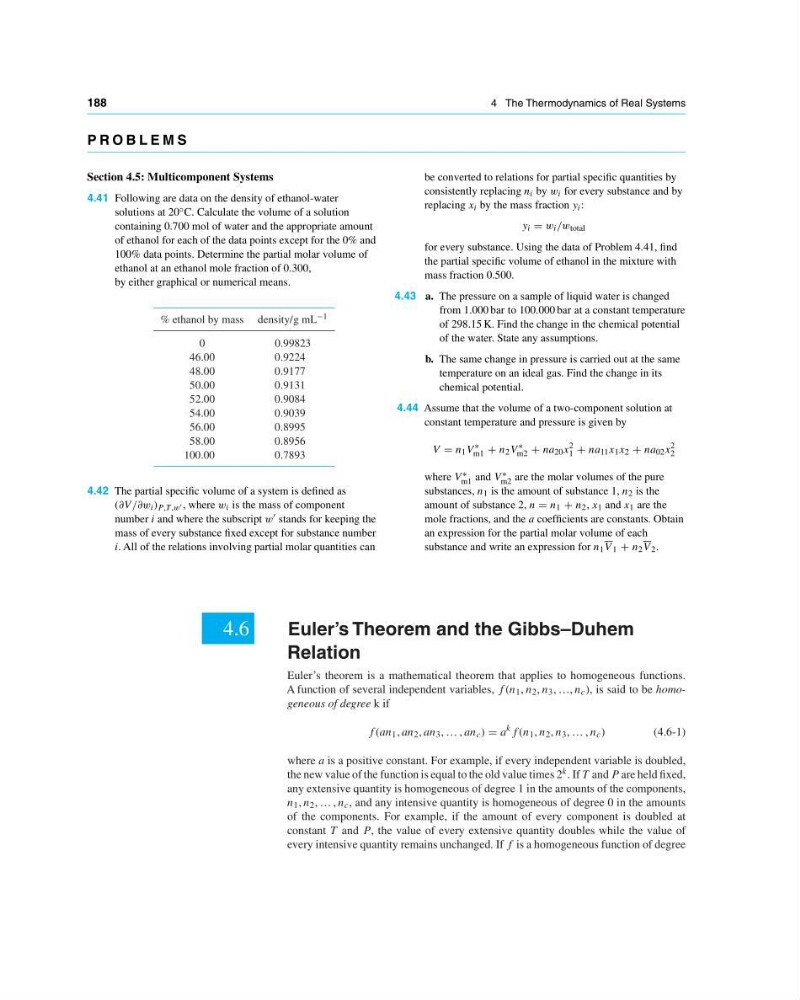
4.41 Following are data on the density of ethanol-water
solutions at 20 ◦ C. Calculate the volume of a solution
containing 0.700 mol of water and the appropriate amount
of ethanol for each of the data points except for the 0% and
100% data points. Determine the partial molar volume of
ethanol at an ethanol mole fraction of 0.300,
by either graphical or numerical means.
% ethanol by mass density/g mL −1
0
0 .99823
46.00
0.9224
48.00
0.9177
50.00
0.9131
52.00
0.9084
54.00
0.9039
56.00
0.8995
58.00
0.8956
100.00
0.7893
4.42 The partial specific volume of a system is defined as
(∂V /∂w i ) P,T ,w , where w i is the mass of component
number i and where the subscript w stands for keeping the
mass of every substance fixed except for substance number
i. All of the relations involving partial molar quantities can
be converted to relations for partial specific quantities by
consistently replacing n i by w i for every substance and by
replacing x i by the mass fraction y i :
y i w i /w total
for every substance. Using the data of Problem 4.41, find
the partial specific volume of ethanol in the mixture with
mass fraction 0.500.
4.43 a. The pressure on a sample of liquid water is changed
from 1.000 bar to 100.000 bar at a constant temperature
of 298.15 K. Find the change in the chemical potential
of the water. State any assumptions.
b. The same change in pressure is carried out at the same
temperature on an ideal gas. Find the change in its
chemical potential.
4.44 Assume that the volume of a two-component solution at
constant temperature and pressure is given by
V n 1 V
∗
m1 + n 2 V
∗
m2 + na 20 x
2
1 + na 11 x 1 x 2 + na 02 x
2
2
where V ∗
m1 and V ∗
m2 are the molar volumes of the pure
substances, n 1 is the amount of substance 1, n 2 is the
amount of substance 2, n n 1 + n 2 , x 1 and x 1 are the
mole fractions, and the a coefficients are constants. Obtain
an expression for the partial molar volume of each
substance and write an expression for n 1 V 1 + n 2 V 2 .
4.6
Euler’s Theorem and the Gibbs–Duhem
Relation
Euler’s theorem is a mathematical theorem that applies to homogeneous functions.
A function of several independent variables, f (n 1 , n 2 , n 3 , …, n c ), is said to be homogeneous of degree k if
f (an 1 , an 2 , an 3 , … , an c ) a
k f (n 1 , n 2 , n 3 , … , n c )
(4.6-1)
where a is a positive constant. For example, if every independent variable is doubled,
the new value of the function is equal to the old value times 2 k . If T and P are held fixed,
any extensive quantity is homogeneous of degree 1 in the amounts of the components,
n 1 , n 2 , … , n c , and any intensive quantity is homogeneous of degree 0 in the amounts
of the components. For example, if the amount of every component is doubled at
constant T and P, the value of every extensive quantity doubles while the value of
every intensive quantity remains unchanged. If f is a homogeneous function of degree
4 The Thermodynamics of Real Systems
P R O B L E M S
Section 4.5: Multicomponent Systems
4.41 Following are data on the density of ethanol-water
solutions at 20 ◦ C. Calculate the volume of a solution
containing 0.700 mol of water and the appropriate amount
of ethanol for each of the data points except for the 0% and
100% data points. Determine the partial molar volume of
ethanol at an ethanol mole fraction of 0.300,
by either graphical or numerical means.
% ethanol by mass density/g mL −1
0
0 .99823
46.00
0.9224
48.00
0.9177
50.00
0.9131
52.00
0.9084
54.00
0.9039
56.00
0.8995
58.00
0.8956
100.00
0.7893
4.42 The partial specific volume of a system is defined as
(∂V /∂w i ) P,T ,w , where w i is the mass of component
number i and where the subscript w stands for keeping the
mass of every substance fixed except for substance number
i. All of the relations involving partial molar quantities can
be converted to relations for partial specific quantities by
consistently replacing n i by w i for every substance and by
replacing x i by the mass fraction y i :
y i w i /w total
for every substance. Using the data of Problem 4.41, find
the partial specific volume of ethanol in the mixture with
mass fraction 0.500.
4.43 a. The pressure on a sample of liquid water is changed
from 1.000 bar to 100.000 bar at a constant temperature
of 298.15 K. Find the change in the chemical potential
of the water. State any assumptions.
b. The same change in pressure is carried out at the same
temperature on an ideal gas. Find the change in its
chemical potential.
4.44 Assume that the volume of a two-component solution at
constant temperature and pressure is given by
V n 1 V
∗
m1 + n 2 V
∗
m2 + na 20 x
2
1 + na 11 x 1 x 2 + na 02 x
2
2
where V ∗
m1 and V ∗
m2 are the molar volumes of the pure
substances, n 1 is the amount of substance 1, n 2 is the
amount of substance 2, n n 1 + n 2 , x 1 and x 1 are the
mole fractions, and the a coefficients are constants. Obtain
an expression for the partial molar volume of each
substance and write an expression for n 1 V 1 + n 2 V 2 .
4.6
Euler’s Theorem and the Gibbs–Duhem
Relation
Euler’s theorem is a mathematical theorem that applies to homogeneous functions.
A function of several independent variables, f (n 1 , n 2 , n 3 , …, n c ), is said to be homogeneous of degree k if
f (an 1 , an 2 , an 3 , … , an c ) a
k f (n 1 , n 2 , n 3 , … , n c )
(4.6-1)
where a is a positive constant. For example, if every independent variable is doubled,
the new value of the function is equal to the old value times 2 k . If T and P are held fixed,
any extensive quantity is homogeneous of degree 1 in the amounts of the components,
n 1 , n 2 , … , n c , and any intensive quantity is homogeneous of degree 0 in the amounts
of the components. For example, if the amount of every component is doubled at
constant T and P, the value of every extensive quantity doubles while the value of
every intensive quantity remains unchanged. If f is a homogeneous function of degree