

160
4 The Thermodynamics of Real Systems
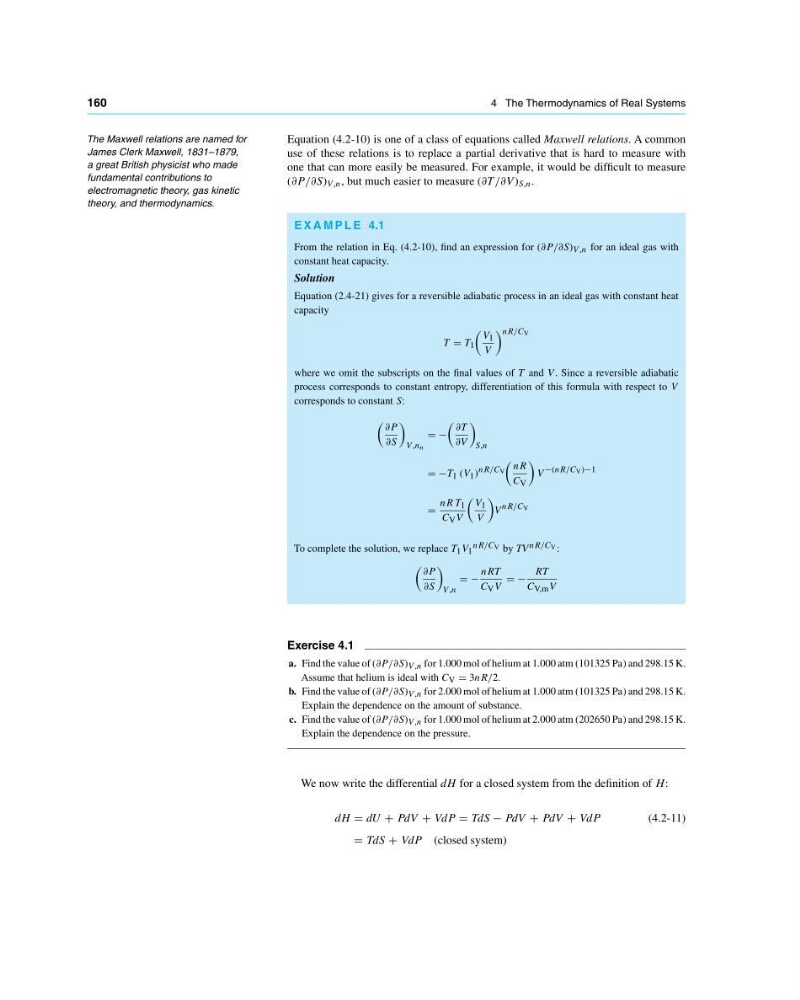
Equation (4.2-10) is one of a class of equations called Maxwell relations. A common
use of these relations is to replace a partial derivative that is hard to measure with
one that can more easily be measured. For example, it would be difficult to measure
(∂P/∂S) V ,n , but much easier to measure (∂T /∂V ) S,n .
The Maxwell relations are named for
James Clerk Maxwell, 1831–1879,
a great British physicist who made
fundamental contributions to
electromagnetic theory, gas kinetic
theory, and thermodynamics.
E X A M P L E 4.1
From the relation in Eq. (4.2-10), find an expression for (∂P/∂S) V ,n for an ideal gas with
constant heat capacity.
Solution
Equation (2.4-21) gives for a reversible adiabatic process in an ideal gas with constant heat
capacity
T T 1
V 1
V
nR/C V
where we omit the subscripts on the final values of T and V . Since a reversible adiabatic
process corresponds to constant entropy, differentiation of this formula with respect to V
corresponds to constant S:
∂P
∂S
V ,n n
−
∂T
∂V
S,n
−T 1 (V 1 ) nR/C V
nR
C V
V −(nR/C V )−1
nR T 1
C V V
V 1
V
V nR/C V
To complete the solution, we replace T 1 V 1
nR/C V by TV nR/C V :
∂P
∂S
V ,n
−
nRT
C V V
−
RT
C V,m V
Exercise 4.1
a. Find the value of (∂P/∂S) V ,n for 1.000 mol of helium at 1.000 atm (101325 Pa) and 298.15 K.
Assume that helium is ideal with C V 3nR/2.
b. Find the value of (∂P/∂S) V ,n for 2.000 mol of helium at 1.000 atm (101325 Pa) and 298.15 K.
Explain the dependence on the amount of substance.
c. Find the value of (∂P/∂S) V ,n for 1.000 mol of helium at 2.000 atm (202650 Pa) and 298.15 K.
Explain the dependence on the pressure.
We now write the differential dH for a closed system from the definition of H:
dH dU + PdV + VdP TdS − PdV + PdV + VdP
(4.2-11)
TdS + VdP (closed system)
4 The Thermodynamics of Real Systems
Equation (4.2-10) is one of a class of equations called Maxwell relations. A common
use of these relations is to replace a partial derivative that is hard to measure with
one that can more easily be measured. For example, it would be difficult to measure
(∂P/∂S) V ,n , but much easier to measure (∂T /∂V ) S,n .
The Maxwell relations are named for
James Clerk Maxwell, 1831–1879,
a great British physicist who made
fundamental contributions to
electromagnetic theory, gas kinetic
theory, and thermodynamics.
E X A M P L E 4.1
From the relation in Eq. (4.2-10), find an expression for (∂P/∂S) V ,n for an ideal gas with
constant heat capacity.
Solution
Equation (2.4-21) gives for a reversible adiabatic process in an ideal gas with constant heat
capacity
T T 1
V 1
V
nR/C V
where we omit the subscripts on the final values of T and V . Since a reversible adiabatic
process corresponds to constant entropy, differentiation of this formula with respect to V
corresponds to constant S:
∂P
∂S
V ,n n
−
∂T
∂V
S,n
−T 1 (V 1 ) nR/C V
nR
C V
V −(nR/C V )−1
nR T 1
C V V
V 1
V
V nR/C V
To complete the solution, we replace T 1 V 1
nR/C V by TV nR/C V :
∂P
∂S
V ,n
−
nRT
C V V
−
RT
C V,m V
Exercise 4.1
a. Find the value of (∂P/∂S) V ,n for 1.000 mol of helium at 1.000 atm (101325 Pa) and 298.15 K.
Assume that helium is ideal with C V 3nR/2.
b. Find the value of (∂P/∂S) V ,n for 2.000 mol of helium at 1.000 atm (101325 Pa) and 298.15 K.
Explain the dependence on the amount of substance.
c. Find the value of (∂P/∂S) V ,n for 1.000 mol of helium at 2.000 atm (202650 Pa) and 298.15 K.
Explain the dependence on the pressure.
We now write the differential dH for a closed system from the definition of H:
dH dU + PdV + VdP TdS − PdV + PdV + VdP
(4.2-11)
TdS + VdP (closed system)