

4.2 Fundamental Relations for Closed Simple Systems
159
Irreversible thermodynamics or nonequilibrium thermodynamics is an extended
version of thermodynamics that deals with rates of entropy production and with rates
of processes and their driving forces. In irreversible thermodynamics, Eq. (4.2-3) is
assumed to be valid for nonequilibrium changes if the deviation from equilibrium is not
too large. This assumption is an additional hypothesis and does not follow from thermodynamics. See the Additional Reading section for further information on irreversible
thermodynamics.
The equilibrium macroscopic state of a one-phase simple system is specified by
c + 2 independent variables, where c is the number of independent substances (components) in the system. If the system is closed, the amounts of the substances are fixed
and only two variables can be varied independently. We take U to be a function of S
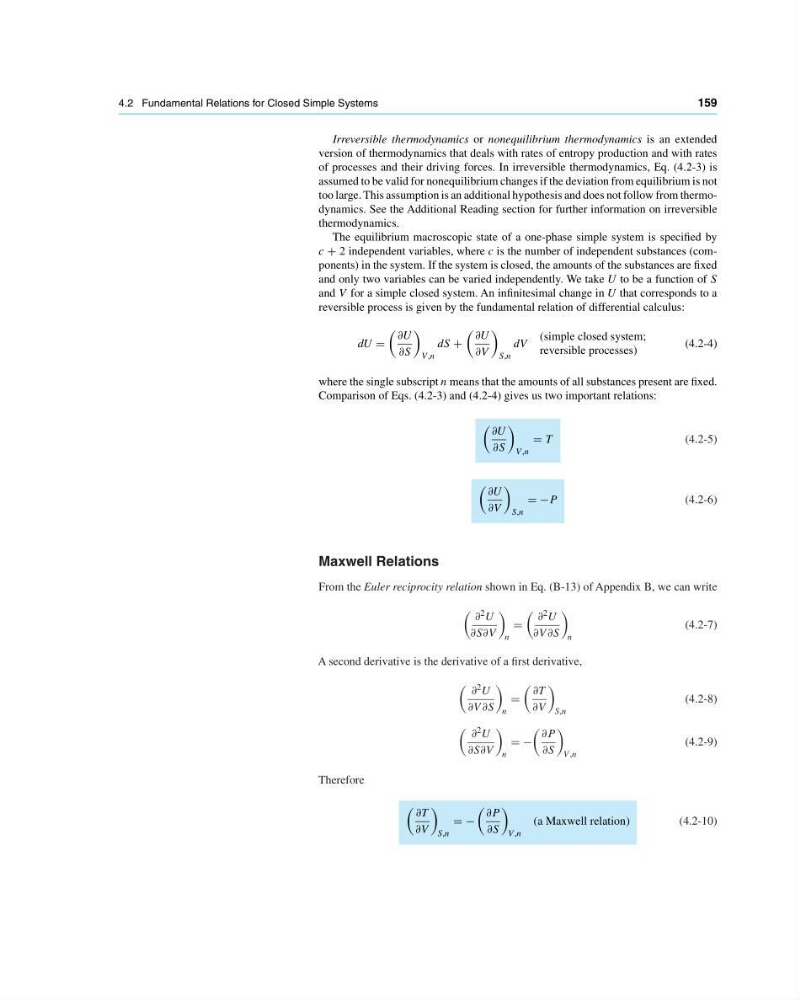
and V for a simple closed system. An infinitesimal change in U that corresponds to a
reversible process is given by the fundamental relation of differential calculus:
dU
∂U
∂S
V ,n
dS +
∂U
∂V
S,n
dV
(simple closed system;
reversible processes)
(4.2-4)
where the single subscript n means that the amounts of all substances present are fixed.
Comparison of Eqs. (4.2-3) and (4.2-4) gives us two important relations:
∂U
∂S
V ,n
T
(4.2-5)
∂U
∂V
S,n
−P
(4.2-6)
Maxwell Relations
From the Euler reciprocity relation shown in Eq. (B-13) of Appendix B, we can write
∂ 2 U
∂S∂V
n
∂ 2 U
∂V ∂S
n
(4.2-7)
A second derivative is the derivative of a first derivative,
∂ 2 U
∂V ∂S
n
∂T
∂V
S,n
(4.2-8)
∂ 2 U
∂S∂V
n
−
∂P
∂S
V ,n
(4.2-9)
Therefore
∂T
∂V
S,n
−
∂P
∂S
V ,n
(a Maxwell relation)
(4.2-10)
159
Irreversible thermodynamics or nonequilibrium thermodynamics is an extended
version of thermodynamics that deals with rates of entropy production and with rates
of processes and their driving forces. In irreversible thermodynamics, Eq. (4.2-3) is
assumed to be valid for nonequilibrium changes if the deviation from equilibrium is not
too large. This assumption is an additional hypothesis and does not follow from thermodynamics. See the Additional Reading section for further information on irreversible
thermodynamics.
The equilibrium macroscopic state of a one-phase simple system is specified by
c + 2 independent variables, where c is the number of independent substances (components) in the system. If the system is closed, the amounts of the substances are fixed
and only two variables can be varied independently. We take U to be a function of S
and V for a simple closed system. An infinitesimal change in U that corresponds to a
reversible process is given by the fundamental relation of differential calculus:
dU
∂U
∂S
V ,n
dS +
∂U
∂V
S,n
dV
(simple closed system;
reversible processes)
(4.2-4)
where the single subscript n means that the amounts of all substances present are fixed.
Comparison of Eqs. (4.2-3) and (4.2-4) gives us two important relations:
∂U
∂S
V ,n
T
(4.2-5)
∂U
∂V
S,n
−P
(4.2-6)
Maxwell Relations
From the Euler reciprocity relation shown in Eq. (B-13) of Appendix B, we can write
∂ 2 U
∂S∂V
n
∂ 2 U
∂V ∂S
n
(4.2-7)
A second derivative is the derivative of a first derivative,
∂ 2 U
∂V ∂S
n
∂T
∂V
S,n
(4.2-8)
∂ 2 U
∂S∂V
n
−
∂P
∂S
V ,n
(4.2-9)
Therefore
∂T
∂V
S,n
−
∂P
∂S
V ,n
(a Maxwell relation)
(4.2-10)