

4.2 Fundamental Relations for Closed Simple Systems
161
Therefore
∂H
∂S
P,n
T
(4.2-12)
and
∂H
∂P
S,n
V
(4.2-13)
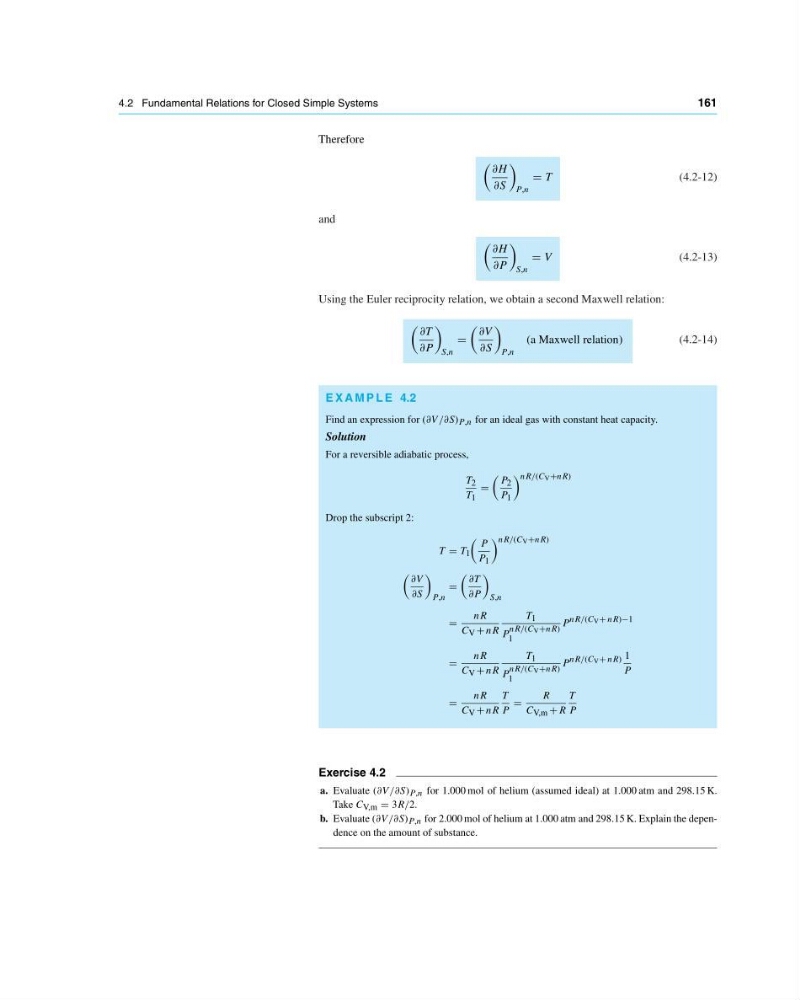
Using the Euler reciprocity relation, we obtain a second Maxwell relation:
∂T
∂P
S,n
∂V
∂S
P,n
(a Maxwell relation)
(4.2-14)
E X A M P L E 4.2
Find an expression for (∂V /∂S) P,n for an ideal gas with constant heat capacity.
Solution
For a reversible adiabatic process,
T 2
T 1
P 2
P 1
nR/(C V +nR)
Drop the subscript 2:
T T 1
P
P 1
nR/(C V +nR)
∂V
∂S
P,n
∂T
∂P
S,n
nR
C V + nR
T 1
P
nR/(C V +nR)
1
P nR/(C V + nR)−1
nR
C V + nR
T 1
P
nR/(C V +nR)
1
P nR/(C V + nR) 1
P
nR
C V + nR
T
P
R
C V,m + R
T
P
Exercise 4.2
a. Evaluate (∂V /∂S) P,n for 1.000 mol of helium (assumed ideal) at 1.000 atm and 298.15 K.
Take C V,m 3R/2.
b. Evaluate (∂V /∂S) P,n for 2.000 mol of helium at 1.000 atm and 298.15 K. Explain the dependence on the amount of substance.
161
Therefore
∂H
∂S
P,n
T
(4.2-12)
and
∂H
∂P
S,n
V
(4.2-13)
Using the Euler reciprocity relation, we obtain a second Maxwell relation:
∂T
∂P
S,n
∂V
∂S
P,n
(a Maxwell relation)
(4.2-14)
E X A M P L E 4.2
Find an expression for (∂V /∂S) P,n for an ideal gas with constant heat capacity.
Solution
For a reversible adiabatic process,
T 2
T 1
P 2
P 1
nR/(C V +nR)
Drop the subscript 2:
T T 1
P
P 1
nR/(C V +nR)
∂V
∂S
P,n
∂T
∂P
S,n
nR
C V + nR
T 1
P
nR/(C V +nR)
1
P nR/(C V + nR)−1
nR
C V + nR
T 1
P
nR/(C V +nR)
1
P nR/(C V + nR) 1
P
nR
C V + nR
T
P
R
C V,m + R
T
P
Exercise 4.2
a. Evaluate (∂V /∂S) P,n for 1.000 mol of helium (assumed ideal) at 1.000 atm and 298.15 K.
Take C V,m 3R/2.
b. Evaluate (∂V /∂S) P,n for 2.000 mol of helium at 1.000 atm and 298.15 K. Explain the dependence on the amount of substance.