

to the main protein via linker sequences, which
may act solely as spacers (Chen et al. 2013), or
contain a proteolytic site that allows for
removal of the attached domain (in vivo or
in vitro) when its function is no longer
required. This adds to the complexity of the
gene-expression cassette structure as additional
bio-blocks need to be designed and
incorporated into the cassette at the appropriate positions.
The design of these bio-blocks depends on
the size of the new functional unit and strategies
for their assembly are presented in Fig. 10.5.
Firstly, bio-blocks encoding large size addendums (>30 amino acid residues) like fluorescent
proteins can be made as individual bio-blocks by
PCR. Similar to the assembly of the basic geneexpression cassette (in Fig. 10.1), proper incorporation of the new bio-block is ensured by
sequences in the tails of the primers used to
generate the individual bio-blocks, which can
be enzymatically cut to provide overhangs that
direct the correct fusion order of all components.
Secondly, for medium size bio-blocks encoding
sequences of 10–30 amino acid residues (e.g.
secretion signals), the information can be
incorporated into each of two oligonucleotides
that are annealed in vitro to form the complete
bio-block. Note that small sequence extensions
may be added to the oligonucleotides to produce
bio-blocks, which are directly equipped with
short ssDNA overhangs for bio-block assembly.
Thirdly, for shorter sequences (<10 amino acid
residues), e.g. purification tags or proteolytic
sites, the information may be incorporated into
the primer tails of neighboring bio-blocks. For
example, if the C-terminus of a protein needs to
be extended with a poly-histidine tag for purification, the primer tail used to link the GOI to the
next bio-block could be elongated with the
sequence encoding the tag. The combinations
in which these basic strategies can be employed
to construct GECs are numerous, and as the
prices decrease, it is likely that even large size
protein tags will be synthesized de novo rather
than by PCR amplification.
IV. Heterologous Protein Production
in Filamentous Fungi
Filamentous fungi serve as favorite hosts for
production of industrial enzymes due to their
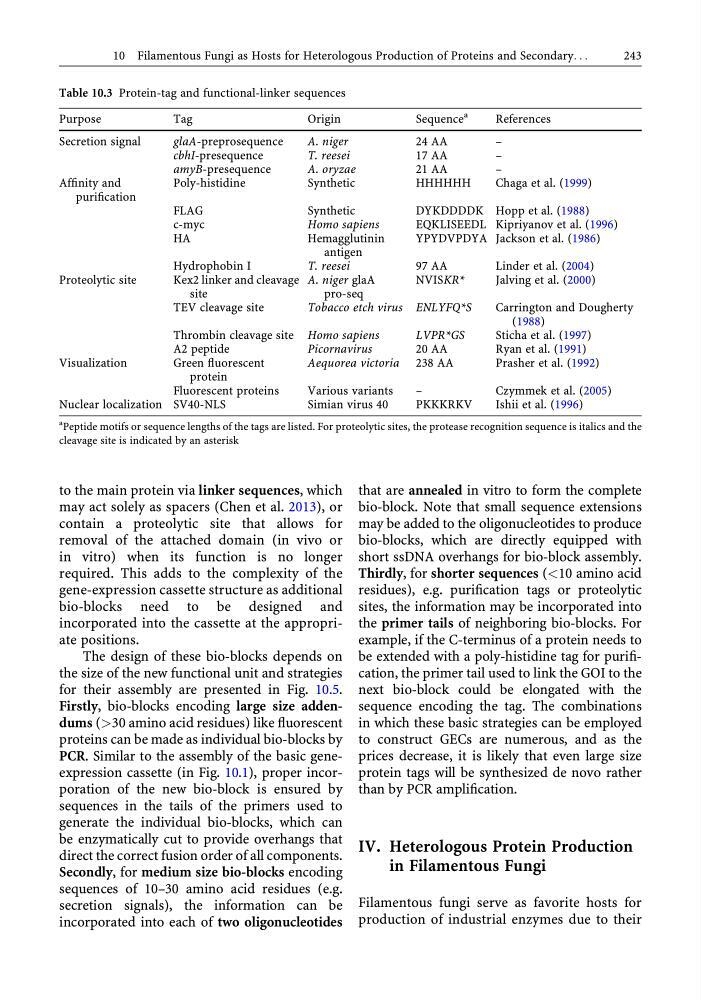
Table 10.3 Protein-tag and functional-linker sequences
Purpose
Tag
Origin
Sequence
a
References
Secretion signal
glaA-preprosequence
A. niger
24 AA
–
cbhI-presequence
T. reesei
17 AA
–
amyB-presequence
A. oryzae
21 AA
–
Affinity and
purification
Poly-histidine
Synthetic
HHHHHH
Chaga et al. (1999)
FLAG
Synthetic
DYKDDDDK Hopp et al. (1988)
c-myc
Homo sapiens
EQKLISEEDL Kipriyanov et al. (1996)
HA
Hemagglutinin
antigen
YPYDVPDYA Jackson et al. (1986)
Hydrophobin I
T. reesei
97 AA
Linder et al. (2004)
Proteolytic site
Kex2 linker and cleavage
site
A. niger glaA
pro-seq
NVISKR*
Jalving et al. (2000)
TEV cleavage site
Tobacco etch virus ENLYFQ*S
Carrington and Dougherty
(1988)
Thrombin cleavage site Homo sapiens
LVPR*GS
Sticha et al. (1997)
A2 peptide
Picornavirus
20 AA
Ryan et al. (1991)
Visualization
Green fluorescent
protein
Aequorea victoria 238 AA
Prasher et al. (1992)
Fluorescent proteins
Various variants
–
Czymmek et al. (2005)
Nuclear localization SV40-NLS
Simian virus 40
PKKKRKV
Ishii et al. (1996)
a
Peptide motifs or sequence lengths of the tags are listed. For proteolytic sites, the protease recognition sequence is italics and the
cleavage site is indicated by an asterisk
10 Filamentous Fungi as Hosts for Heterologous Production of Proteins and Secondary. . .
243
may act solely as spacers (Chen et al. 2013), or
contain a proteolytic site that allows for
removal of the attached domain (in vivo or
in vitro) when its function is no longer
required. This adds to the complexity of the
gene-expression cassette structure as additional
bio-blocks need to be designed and
incorporated into the cassette at the appropriate positions.
The design of these bio-blocks depends on
the size of the new functional unit and strategies
for their assembly are presented in Fig. 10.5.
Firstly, bio-blocks encoding large size addendums (>30 amino acid residues) like fluorescent
proteins can be made as individual bio-blocks by
PCR. Similar to the assembly of the basic geneexpression cassette (in Fig. 10.1), proper incorporation of the new bio-block is ensured by
sequences in the tails of the primers used to
generate the individual bio-blocks, which can
be enzymatically cut to provide overhangs that
direct the correct fusion order of all components.
Secondly, for medium size bio-blocks encoding
sequences of 10–30 amino acid residues (e.g.
secretion signals), the information can be
incorporated into each of two oligonucleotides
that are annealed in vitro to form the complete
bio-block. Note that small sequence extensions
may be added to the oligonucleotides to produce
bio-blocks, which are directly equipped with
short ssDNA overhangs for bio-block assembly.
Thirdly, for shorter sequences (<10 amino acid
residues), e.g. purification tags or proteolytic
sites, the information may be incorporated into
the primer tails of neighboring bio-blocks. For
example, if the C-terminus of a protein needs to
be extended with a poly-histidine tag for purification, the primer tail used to link the GOI to the
next bio-block could be elongated with the
sequence encoding the tag. The combinations
in which these basic strategies can be employed
to construct GECs are numerous, and as the
prices decrease, it is likely that even large size
protein tags will be synthesized de novo rather
than by PCR amplification.
IV. Heterologous Protein Production
in Filamentous Fungi
Filamentous fungi serve as favorite hosts for
production of industrial enzymes due to their
Table 10.3 Protein-tag and functional-linker sequences
Purpose
Tag
Origin
Sequence
a
References
Secretion signal
glaA-preprosequence
A. niger
24 AA
–
cbhI-presequence
T. reesei
17 AA
–
amyB-presequence
A. oryzae
21 AA
–
Affinity and
purification
Poly-histidine
Synthetic
HHHHHH
Chaga et al. (1999)
FLAG
Synthetic
DYKDDDDK Hopp et al. (1988)
c-myc
Homo sapiens
EQKLISEEDL Kipriyanov et al. (1996)
HA
Hemagglutinin
antigen
YPYDVPDYA Jackson et al. (1986)
Hydrophobin I
T. reesei
97 AA
Linder et al. (2004)
Proteolytic site
Kex2 linker and cleavage
site
A. niger glaA
pro-seq
NVISKR*
Jalving et al. (2000)
TEV cleavage site
Tobacco etch virus ENLYFQ*S
Carrington and Dougherty
(1988)
Thrombin cleavage site Homo sapiens
LVPR*GS
Sticha et al. (1997)
A2 peptide
Picornavirus
20 AA
Ryan et al. (1991)
Visualization
Green fluorescent
protein
Aequorea victoria 238 AA
Prasher et al. (1992)
Fluorescent proteins
Various variants
–
Czymmek et al. (2005)
Nuclear localization SV40-NLS
Simian virus 40
PKKKRKV
Ishii et al. (1996)
a
Peptide motifs or sequence lengths of the tags are listed. For proteolytic sites, the protease recognition sequence is italics and the
cleavage site is indicated by an asterisk
10 Filamentous Fungi as Hosts for Heterologous Production of Proteins and Secondary. . .
243