

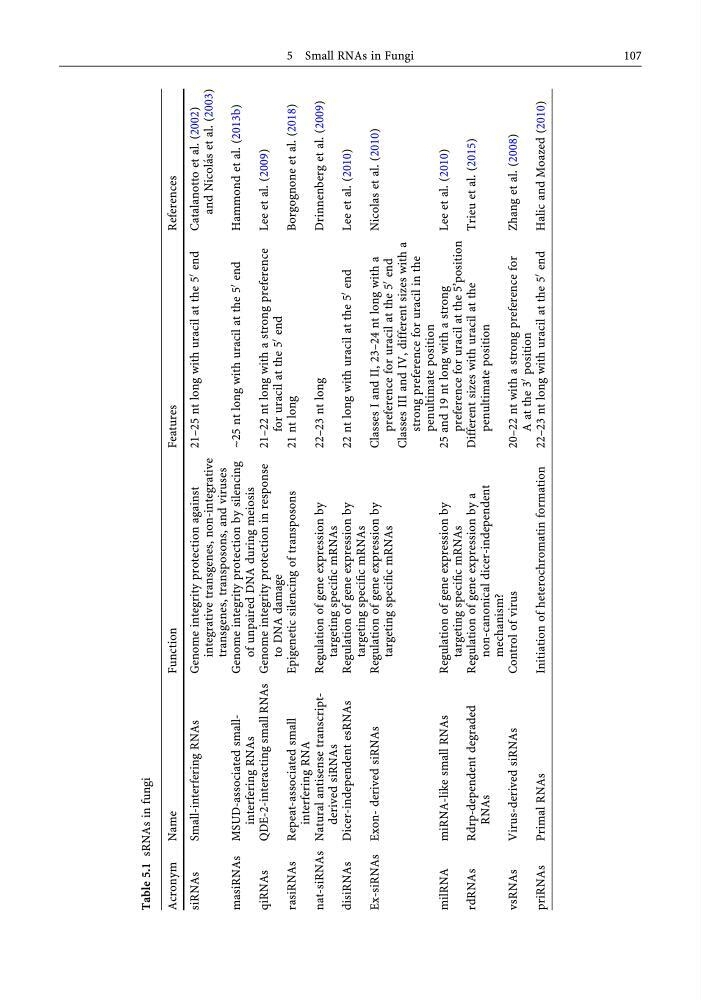
Table 5.1 sRNAs in fungi
Acronym
Name
Function
Features
References
siRNAs
Small-interfering RNAs
Genome integrity protection against
integrative transgenes, non-integrative
transgenes, transposons, and viruses
21–25 nt long with uracil at the 5
0
end
Catalanotto et al. (2002)
and Nicola ´s
et al. (2003)
masiRNAs MSUD-associated smallinterfering RNAs
Genome integrity protection by silencing
of unpaired DNA during meiosis
~25 nt long with uracil at the 5
0
end
Hammond et al. (2013b)
qiRNAs
QDE-2-interacting small RNAs Genome integrity protection in response
to DNA damage
21–22 nt long with a strong preference
for uracil at the 5
0
end
Lee et al. (2009)
rasiRNAs
Repeat-associated small
interfering RNA
Epigenetic silencing of transposons
21 nt long
Borgognone et al. (2018)
nat-siRNAs Natural antisense transcriptderived siRNAs
Regulation of gene expression by
targeting specific mRNAs
22–23 nt long
Drinnenberg et al. (2009)
disiRNAs
Dicer-independent esRNAs
Regulation of gene expression by
targeting specific mRNAs
22 nt long with uracil at the 5
0
end
Lee et al. (2010)
Ex-siRNAs Exon- derived siRNAs
Regulation of gene expression by
targeting specific mRNAs
Classes I and II, 23–24 nt long with a
preference for uracil at the 5
0
end
Classes III and IV, different sizes with a
strong preference for uracil in the
penultimate position
Nicolas et al. (2010)
milRNA
miRNA-like small RNAs
Regulation of gene expression by
targeting specific mRNAs
25 and 19 nt long with a strong
preference for uracil at the 5’position
Lee et al. (2010)
rdRNAs
Rdrp-dependent degraded
RNAs
Regulation of gene expression by a
non-canonical dicer-independent
mechanism?
Different sizes with uracil at the
penultimate position
Trieu et al. (2015)
vsRNAs
Virus-derived siRNAs
Control of virus
20–22 nt with a strong preference for
A at the 3
0
position
Zhang et al. (2008)
priRNAs
Primal RNAs
Initiation of heterochromatin formation 22–23 nt long with uracil at the 5
0
end
Halic and Moazed (2010)
5 Small RNAs in Fungi
107
Acronym
Name
Function
Features
References
siRNAs
Small-interfering RNAs
Genome integrity protection against
integrative transgenes, non-integrative
transgenes, transposons, and viruses
21–25 nt long with uracil at the 5
0
end
Catalanotto et al. (2002)
and Nicola ´s
et al. (2003)
masiRNAs MSUD-associated smallinterfering RNAs
Genome integrity protection by silencing
of unpaired DNA during meiosis
~25 nt long with uracil at the 5
0
end
Hammond et al. (2013b)
qiRNAs
QDE-2-interacting small RNAs Genome integrity protection in response
to DNA damage
21–22 nt long with a strong preference
for uracil at the 5
0
end
Lee et al. (2009)
rasiRNAs
Repeat-associated small
interfering RNA
Epigenetic silencing of transposons
21 nt long
Borgognone et al. (2018)
nat-siRNAs Natural antisense transcriptderived siRNAs
Regulation of gene expression by
targeting specific mRNAs
22–23 nt long
Drinnenberg et al. (2009)
disiRNAs
Dicer-independent esRNAs
Regulation of gene expression by
targeting specific mRNAs
22 nt long with uracil at the 5
0
end
Lee et al. (2010)
Ex-siRNAs Exon- derived siRNAs
Regulation of gene expression by
targeting specific mRNAs
Classes I and II, 23–24 nt long with a
preference for uracil at the 5
0
end
Classes III and IV, different sizes with a
strong preference for uracil in the
penultimate position
Nicolas et al. (2010)
milRNA
miRNA-like small RNAs
Regulation of gene expression by
targeting specific mRNAs
25 and 19 nt long with a strong
preference for uracil at the 5’position
Lee et al. (2010)
rdRNAs
Rdrp-dependent degraded
RNAs
Regulation of gene expression by a
non-canonical dicer-independent
mechanism?
Different sizes with uracil at the
penultimate position
Trieu et al. (2015)
vsRNAs
Virus-derived siRNAs
Control of virus
20–22 nt with a strong preference for
A at the 3
0
position
Zhang et al. (2008)
priRNAs
Primal RNAs
Initiation of heterochromatin formation 22–23 nt long with uracil at the 5
0
end
Halic and Moazed (2010)
5 Small RNAs in Fungi
107