

RNAi mechanism suggests that it plays an
essential role in their biology, although in
some particular cases its absence might provide
some advantage (Drinnenberg et al. 2011; Nicola ´s et al. 2013; Wang et al. 2010). Despite the
original function of RNAi was to protect the
genome from deleterious movements of transposable elements (TEs) and viruses, the basic
machinery has evolved in all groups of eukaryotes to generate specific pathways with endogenous regulatory functions. These pathways
produce particular types of sRNAs that are
involved in the regulation of gene expression
(Table 5.1) (Cerutti and Casas-Mollano 2006).
The most representative example of these regulatory sRNAs is the animal and plant microRNA (miRNA) (Ghildiyal and Zamore 2009).
In fungi, various endogenous regulatory RNAi
pathways have also been described (Calo et al.
2017; Lee et al. 2010; Nicolas et al. 2010; Yu et al.
2018). These pathways interact with each other
at several levels, competing for and sharing
substrates, components, and cross-regulating
each other (Fig. 5.1) (Calo et al. 2017).
Several excellent reviews have examined the
RNAi-related pathways, types of sRNAs and
their associated functions in fungi (Chang
et al. 2012; Torres-Martı ´nez and Ruiz-Va ´zquez
2017; Villalobos-Escobedo et al. 2016). In this
Chapter of The Mycota, we have updated the
most recent discoveries and contributions to
the field with particular emphasis on functional
aspects. Readers interested in mechanistic
details specific for each RNAi-related pathway
are advised to go through the indicated reviews
or the references in this Chapter.
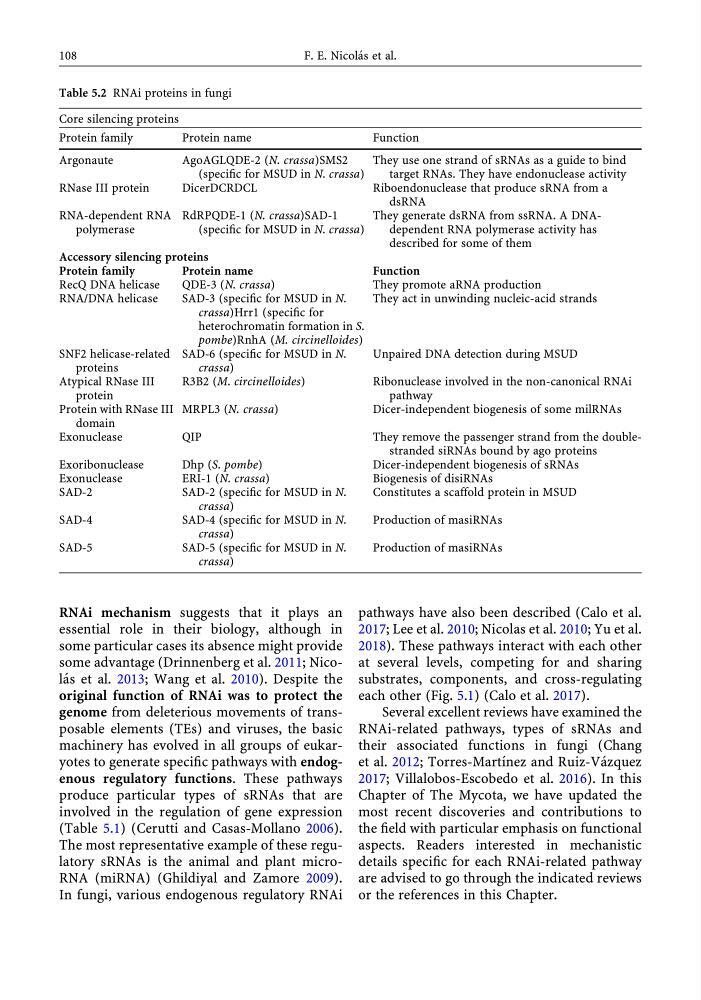
Table 5.2 RNAi proteins in fungi
Core silencing proteins
Protein family
Protein name
Function
Argonaute
AgoAGLQDE-2 (N. crassa)SMS2
(specific for MSUD in N. crassa)
They use one strand of sRNAs as a guide to bind
target RNAs. They have endonuclease activity
RNase III protein
DicerDCRDCL
Riboendonuclease that produce sRNA from a
dsRNA
RNA-dependent RNA
polymerase
RdRPQDE-1 (N. crassa)SAD-1
(specific for MSUD in N. crassa)
They generate dsRNA from ssRNA. A DNAdependent RNA polymerase activity has
described for some of them
Accessory silencing proteins
Protein family
Protein name
Function
RecQ DNA helicase
QDE-3 (N. crassa)
They promote aRNA production
RNA/DNA helicase
SAD-3 (specific for MSUD in N.
crassa)Hrr1 (specific for
heterochromatin formation in S.
pombe)RnhA (M. circinelloides)
They act in unwinding nucleic-acid strands
SNF2 helicase-related
proteins
SAD-6 (specific for MSUD in N.
crassa)
Unpaired DNA detection during MSUD
Atypical RNase III
protein
R3B2 (M. circinelloides)
Ribonuclease involved in the non-canonical RNAi
pathway
Protein with RNase III
domain
MRPL3 (N. crassa)
Dicer-independent biogenesis of some milRNAs
Exonuclease
QIP
They remove the passenger strand from the doublestranded siRNAs bound by ago proteins
Exoribonuclease
Dhp (S. pombe)
Dicer-independent biogenesis of sRNAs
Exonuclease
ERI-1 (N. crassa)
Biogenesis of disiRNAs
SAD-2
SAD-2 (specific for MSUD in N.
crassa)
Constitutes a scaffold protein in MSUD
SAD-4
SAD-4 (specific for MSUD in N.
crassa)
Production of masiRNAs
SAD-5
SAD-5 (specific for MSUD in N.
crassa)
Production of masiRNAs
108
F. E. Nicola ´s et al.
essential role in their biology, although in
some particular cases its absence might provide
some advantage (Drinnenberg et al. 2011; Nicola ´s et al. 2013; Wang et al. 2010). Despite the
original function of RNAi was to protect the
genome from deleterious movements of transposable elements (TEs) and viruses, the basic
machinery has evolved in all groups of eukaryotes to generate specific pathways with endogenous regulatory functions. These pathways
produce particular types of sRNAs that are
involved in the regulation of gene expression
(Table 5.1) (Cerutti and Casas-Mollano 2006).
The most representative example of these regulatory sRNAs is the animal and plant microRNA (miRNA) (Ghildiyal and Zamore 2009).
In fungi, various endogenous regulatory RNAi
pathways have also been described (Calo et al.
2017; Lee et al. 2010; Nicolas et al. 2010; Yu et al.
2018). These pathways interact with each other
at several levels, competing for and sharing
substrates, components, and cross-regulating
each other (Fig. 5.1) (Calo et al. 2017).
Several excellent reviews have examined the
RNAi-related pathways, types of sRNAs and
their associated functions in fungi (Chang
et al. 2012; Torres-Martı ´nez and Ruiz-Va ´zquez
2017; Villalobos-Escobedo et al. 2016). In this
Chapter of The Mycota, we have updated the
most recent discoveries and contributions to
the field with particular emphasis on functional
aspects. Readers interested in mechanistic
details specific for each RNAi-related pathway
are advised to go through the indicated reviews
or the references in this Chapter.
Table 5.2 RNAi proteins in fungi
Core silencing proteins
Protein family
Protein name
Function
Argonaute
AgoAGLQDE-2 (N. crassa)SMS2
(specific for MSUD in N. crassa)
They use one strand of sRNAs as a guide to bind
target RNAs. They have endonuclease activity
RNase III protein
DicerDCRDCL
Riboendonuclease that produce sRNA from a
dsRNA
RNA-dependent RNA
polymerase
RdRPQDE-1 (N. crassa)SAD-1
(specific for MSUD in N. crassa)
They generate dsRNA from ssRNA. A DNAdependent RNA polymerase activity has
described for some of them
Accessory silencing proteins
Protein family
Protein name
Function
RecQ DNA helicase
QDE-3 (N. crassa)
They promote aRNA production
RNA/DNA helicase
SAD-3 (specific for MSUD in N.
crassa)Hrr1 (specific for
heterochromatin formation in S.
pombe)RnhA (M. circinelloides)
They act in unwinding nucleic-acid strands
SNF2 helicase-related
proteins
SAD-6 (specific for MSUD in N.
crassa)
Unpaired DNA detection during MSUD
Atypical RNase III
protein
R3B2 (M. circinelloides)
Ribonuclease involved in the non-canonical RNAi
pathway
Protein with RNase III
domain
MRPL3 (N. crassa)
Dicer-independent biogenesis of some milRNAs
Exonuclease
QIP
They remove the passenger strand from the doublestranded siRNAs bound by ago proteins
Exoribonuclease
Dhp (S. pombe)
Dicer-independent biogenesis of sRNAs
Exonuclease
ERI-1 (N. crassa)
Biogenesis of disiRNAs
SAD-2
SAD-2 (specific for MSUD in N.
crassa)
Constitutes a scaffold protein in MSUD
SAD-4
SAD-4 (specific for MSUD in N.
crassa)
Production of masiRNAs
SAD-5
SAD-5 (specific for MSUD in N.
crassa)
Production of masiRNAs
108
F. E. Nicola ´s et al.