

90
enantioselective borylation of C(sp
3
)−H bonds for the first time [154]. This reaction
is compatible with carbocyclic amides containing α-tertiary as well as α-quaternary
carbon centers.
3.5 Conclusions
The development of new oxidative cross-couplings based on catalytic functionalization of C–H bonds has the potential to simplify the synthesis of complex molecules
dramatically. By viewing C–H bond as “nucleophile” to react with another nucleophile (organometallic reagent in this chapter) gives rise to the second generation of
oxidative coupling reactions. During the last decade, huge successful results have
been achieved in this emerging area, which have become one of the most efficient
tools for the construction of carbon–carbon and carbon–heteroatom bonds.
Although many progresses have been achieved in this field, until now, the most
successful way for the selective cleavage of C–H bond is still the use of directing
groups, which must be pre-synthesized through tedious synthetic routes and are difficult to remove. Thus, native directing groups such as carboxylic acids, hydroxyl
groups, and unprotected aliphatic amines offer a more efficient and elegant way for
C–H functionalization. Meanwhile, most of current oxidative cross-couplings are
still catalyzed by noble transition metals, such as Pd, Rh, Ru, etc. It is foreseeable
that inexpensive metals such as Cu, Ni, Co, Fe, etc. will also find their way into this
Mn(TMP)Cl
49%
49% (exo:endo=5.7)
PhIO, TBAF 3H 2 O
AgF
Alkyl H
Alkyl F
F
F
Me OH
F
44% (dr=8:1)
N
F
Me
O
F 3 C
51% (dr=1.5:1)
F
BzO
49% (dr=1.6:1)
F
F
51% (3.5 : 1)
Me Me
Me
F
OAc
57%
53% (1 : 1.4)
F
F
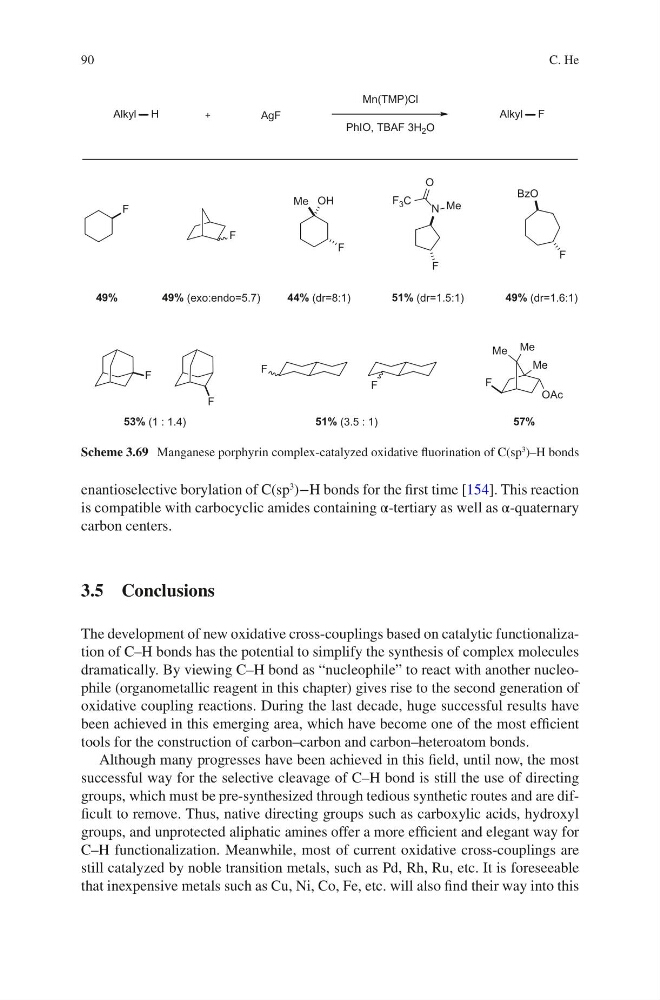
Scheme 3.69 Manganese porphyrin complex-catalyzed oxidative fluorination of C(sp
3
)–H bonds
C. He
enantioselective borylation of C(sp
3
)−H bonds for the first time [154]. This reaction
is compatible with carbocyclic amides containing α-tertiary as well as α-quaternary
carbon centers.
3.5 Conclusions
The development of new oxidative cross-couplings based on catalytic functionalization of C–H bonds has the potential to simplify the synthesis of complex molecules
dramatically. By viewing C–H bond as “nucleophile” to react with another nucleophile (organometallic reagent in this chapter) gives rise to the second generation of
oxidative coupling reactions. During the last decade, huge successful results have
been achieved in this emerging area, which have become one of the most efficient
tools for the construction of carbon–carbon and carbon–heteroatom bonds.
Although many progresses have been achieved in this field, until now, the most
successful way for the selective cleavage of C–H bond is still the use of directing
groups, which must be pre-synthesized through tedious synthetic routes and are difficult to remove. Thus, native directing groups such as carboxylic acids, hydroxyl
groups, and unprotected aliphatic amines offer a more efficient and elegant way for
C–H functionalization. Meanwhile, most of current oxidative cross-couplings are
still catalyzed by noble transition metals, such as Pd, Rh, Ru, etc. It is foreseeable
that inexpensive metals such as Cu, Ni, Co, Fe, etc. will also find their way into this
Mn(TMP)Cl
49%
49% (exo:endo=5.7)
PhIO, TBAF 3H 2 O
AgF
Alkyl H
Alkyl F
F
F
Me OH
F
44% (dr=8:1)
N
F
Me
O
F 3 C
51% (dr=1.5:1)
F
BzO
49% (dr=1.6:1)
F
F
51% (3.5 : 1)
Me Me
Me
F
OAc
57%
53% (1 : 1.4)
F
F
Scheme 3.69 Manganese porphyrin complex-catalyzed oxidative fluorination of C(sp
3
)–H bonds
C. He