

89
Meanwhile, another manganese porphyrin complex-catalyzed oxidative fluorination of aliphatic C–H bonds by fluoride ion in the presence of iodosylbenzene
oxidant was achieved by Groves and co-workers (Scheme 3.69) [151]. Simple
alkanes, terpenoids, and even steroids were selectively fluorinated at otherwise
inaccessible sites in moderate yields. Mechanistic analysis suggests that the regioselectivity for C–H bond cleavage is directed by an oxomanganese(V) catalytic
intermediate followed by F delivery via an unusual manganese(IV) fluoride that has
been isolated and structurally characterized.
3.4.4.2 C–H and B 2 pin 2 as Nucleophiles
Recently, three representative examples of oxidative borylation of C(sp
3
)–H bonds
were developed by Shi [152] and Yu [153, 154], respectively (Scheme 3.70).
Assisted by the picolinamide auxiliary, Shi and co-workers achieved γ-methyl
C(sp
3
)−H borylation of amine derivatives [152]. Diisopropyl sulfide is essential for
improving the reaction efficiency, as it stabilizes the Pd(0) species generated in situ.
Amino acids, amino alcohols, alkyl amines, and a series of bioactive molecules can
be functionalized in good yields. Later, in the presence of quinoline-derived ligand,
Yu and co- workers described another Pd(II)-catalyzed oxidative borylation of
β-C(sp
3
)−H bonds in carboxylic acids containing α-tertiary and α-quaternary carbon centers, as well as methylene C(sp
3
)−H bonds in a variety of carbocyclic rings
[153]. Oxygen serves as the sole oxidant in the reaction to reoxidize Pd(0) to Pd(II).
Moreover, by using chiral acetyl-protected aminomethyl oxazoline ligands in the
oxidative cross- coupling reaction, the same group realized a Pd(II)-catalyzed
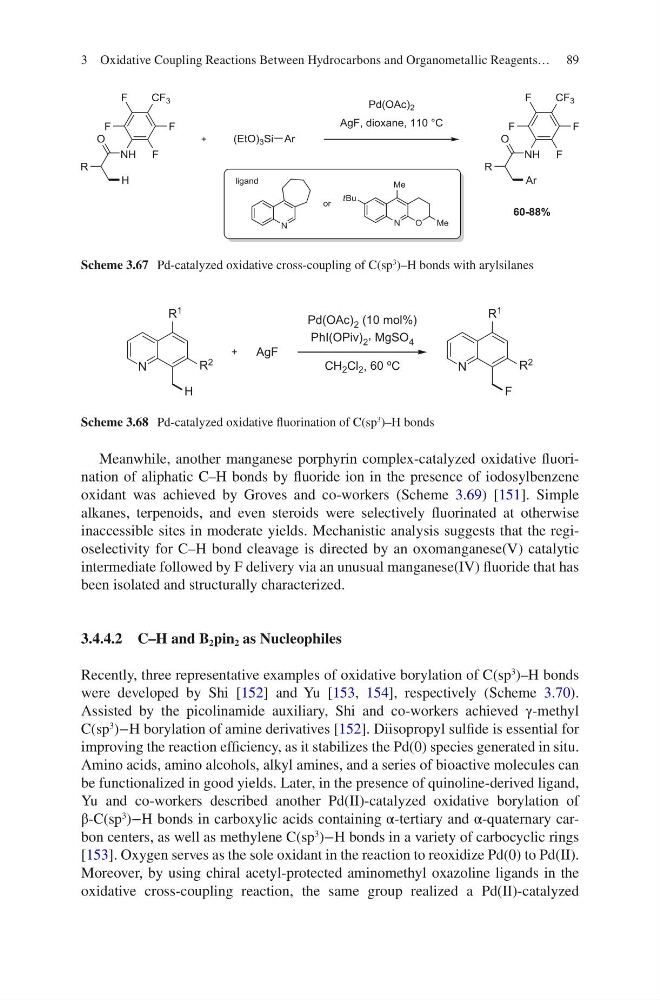
Scheme 3.67 Pd-catalyzed oxidative cross-coupling of C(sp
3
)–H bonds with arylsilanes
Pd(OAc) 2 (10 mol%)
PhI(OPiv) 2 , MgSO 4
CH 2 Cl 2 , 60 ºC
N
R 1
R 2
H
AgF
N
R 1
R 2
F
Scheme 3.68 Pd-catalyzed oxidative fluorination of C(sp
3 )–H bonds
3 Oxidative Coupling Reactions Between Hydrocarbons and Organometallic Reagents…
Meanwhile, another manganese porphyrin complex-catalyzed oxidative fluorination of aliphatic C–H bonds by fluoride ion in the presence of iodosylbenzene
oxidant was achieved by Groves and co-workers (Scheme 3.69) [151]. Simple
alkanes, terpenoids, and even steroids were selectively fluorinated at otherwise
inaccessible sites in moderate yields. Mechanistic analysis suggests that the regioselectivity for C–H bond cleavage is directed by an oxomanganese(V) catalytic
intermediate followed by F delivery via an unusual manganese(IV) fluoride that has
been isolated and structurally characterized.
3.4.4.2 C–H and B 2 pin 2 as Nucleophiles
Recently, three representative examples of oxidative borylation of C(sp
3
)–H bonds
were developed by Shi [152] and Yu [153, 154], respectively (Scheme 3.70).
Assisted by the picolinamide auxiliary, Shi and co-workers achieved γ-methyl
C(sp
3
)−H borylation of amine derivatives [152]. Diisopropyl sulfide is essential for
improving the reaction efficiency, as it stabilizes the Pd(0) species generated in situ.
Amino acids, amino alcohols, alkyl amines, and a series of bioactive molecules can
be functionalized in good yields. Later, in the presence of quinoline-derived ligand,
Yu and co- workers described another Pd(II)-catalyzed oxidative borylation of
β-C(sp
3
)−H bonds in carboxylic acids containing α-tertiary and α-quaternary carbon centers, as well as methylene C(sp
3
)−H bonds in a variety of carbocyclic rings
[153]. Oxygen serves as the sole oxidant in the reaction to reoxidize Pd(0) to Pd(II).
Moreover, by using chiral acetyl-protected aminomethyl oxazoline ligands in the
oxidative cross- coupling reaction, the same group realized a Pd(II)-catalyzed
Scheme 3.67 Pd-catalyzed oxidative cross-coupling of C(sp
3
)–H bonds with arylsilanes
Pd(OAc) 2 (10 mol%)
PhI(OPiv) 2 , MgSO 4
CH 2 Cl 2 , 60 ºC
N
R 1
R 2
H
AgF
N
R 1
R 2
F
Scheme 3.68 Pd-catalyzed oxidative fluorination of C(sp
3 )–H bonds
3 Oxidative Coupling Reactions Between Hydrocarbons and Organometallic Reagents…