

84
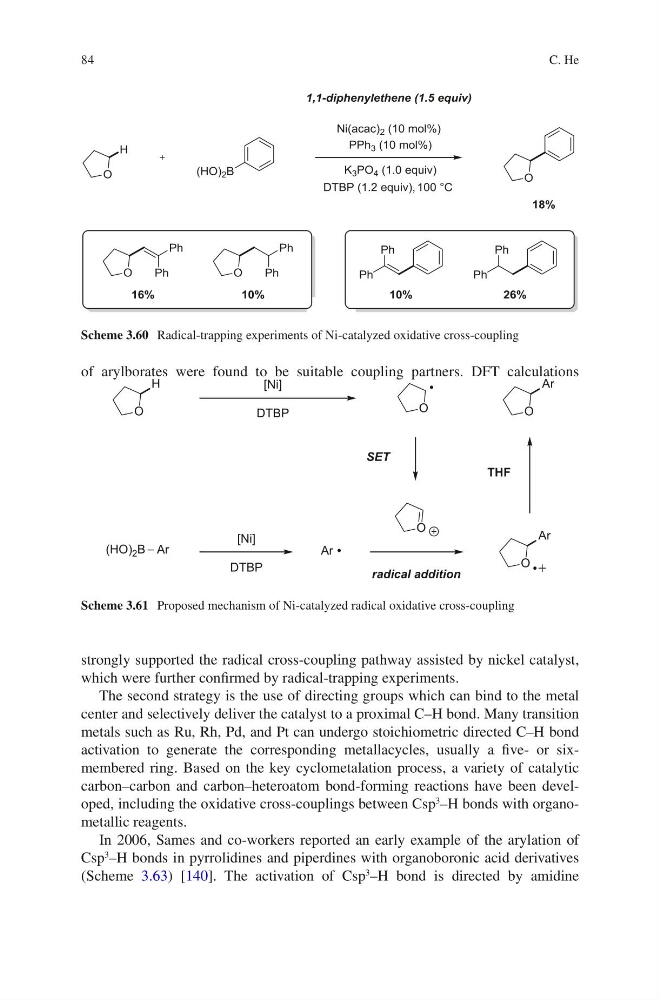
of arylborates were found to be suitable coupling partners. DFT calculations
strongly supported the radical cross-coupling pathway assisted by nickel catalyst,
which were further confirmed by radical-trapping experiments.
The second strategy is the use of directing groups which can bind to the metal
center and selectively deliver the catalyst to a proximal C–H bond. Many transition
metals such as Ru, Rh, Pd, and Pt can undergo stoichiometric directed C–H bond
activation to generate the corresponding metallacycles, usually a five- or sixmembered ring. Based on the key cyclometalation process, a variety of catalytic
carbon–carbon and carbon–heteroatom bond-forming reactions have been developed, including the oxidative cross-couplings between Csp
3
–H bonds with organometallic reagents.
In 2006, Sames and co-workers reported an early example of the arylation of
Csp
3
–H bonds in pyrrolidines and piperdines with organoboronic acid derivatives
(Scheme 3.63) [140]. The activation of Csp
3
–H bond is directed by amidine
Scheme 3.60 Radical-trapping experiments of Ni-catalyzed oxidative cross-coupling
Ar
(HO) 2 B
H
O
[Ni]
DTBP
O
SET
O
[Ni]
DTBP
Ar
radical addition
Ar
O
Ar
O
THF
Scheme 3.61 Proposed mechanism of Ni-catalyzed radical oxidative cross-coupling
C. He
of arylborates were found to be suitable coupling partners. DFT calculations
strongly supported the radical cross-coupling pathway assisted by nickel catalyst,
which were further confirmed by radical-trapping experiments.
The second strategy is the use of directing groups which can bind to the metal
center and selectively deliver the catalyst to a proximal C–H bond. Many transition
metals such as Ru, Rh, Pd, and Pt can undergo stoichiometric directed C–H bond
activation to generate the corresponding metallacycles, usually a five- or sixmembered ring. Based on the key cyclometalation process, a variety of catalytic
carbon–carbon and carbon–heteroatom bond-forming reactions have been developed, including the oxidative cross-couplings between Csp
3
–H bonds with organometallic reagents.
In 2006, Sames and co-workers reported an early example of the arylation of
Csp
3
–H bonds in pyrrolidines and piperdines with organoboronic acid derivatives
(Scheme 3.63) [140]. The activation of Csp
3
–H bond is directed by amidine
Scheme 3.60 Radical-trapping experiments of Ni-catalyzed oxidative cross-coupling
Ar
(HO) 2 B
H
O
[Ni]
DTBP
O
SET
O
[Ni]
DTBP
Ar
radical addition
Ar
O
Ar
O
THF
Scheme 3.61 Proposed mechanism of Ni-catalyzed radical oxidative cross-coupling
C. He