

85
protecting groups. In the presence of Ru 3 (CO) 12 as the catalyst and pinacolone as the
oxidant, the oxidative cross-coupling products could be obtained in moderate to
good yields.
Later, Yu and co-workers reported a series of oxidative cross-coupling reactions
between Csp
3
–H bonds and organoboron reagents [55, 56, 59, 141–147]. The use of
mono- and bidentate ligands has proven to be effective for accelerating C(sp
3
)−H
activation, which provides great opportunities to enhance both reactivity and selectivity. In the presence of chiral amino acid-derived ligand or phosphoric acid ligand,
a couple of remarkable asymmetric C(sp
3
)−H functionalization reactions have been
demonstrated. Recently, plenty of excellent reviews have been published in this
exciting area [114]. Here selected examples are shown in Scheme 3.64.
In 2015, another impressive example of oxidative cross-coupling reactions
between Csp
3
–H bonds and organoboron reagents was developed by He and Gaunt
(Scheme 3.65) [148]. This novel palladium-catalyzed C(sp
3
)−H arylation of aliphatic amines proceeds through a remarkable four-membered-ring cyclopalladation
pathway, which provides an efficient way for the construction of highly substituted
variants of the biologically relevant phenethylamine scaffold. A range of hindered
secondary amines and arylboronic esters are compatible with this process. More
interestingly, the arylated products provide a platform for further catalytic C−H
activation reactions to readily generate previously unexplored complex amines,
which could be attractive to practitioners of medicinal chemistry (Scheme 3.66).
X 2 B
Ni(acac) 2 (10 mol%)
PPh 3 (20 mol%)
DTBP (2.0 equiv), 130 °C
K 3 PO 4 (1.5 equiv)
53%
42%
62%
67%
60%
43%
H
dppb (5 mol%)
Ar
Ar
Me
OMe
MeO
F
CN
F
F
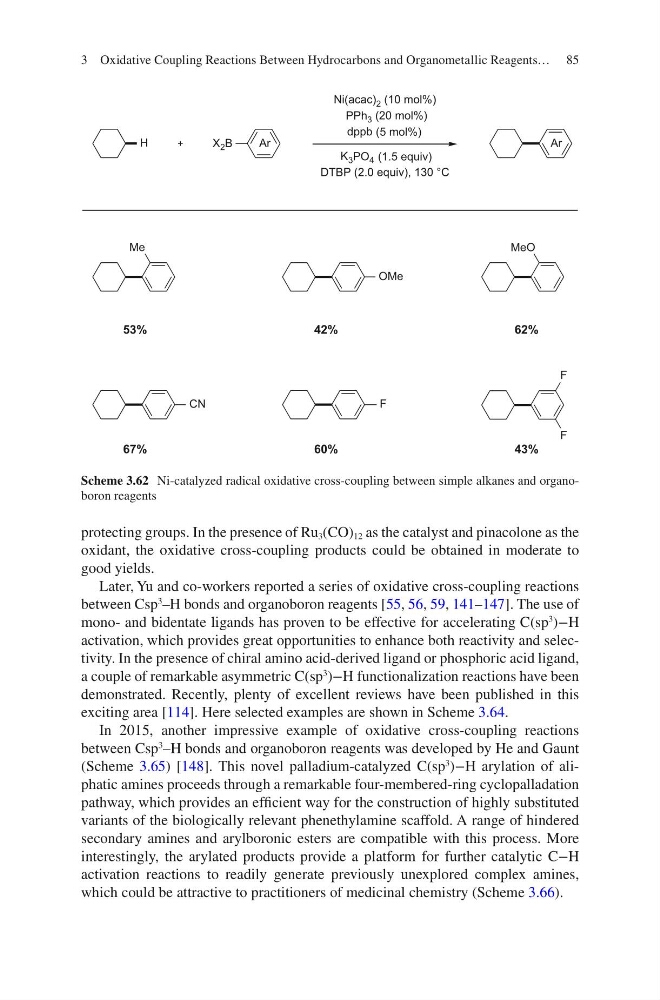
Scheme 3.62 Ni-catalyzed radical oxidative cross-coupling between simple alkanes and organoboron reagents
3 Oxidative Coupling Reactions Between Hydrocarbons and Organometallic Reagents…
protecting groups. In the presence of Ru 3 (CO) 12 as the catalyst and pinacolone as the
oxidant, the oxidative cross-coupling products could be obtained in moderate to
good yields.
Later, Yu and co-workers reported a series of oxidative cross-coupling reactions
between Csp
3
–H bonds and organoboron reagents [55, 56, 59, 141–147]. The use of
mono- and bidentate ligands has proven to be effective for accelerating C(sp
3
)−H
activation, which provides great opportunities to enhance both reactivity and selectivity. In the presence of chiral amino acid-derived ligand or phosphoric acid ligand,
a couple of remarkable asymmetric C(sp
3
)−H functionalization reactions have been
demonstrated. Recently, plenty of excellent reviews have been published in this
exciting area [114]. Here selected examples are shown in Scheme 3.64.
In 2015, another impressive example of oxidative cross-coupling reactions
between Csp
3
–H bonds and organoboron reagents was developed by He and Gaunt
(Scheme 3.65) [148]. This novel palladium-catalyzed C(sp
3
)−H arylation of aliphatic amines proceeds through a remarkable four-membered-ring cyclopalladation
pathway, which provides an efficient way for the construction of highly substituted
variants of the biologically relevant phenethylamine scaffold. A range of hindered
secondary amines and arylboronic esters are compatible with this process. More
interestingly, the arylated products provide a platform for further catalytic C−H
activation reactions to readily generate previously unexplored complex amines,
which could be attractive to practitioners of medicinal chemistry (Scheme 3.66).
X 2 B
Ni(acac) 2 (10 mol%)
PPh 3 (20 mol%)
DTBP (2.0 equiv), 130 °C
K 3 PO 4 (1.5 equiv)
53%
42%
62%
67%
60%
43%
H
dppb (5 mol%)
Ar
Ar
Me
OMe
MeO
F
CN
F
F
Scheme 3.62 Ni-catalyzed radical oxidative cross-coupling between simple alkanes and organoboron reagents
3 Oxidative Coupling Reactions Between Hydrocarbons and Organometallic Reagents…