

3
CuCl was used as catalyst; ammonia and EtOH acted as the co-solvent, under O 2
atmosphere; and phenyl acetylene transformed to 1,3-diynes. This transformation is
now called Glaser coupling. However, the term “oxidative coupling” has been rarely
used in homogeneous system during the twentieth century. Before the year of 2005,
the term oxidative coupling was majorly used in heterogeneous catalytic system for
the oxidative coupling of methane (OCM). As early as 1982, since the report by
Keller and Bhasin on the oxidative coupling of methane reaction to synthesis ethylene and ethane [7]. Subsequently, more and more attention has been paid on the
study of the catalysts’ preparation and reaction mechanism [2, 20]. It can be seen
that both the homogeneous and heterogeneous systems have been majorly focused
on the oxidative coupling between two identical nucleophiles. Those reactions can
be termed as oxidative homo-couplings. In this case, it is highly restricted on the
substrate scope. Therefore, the oxidative coupling was developed with a slow
progress.
The oxidative coupling between two different nucleophiles will obviously
enlarge the scope of nucleophiles; thus, it can broaden the type of the products.
However, the selectivity is difficult to control, for both homo-couplings and crosscouplings of two different nucleophiles may occur in one reaction system. It seemed
unreachable for achieving the selective oxidative cross-couplings. Thanks to those
early developments on the oxidative cross-couplings between two nucleophiles at
the beginning of this century. Those breakthroughs bring the light of such appealing
chemistry into the front of people. Since then, the oxidative cross-coupling between
two different nucleophiles sprung up throughout the last 10 years, due to their great
potential for green and economic synthesis as well as considerable advantages over
traditional cross-couplings, especially for those cross-couplings between two C-H
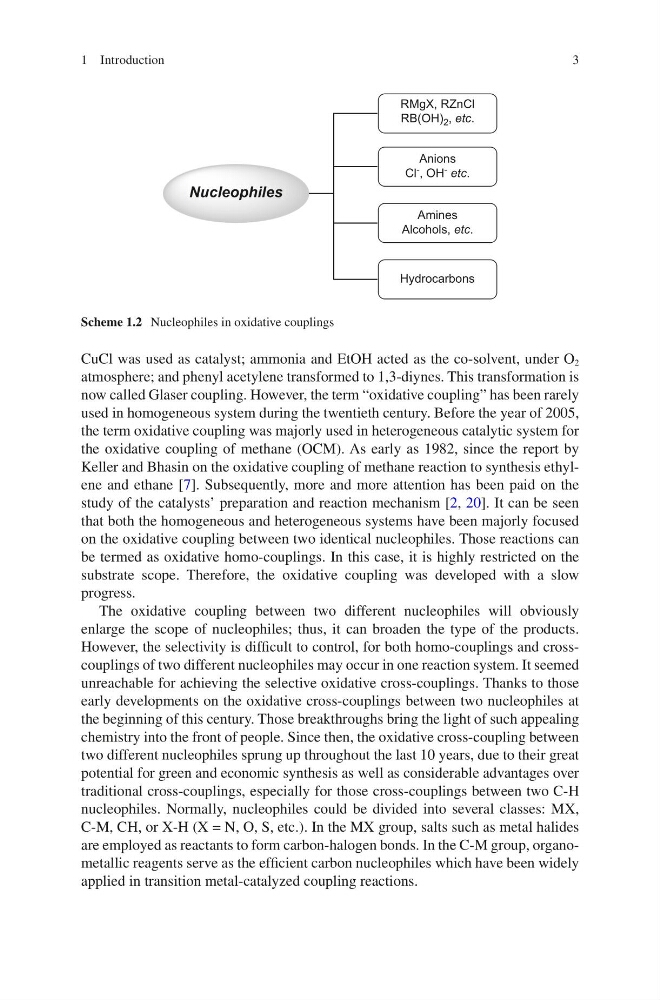
nucleophiles. Normally, nucleophiles could be divided into several classes: MX,
C-M, CH, or X-H (X = N, O, S, etc.). In the MX group, salts such as metal halides
are employed as reactants to form carbon-halogen bonds. In the C-M group, organometallic reagents serve as the efficient carbon nucleophiles which have been widely
applied in transition metal-catalyzed coupling reactions.
Nucleophiles
Anions
Cl
-
, OH
- etc.
Amines
Alcohols, etc.
RMgX, RZnCl
RB(OH) 2 , etc.
Hydrocarbons
Scheme 1.2 Nucleophiles in oxidative couplings
1 Introduction
CuCl was used as catalyst; ammonia and EtOH acted as the co-solvent, under O 2
atmosphere; and phenyl acetylene transformed to 1,3-diynes. This transformation is
now called Glaser coupling. However, the term “oxidative coupling” has been rarely
used in homogeneous system during the twentieth century. Before the year of 2005,
the term oxidative coupling was majorly used in heterogeneous catalytic system for
the oxidative coupling of methane (OCM). As early as 1982, since the report by
Keller and Bhasin on the oxidative coupling of methane reaction to synthesis ethylene and ethane [7]. Subsequently, more and more attention has been paid on the
study of the catalysts’ preparation and reaction mechanism [2, 20]. It can be seen
that both the homogeneous and heterogeneous systems have been majorly focused
on the oxidative coupling between two identical nucleophiles. Those reactions can
be termed as oxidative homo-couplings. In this case, it is highly restricted on the
substrate scope. Therefore, the oxidative coupling was developed with a slow
progress.
The oxidative coupling between two different nucleophiles will obviously
enlarge the scope of nucleophiles; thus, it can broaden the type of the products.
However, the selectivity is difficult to control, for both homo-couplings and crosscouplings of two different nucleophiles may occur in one reaction system. It seemed
unreachable for achieving the selective oxidative cross-couplings. Thanks to those
early developments on the oxidative cross-couplings between two nucleophiles at
the beginning of this century. Those breakthroughs bring the light of such appealing
chemistry into the front of people. Since then, the oxidative cross-coupling between
two different nucleophiles sprung up throughout the last 10 years, due to their great
potential for green and economic synthesis as well as considerable advantages over
traditional cross-couplings, especially for those cross-couplings between two C-H
nucleophiles. Normally, nucleophiles could be divided into several classes: MX,
C-M, CH, or X-H (X = N, O, S, etc.). In the MX group, salts such as metal halides
are employed as reactants to form carbon-halogen bonds. In the C-M group, organometallic reagents serve as the efficient carbon nucleophiles which have been widely
applied in transition metal-catalyzed coupling reactions.
Nucleophiles
Anions
Cl
-
, OH
- etc.
Amines
Alcohols, etc.
RMgX, RZnCl
RB(OH) 2 , etc.
Hydrocarbons
Scheme 1.2 Nucleophiles in oxidative couplings
1 Introduction