

4
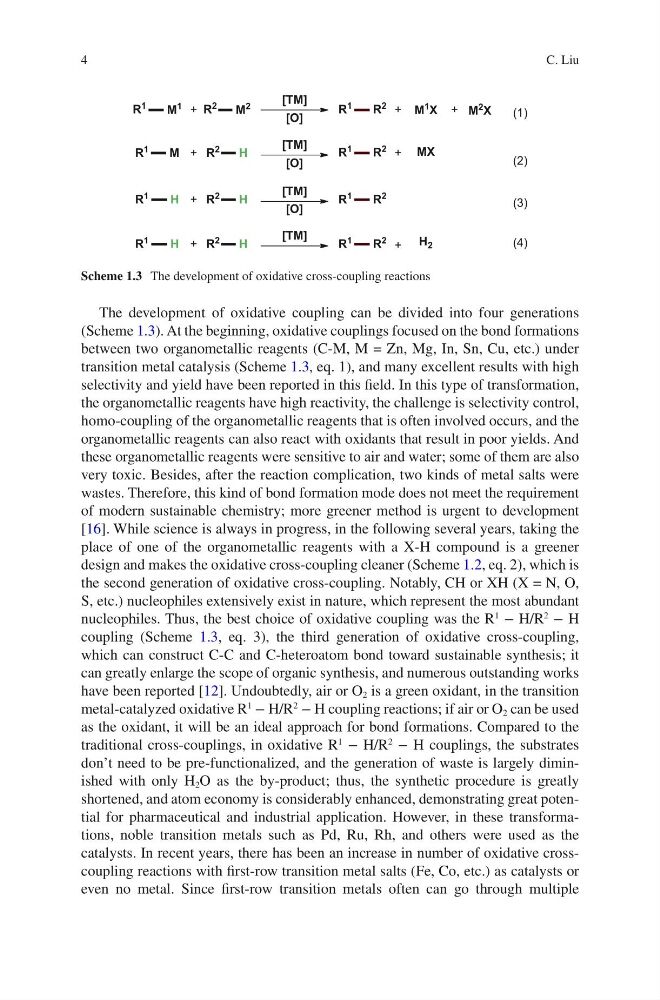
The development of oxidative coupling can be divided into four generations
(Scheme 1.3). At the beginning, oxidative couplings focused on the bond formations
between two organometallic reagents (C-M, M = Zn, Mg, In, Sn, Cu, etc.) under
transition metal catalysis (Scheme 1.3, eq. 1), and many excellent results with high
selectivity and yield have been reported in this field. In this type of transformation,
the organometallic reagents have high reactivity, the challenge is selectivity control,
homo-coupling of the organometallic reagents that is often involved occurs, and the
organometallic reagents can also react with oxidants that result in poor yields. And
these organometallic reagents were sensitive to air and water; some of them are also
very toxic. Besides, after the reaction complication, two kinds of metal salts were
wastes. Therefore, this kind of bond formation mode does not meet the requirement
of modern sustainable chemistry; more greener method is urgent to development
[16]. While science is always in progress, in the following several years, taking the
place of one of the organometallic reagents with a X-H compound is a greener
design and makes the oxidative cross-coupling cleaner (Scheme 1.2, eq. 2), which is
the second generation of oxidative cross-coupling. Notably, CH or XH (X = N, O,
S, etc.) nucleophiles extensively exist in nature, which represent the most abundant
nucleophiles. Thus, the best choice of oxidative coupling was the R
1
− H/R
2
− H
coupling (Scheme 1.3, eq. 3), the third generation of oxidative cross-coupling,
which can construct C-C and C-heteroatom bond toward sustainable synthesis; it
can greatly enlarge the scope of organic synthesis, and numerous outstanding works
have been reported [12]. Undoubtedly, air or O 2 is a green oxidant, in the transition
metal-catalyzed oxidative R
1
− H/R
2
− H coupling reactions; if air or O 2 can be used
as the oxidant, it will be an ideal approach for bond formations. Compared to the
traditional cross-couplings, in oxidative R
1
− H/R
2
− H couplings, the substrates
don’t need to be pre-functionalized, and the generation of waste is largely diminished with only H 2 O as the by-product; thus, the synthetic procedure is greatly
shortened, and atom economy is considerably enhanced, demonstrating great potential for pharmaceutical and industrial application. However, in these transformations, noble transition metals such as Pd, Ru, Rh, and others were used as the
catalysts. In recent years, there has been an increase in number of oxidative crosscoupling reactions with first-row transition metal salts (Fe, Co, etc.) as catalysts or
even no metal. Since first-row transition metals often can go through multiple
M
1 +
M
2
+ M
1
X
M
2
X
+
M +
H
+ MX
H +
H
[O]
[O]
[O]
(4)
(3)
(2)
(1)
H 2
H + R
2
R
1
R
1
R
1
R
2
R
2
R
2
R
1
H
R
1
R
2
R
1
R
2
R
1
R
2
R
1
R
2
[TM]
[TM]
[TM]
[TM]
+
Scheme 1.3 The development of oxidative cross-coupling reactions
C. Liu
The development of oxidative coupling can be divided into four generations
(Scheme 1.3). At the beginning, oxidative couplings focused on the bond formations
between two organometallic reagents (C-M, M = Zn, Mg, In, Sn, Cu, etc.) under
transition metal catalysis (Scheme 1.3, eq. 1), and many excellent results with high
selectivity and yield have been reported in this field. In this type of transformation,
the organometallic reagents have high reactivity, the challenge is selectivity control,
homo-coupling of the organometallic reagents that is often involved occurs, and the
organometallic reagents can also react with oxidants that result in poor yields. And
these organometallic reagents were sensitive to air and water; some of them are also
very toxic. Besides, after the reaction complication, two kinds of metal salts were
wastes. Therefore, this kind of bond formation mode does not meet the requirement
of modern sustainable chemistry; more greener method is urgent to development
[16]. While science is always in progress, in the following several years, taking the
place of one of the organometallic reagents with a X-H compound is a greener
design and makes the oxidative cross-coupling cleaner (Scheme 1.2, eq. 2), which is
the second generation of oxidative cross-coupling. Notably, CH or XH (X = N, O,
S, etc.) nucleophiles extensively exist in nature, which represent the most abundant
nucleophiles. Thus, the best choice of oxidative coupling was the R
1
− H/R
2
− H
coupling (Scheme 1.3, eq. 3), the third generation of oxidative cross-coupling,
which can construct C-C and C-heteroatom bond toward sustainable synthesis; it
can greatly enlarge the scope of organic synthesis, and numerous outstanding works
have been reported [12]. Undoubtedly, air or O 2 is a green oxidant, in the transition
metal-catalyzed oxidative R
1
− H/R
2
− H coupling reactions; if air or O 2 can be used
as the oxidant, it will be an ideal approach for bond formations. Compared to the
traditional cross-couplings, in oxidative R
1
− H/R
2
− H couplings, the substrates
don’t need to be pre-functionalized, and the generation of waste is largely diminished with only H 2 O as the by-product; thus, the synthetic procedure is greatly
shortened, and atom economy is considerably enhanced, demonstrating great potential for pharmaceutical and industrial application. However, in these transformations, noble transition metals such as Pd, Ru, Rh, and others were used as the
catalysts. In recent years, there has been an increase in number of oxidative crosscoupling reactions with first-row transition metal salts (Fe, Co, etc.) as catalysts or
even no metal. Since first-row transition metals often can go through multiple
M
1 +
M
2
+ M
1
X
M
2
X
+
M +
H
+ MX
H +
H
[O]
[O]
[O]
(4)
(3)
(2)
(1)
H 2
H + R
2
R
1
R
1
R
1
R
2
R
2
R
2
R
1
H
R
1
R
2
R
1
R
2
R
1
R
2
R
1
R
2
[TM]
[TM]
[TM]
[TM]
+
Scheme 1.3 The development of oxidative cross-coupling reactions
C. Liu