

5
chemical valence changes, those oxidative cross-couplings can involve single-electron transfer processes. Radical oxidative coupling reactions represent a promising
development in green chemistry [11]. Recently, an external oxidant-free oxidative
coupling was developed, which no oxidant was needed and only H 2 was generated
as a side product (Scheme 1.3, eq. 4), which could be called the fourth-generation
oxidative coupling reactions. In this transformation, no oxidants and proton acceptors were applied as the sacrificial reagents, with no wasteful by-products or oxidation side reactions. This was no doubt the most ideal mode to construct C-C and
C-heteroatom bond. The field holds significant potential for the applications to a
series of organic reactions, and scientists paid more and more attention on this field.
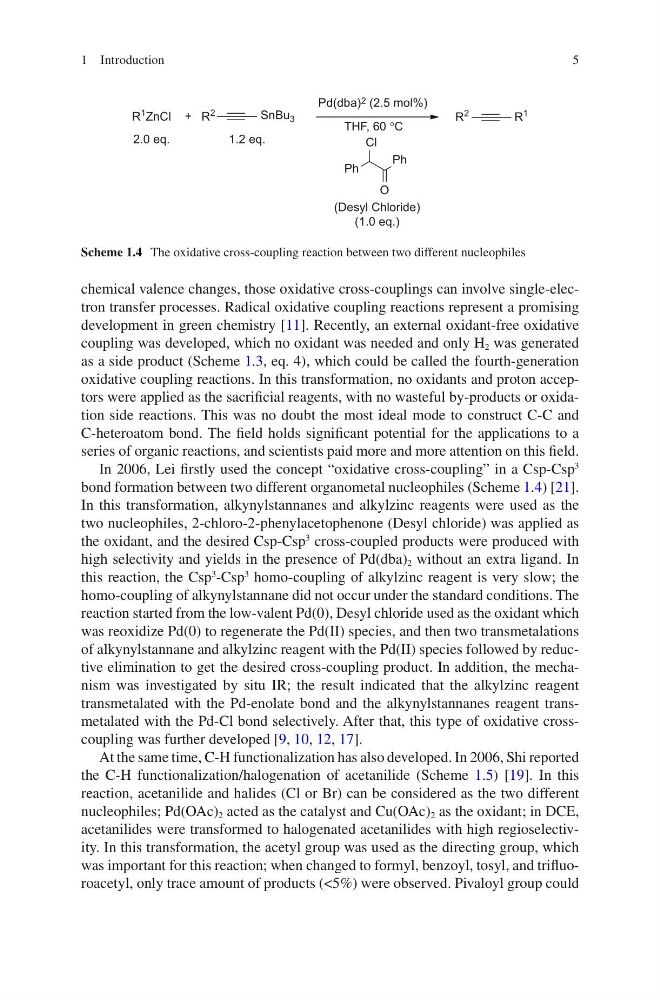
In 2006, Lei firstly used the concept “oxidative cross-coupling” in a Csp-Csp
3
bond formation between two different organometal nucleophiles (Scheme 1.4) [21].
In this transformation, alkynylstannanes and alkylzinc reagents were used as the
two nucleophiles, 2-chloro-2-phenylacetophenone (Desyl chloride) was applied as
the oxidant, and the desired Csp-Csp
3
cross-coupled products were produced with
high selectivity and yields in the presence of Pd(dba) 2 without an extra ligand. In
this reaction, the Csp
3
-Csp
3
homo-coupling of alkylzinc reagent is very slow; the
homo- coupling of alkynylstannane did not occur under the standard conditions. The
reaction started from the low-valent Pd(0), Desyl chloride used as the oxidant which
was reoxidize Pd(0) to regenerate the Pd(II) species, and then two transmetalations
of alkynylstannane and alkylzinc reagent with the Pd(II) species followed by reductive elimination to get the desired cross-coupling product. In addition, the mechanism was investigated by situ IR; the result indicated that the alkylzinc reagent
transmetalated with the Pd-enolate bond and the alkynylstannanes reagent transmetalated with the Pd-Cl bond selectively. After that, this type of oxidative crosscoupling was further developed [9, 10, 12, 17].
At the same time, C-H functionalization has also developed. In 2006, Shi reported
the C-H functionalization/halogenation of acetanilide (Scheme 1.5) [19]. In this
reaction, acetanilide and halides (Cl or Br) can be considered as the two different
nucleophiles; Pd(OAc) 2 acted as the catalyst and Cu(OAc) 2 as the oxidant; in DCE,
acetanilides were transformed to halogenated acetanilides with high regioselectivity. In this transformation, the acetyl group was used as the directing group, which
was important for this reaction; when changed to formyl, benzoyl, tosyl, and trifluoroacetyl, only trace amount of products (<5%) were observed. Pivaloyl group could
R
1
ZnCl + R
2
SnBu 3
Pd(dba) 2 (2.5 mol%)
THF, 60 °C
Ph
Cl
Ph
O
(Desyl Chloride)
(1.0 eq.)
1.2 eq.
2.0 eq.
R
2
R
1
Scheme 1.4 The oxidative cross-coupling reaction between two different nucleophiles
1 Introduction
chemical valence changes, those oxidative cross-couplings can involve single-electron transfer processes. Radical oxidative coupling reactions represent a promising
development in green chemistry [11]. Recently, an external oxidant-free oxidative
coupling was developed, which no oxidant was needed and only H 2 was generated
as a side product (Scheme 1.3, eq. 4), which could be called the fourth-generation
oxidative coupling reactions. In this transformation, no oxidants and proton acceptors were applied as the sacrificial reagents, with no wasteful by-products or oxidation side reactions. This was no doubt the most ideal mode to construct C-C and
C-heteroatom bond. The field holds significant potential for the applications to a
series of organic reactions, and scientists paid more and more attention on this field.
In 2006, Lei firstly used the concept “oxidative cross-coupling” in a Csp-Csp
3
bond formation between two different organometal nucleophiles (Scheme 1.4) [21].
In this transformation, alkynylstannanes and alkylzinc reagents were used as the
two nucleophiles, 2-chloro-2-phenylacetophenone (Desyl chloride) was applied as
the oxidant, and the desired Csp-Csp
3
cross-coupled products were produced with
high selectivity and yields in the presence of Pd(dba) 2 without an extra ligand. In
this reaction, the Csp
3
-Csp
3
homo-coupling of alkylzinc reagent is very slow; the
homo- coupling of alkynylstannane did not occur under the standard conditions. The
reaction started from the low-valent Pd(0), Desyl chloride used as the oxidant which
was reoxidize Pd(0) to regenerate the Pd(II) species, and then two transmetalations
of alkynylstannane and alkylzinc reagent with the Pd(II) species followed by reductive elimination to get the desired cross-coupling product. In addition, the mechanism was investigated by situ IR; the result indicated that the alkylzinc reagent
transmetalated with the Pd-enolate bond and the alkynylstannanes reagent transmetalated with the Pd-Cl bond selectively. After that, this type of oxidative crosscoupling was further developed [9, 10, 12, 17].
At the same time, C-H functionalization has also developed. In 2006, Shi reported
the C-H functionalization/halogenation of acetanilide (Scheme 1.5) [19]. In this
reaction, acetanilide and halides (Cl or Br) can be considered as the two different
nucleophiles; Pd(OAc) 2 acted as the catalyst and Cu(OAc) 2 as the oxidant; in DCE,
acetanilides were transformed to halogenated acetanilides with high regioselectivity. In this transformation, the acetyl group was used as the directing group, which
was important for this reaction; when changed to formyl, benzoyl, tosyl, and trifluoroacetyl, only trace amount of products (<5%) were observed. Pivaloyl group could
R
1
ZnCl + R
2
SnBu 3
Pd(dba) 2 (2.5 mol%)
THF, 60 °C
Ph
Cl
Ph
O
(Desyl Chloride)
(1.0 eq.)
1.2 eq.
2.0 eq.
R
2
R
1
Scheme 1.4 The oxidative cross-coupling reaction between two different nucleophiles
1 Introduction