

6
be utilized as a directing group but yield with a slight decrease. In the mechanism
studies, cyclopalladation of acetanilide which has C-Pd bond could be the active
species during this catalytic cycle. Subsequently, other directing groups such as
O-alkyl oximes, carboxylic acids, 2-aryl or alkyl pyridines, oxazolines, O-methyl
hydroxamic acids, cyano, etc. and even common electron-rich (hetero)arenes without directing groups have been successfully introduced into C-H functionalization.
Even through this chemistry has been demonstrated as C-H functionalization, it is
clear that this chemistry is an oxidative cross-coupling process between two
nucleophiles.
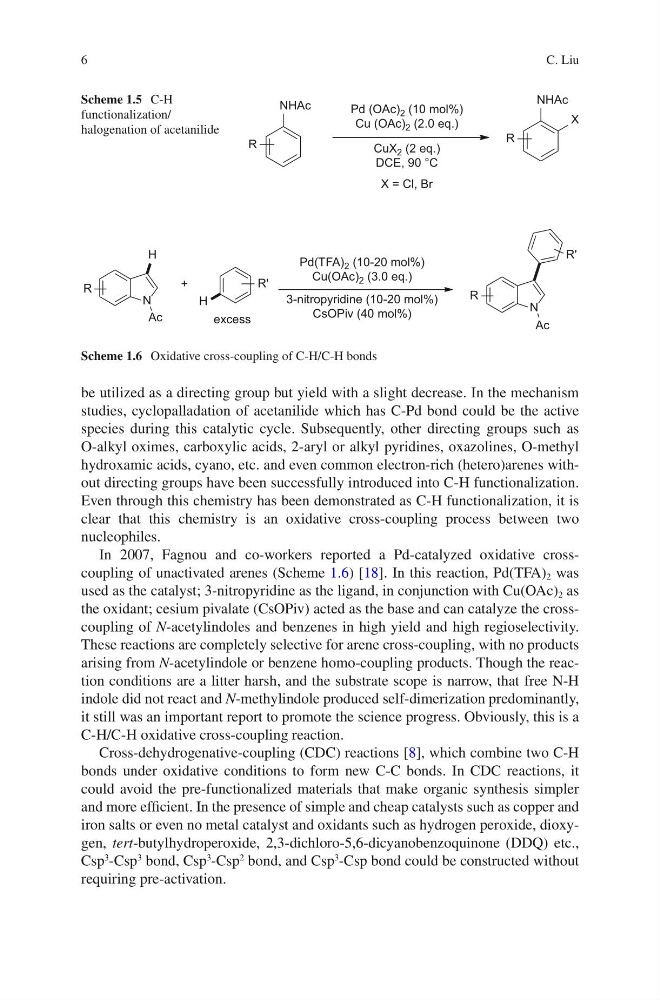
In 2007, Fagnou and co-workers reported a Pd-catalyzed oxidative crosscoupling of unactivated arenes (Scheme 1.6) [18]. In this reaction, Pd(TFA) 2 was
used as the catalyst; 3-nitropyridine as the ligand, in conjunction with Cu(OAc) 2 as
the oxidant; cesium pivalate (CsOPiv) acted as the base and can catalyze the crosscoupling of N-acetylindoles and benzenes in high yield and high regioselectivity.
These reactions are completely selective for arene cross-coupling, with no products
arising from N-acetylindole or benzene homo-coupling products. Though the reaction conditions are a litter harsh, and the substrate scope is narrow, that free N-H
indole did not react and N-methylindole produced self-dimerization predominantly,
it still was an important report to promote the science progress. Obviously, this is a
C-H/C-H oxidative cross-coupling reaction.
Cross-dehydrogenative-coupling (CDC) reactions [8], which combine two C-H
bonds under oxidative conditions to form new C-C bonds. In CDC reactions, it
could avoid the pre-functionalized materials that make organic synthesis simpler
and more efficient. In the presence of simple and cheap catalysts such as copper and
iron salts or even no metal catalyst and oxidants such as hydrogen peroxide, dioxygen, tert-butylhydroperoxide, 2,3-dichloro-5,6-dicyanobenzoquinone (DDQ) etc.,
Csp
3
-Csp
3
bond, Csp
3
-Csp
2
bond, and Csp
3
-Csp bond could be constructed without
requiring pre-activation.
NHAc
R
Pd (OAc) 2 (10 mol%)
Cu (OAc) 2 (2.0 eq.)
NHAc
R
X
X = Cl, Br
CuX 2 (2 eq.)
DCE, 90 °C
Scheme 1.5 C-H
functionalization/
halogenation of acetanilide
N
H
Ac
R
+
H
R'
excess
Pd(TFA) 2 (10-20 mol%)
Cu(OAc) 2 (3.0 eq.)
3-nitropyridine (10-20 mol%)
CsOPiv (40 mol%)
N
Ac
R
R'
Scheme 1.6 Oxidative cross-coupling of C-H/C-H bonds
C. Liu
be utilized as a directing group but yield with a slight decrease. In the mechanism
studies, cyclopalladation of acetanilide which has C-Pd bond could be the active
species during this catalytic cycle. Subsequently, other directing groups such as
O-alkyl oximes, carboxylic acids, 2-aryl or alkyl pyridines, oxazolines, O-methyl
hydroxamic acids, cyano, etc. and even common electron-rich (hetero)arenes without directing groups have been successfully introduced into C-H functionalization.
Even through this chemistry has been demonstrated as C-H functionalization, it is
clear that this chemistry is an oxidative cross-coupling process between two
nucleophiles.
In 2007, Fagnou and co-workers reported a Pd-catalyzed oxidative crosscoupling of unactivated arenes (Scheme 1.6) [18]. In this reaction, Pd(TFA) 2 was
used as the catalyst; 3-nitropyridine as the ligand, in conjunction with Cu(OAc) 2 as
the oxidant; cesium pivalate (CsOPiv) acted as the base and can catalyze the crosscoupling of N-acetylindoles and benzenes in high yield and high regioselectivity.
These reactions are completely selective for arene cross-coupling, with no products
arising from N-acetylindole or benzene homo-coupling products. Though the reaction conditions are a litter harsh, and the substrate scope is narrow, that free N-H
indole did not react and N-methylindole produced self-dimerization predominantly,
it still was an important report to promote the science progress. Obviously, this is a
C-H/C-H oxidative cross-coupling reaction.
Cross-dehydrogenative-coupling (CDC) reactions [8], which combine two C-H
bonds under oxidative conditions to form new C-C bonds. In CDC reactions, it
could avoid the pre-functionalized materials that make organic synthesis simpler
and more efficient. In the presence of simple and cheap catalysts such as copper and
iron salts or even no metal catalyst and oxidants such as hydrogen peroxide, dioxygen, tert-butylhydroperoxide, 2,3-dichloro-5,6-dicyanobenzoquinone (DDQ) etc.,
Csp
3
-Csp
3
bond, Csp
3
-Csp
2
bond, and Csp
3
-Csp bond could be constructed without
requiring pre-activation.
NHAc
R
Pd (OAc) 2 (10 mol%)
Cu (OAc) 2 (2.0 eq.)
NHAc
R
X
X = Cl, Br
CuX 2 (2 eq.)
DCE, 90 °C
Scheme 1.5 C-H
functionalization/
halogenation of acetanilide
N
H
Ac
R
+
H
R'
excess
Pd(TFA) 2 (10-20 mol%)
Cu(OAc) 2 (3.0 eq.)
3-nitropyridine (10-20 mol%)
CsOPiv (40 mol%)
N
Ac
R
R'
Scheme 1.6 Oxidative cross-coupling of C-H/C-H bonds
C. Liu