

7
It can be seen that oxidative cross-couplings and C-H functionalization are two
different concepts. However, they have overlaps and differences on the topic of
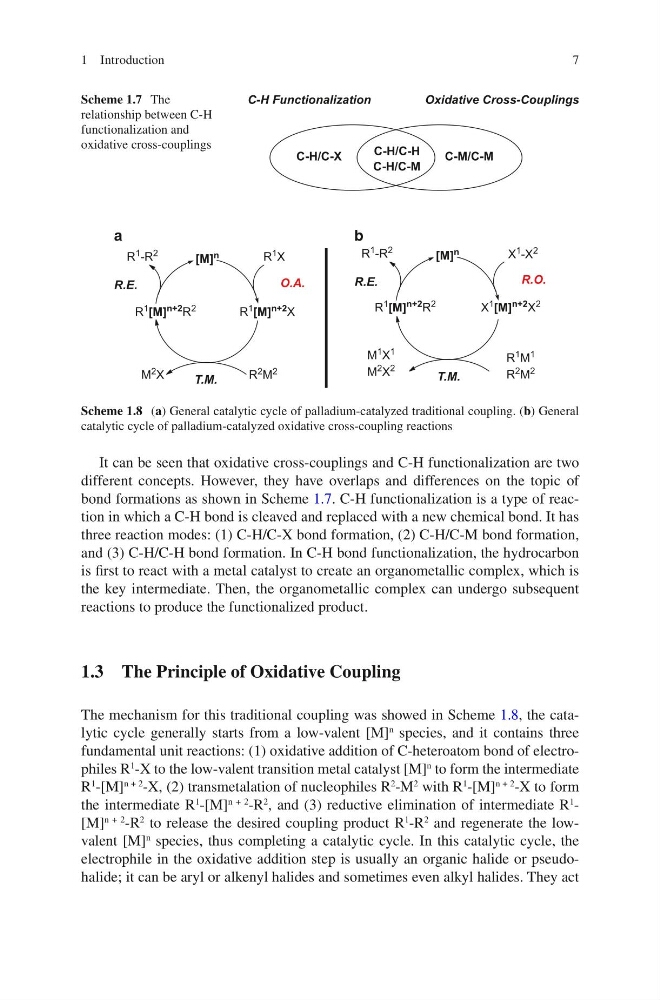
bond formations as shown in Scheme 1.7. C-H functionalization is a type of reaction in which a C-H bond is cleaved and replaced with a new chemical bond. It has
three reaction modes: (1) C-H/C-X bond formation, (2) C-H/C-M bond formation,
and (3) C-H/C-H bond formation. In C-H bond functionalization, the hydrocarbon
is first to react with a metal catalyst to create an organometallic complex, which is
the key intermediate. Then, the organometallic complex can undergo subsequent
reactions to produce the functionalized product.
1.3 The Principle of Oxidative Coupling
The mechanism for this traditional coupling was showed in Scheme 1.8, the catalytic cycle generally starts from a low-valent [M]
n
species, and it contains three
fundamental unit reactions: (1) oxidative addition of C-heteroatom bond of electrophiles R
1
-X to the low-valent transition metal catalyst [M]
n
to form the intermediate
R
1
-[M]
n + 2
-X, (2) transmetalation of nucleophiles R
2
-M
2
with R
1
-[M]
n + 2
-X to form
the intermediate R
1
-[M]
n + 2
-R
2
, and (3) reductive elimination of intermediate R
1
-
[M]
n + 2
-R
2
to release the desired coupling product R
1
-R
2
and regenerate the lowvalent [M]
n
species, thus completing a catalytic cycle. In this catalytic cycle, the
electrophile in the oxidative addition step is usually an organic halide or pseudohalide; it can be aryl or alkenyl halides and sometimes even alkyl halides. They act
C-H/C-H
C-H/C-M
C-H/C-X
C-M/C-M
C-H Functionalization
Oxidative Cross-Couplings
Scheme 1.7 The
relationship between C-H
functionalization and
oxidative cross-couplings
R
1
X
X
1
-X
2
R
1
[M]
n+2
X
R
1
[M]
n+2
R
2
X
1
[M]
n+2
X
2
R
1
[M]
n+2
R
2
R
1
-R
2
R
1
-R
2
R
2
M
2
M
2
X
M
2
X
2
R
2
M
2
R
1
M
1
M
1
X
1
O.A.
R.O.
T.M.
T.M.
R.E.
a
b
R.E.
[M]
n
[M]
n
Scheme 1.8 (a) General catalytic cycle of palladium-catalyzed traditional coupling. (b) General
catalytic cycle of palladium-catalyzed oxidative cross-coupling reactions
1 Introduction
It can be seen that oxidative cross-couplings and C-H functionalization are two
different concepts. However, they have overlaps and differences on the topic of
bond formations as shown in Scheme 1.7. C-H functionalization is a type of reaction in which a C-H bond is cleaved and replaced with a new chemical bond. It has
three reaction modes: (1) C-H/C-X bond formation, (2) C-H/C-M bond formation,
and (3) C-H/C-H bond formation. In C-H bond functionalization, the hydrocarbon
is first to react with a metal catalyst to create an organometallic complex, which is
the key intermediate. Then, the organometallic complex can undergo subsequent
reactions to produce the functionalized product.
1.3 The Principle of Oxidative Coupling
The mechanism for this traditional coupling was showed in Scheme 1.8, the catalytic cycle generally starts from a low-valent [M]
n
species, and it contains three
fundamental unit reactions: (1) oxidative addition of C-heteroatom bond of electrophiles R
1
-X to the low-valent transition metal catalyst [M]
n
to form the intermediate
R
1
-[M]
n + 2
-X, (2) transmetalation of nucleophiles R
2
-M
2
with R
1
-[M]
n + 2
-X to form
the intermediate R
1
-[M]
n + 2
-R
2
, and (3) reductive elimination of intermediate R
1
-
[M]
n + 2
-R
2
to release the desired coupling product R
1
-R
2
and regenerate the lowvalent [M]
n
species, thus completing a catalytic cycle. In this catalytic cycle, the
electrophile in the oxidative addition step is usually an organic halide or pseudohalide; it can be aryl or alkenyl halides and sometimes even alkyl halides. They act
C-H/C-H
C-H/C-M
C-H/C-X
C-M/C-M
C-H Functionalization
Oxidative Cross-Couplings
Scheme 1.7 The
relationship between C-H
functionalization and
oxidative cross-couplings
R
1
X
X
1
-X
2
R
1
[M]
n+2
X
R
1
[M]
n+2
R
2
X
1
[M]
n+2
X
2
R
1
[M]
n+2
R
2
R
1
-R
2
R
1
-R
2
R
2
M
2
M
2
X
M
2
X
2
R
2
M
2
R
1
M
1
M
1
X
1
O.A.
R.O.
T.M.
T.M.
R.E.
a
b
R.E.
[M]
n
[M]
n
Scheme 1.8 (a) General catalytic cycle of palladium-catalyzed traditional coupling. (b) General
catalytic cycle of palladium-catalyzed oxidative cross-coupling reactions
1 Introduction