

8
as an oxidant to oxidize the low-valent metal catalyst [M]
n
; at last their organic
group goes on to form part of the final cross-coupling product. As a result, no extra
oxidant is required.
In oxidative cross-coupling reactions, the general catalytic cycle could be elucidated as in Scheme 1.8 [9]. As shown in Scheme 1.8, the catalytic cycle generally
starts from a high-valent metal species X
1
-[M]
n + 2
-X
2
, which has two different leaving groups X
1
and X
2
. Consequent transmetalation of two different nucleophiles
R
1
M
1
and R
2
M
2
with the high-valent metal species X
1
-[M]
n + 2
-X
2
affords a R
1
-
[M]
n + 2
-R
2
intermediate, followed by reductive elimination to afford the desired
coupling product R
1
-R
2
and release a low-valent metal species [M]
n
. In order to
restart the catalytic cycle, a proper oxidant is needed to reoxidize [M]
n
to regenerate
the X
1
[M]
n + 2
X
2
species. From the catalytic cycle in Scheme 1.8, we can see that
both of the two nucleophiles are involved in the final product, while the oxidant only
acts as the electron acceptor to reoxidize the [M]
n
species without going into the
coupling product. In oxidative cross-coupling, both nucleophiles are electron-rich
species, and an appropriate oxidant is required to remove the extra electrons for
their chemical bond formation. Therefore,
Along with the development of oxidative cross-couplings, more and more
single- electron transfer (SET) processes become common phenomena with first
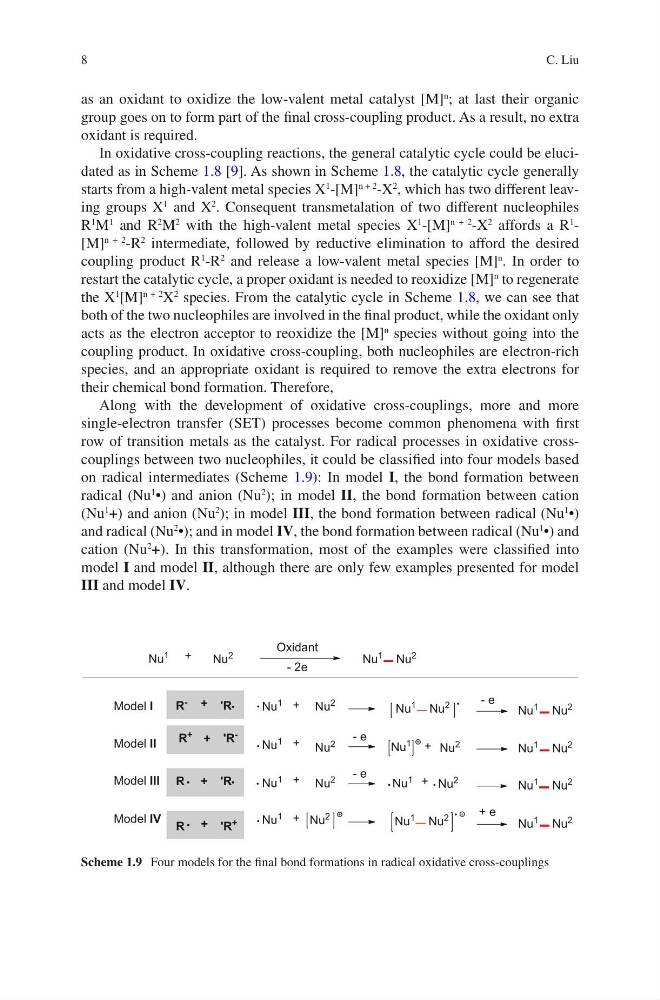
row of transition metals as the catalyst. For radical processes in oxidative crosscouplings between two nucleophiles, it could be classified into four models based
on radical intermediates (Scheme 1.9): In model I, the bond formation between
radical (Nu
1
•) and anion (Nu
2
); in model II, the bond formation between cation
(Nu
1
+) and anion (Nu
2
); in model III, the bond formation between radical (Nu
1
•)
and radical (Nu
2
•); and in model IV, the bond formation between radical (Nu
1
•) and
cation (Nu
2
+). In this transformation, most of the examples were classified into
model I and model II, although there are only few examples presented for model
III and model IV.
R
-
'R
+
R
' R
+
Nu
1
Nu
1
Nu
2
Nu
2
+
Oxidant
- 2e
Nu
2
Nu
1
Nu
1
Nu
1
Nu
1
Nu
2
Nu
2
Nu
2
+
- e
Nu
1
Nu
2
Nu
2
Nu
2
Nu
2
Nu
1
Nu
1
Nu
1
Nu
2
Nu
2
Nu
2
Nu
2
Nu
1
Nu
1
Nu
1
Nu
1
Model I
Model II
Model III
Model IV
+
- e
+
+
- e
+
+
+ e
R
+
'R
-
+
R
'R
+
+
Scheme 1.9 Four models for the final bond formations in radical oxidative cross-couplings
C. Liu
as an oxidant to oxidize the low-valent metal catalyst [M]
n
; at last their organic
group goes on to form part of the final cross-coupling product. As a result, no extra
oxidant is required.
In oxidative cross-coupling reactions, the general catalytic cycle could be elucidated as in Scheme 1.8 [9]. As shown in Scheme 1.8, the catalytic cycle generally
starts from a high-valent metal species X
1
-[M]
n + 2
-X
2
, which has two different leaving groups X
1
and X
2
. Consequent transmetalation of two different nucleophiles
R
1
M
1
and R
2
M
2
with the high-valent metal species X
1
-[M]
n + 2
-X
2
affords a R
1
-
[M]
n + 2
-R
2
intermediate, followed by reductive elimination to afford the desired
coupling product R
1
-R
2
and release a low-valent metal species [M]
n
. In order to
restart the catalytic cycle, a proper oxidant is needed to reoxidize [M]
n
to regenerate
the X
1
[M]
n + 2
X
2
species. From the catalytic cycle in Scheme 1.8, we can see that
both of the two nucleophiles are involved in the final product, while the oxidant only
acts as the electron acceptor to reoxidize the [M]
n
species without going into the
coupling product. In oxidative cross-coupling, both nucleophiles are electron-rich
species, and an appropriate oxidant is required to remove the extra electrons for
their chemical bond formation. Therefore,
Along with the development of oxidative cross-couplings, more and more
single- electron transfer (SET) processes become common phenomena with first
row of transition metals as the catalyst. For radical processes in oxidative crosscouplings between two nucleophiles, it could be classified into four models based
on radical intermediates (Scheme 1.9): In model I, the bond formation between
radical (Nu
1
•) and anion (Nu
2
); in model II, the bond formation between cation
(Nu
1
+) and anion (Nu
2
); in model III, the bond formation between radical (Nu
1
•)
and radical (Nu
2
•); and in model IV, the bond formation between radical (Nu
1
•) and
cation (Nu
2
+). In this transformation, most of the examples were classified into
model I and model II, although there are only few examples presented for model
III and model IV.
R
-
'R
+
R
' R
+
Nu
1
Nu
1
Nu
2
Nu
2
+
Oxidant
- 2e
Nu
2
Nu
1
Nu
1
Nu
1
Nu
1
Nu
2
Nu
2
Nu
2
+
- e
Nu
1
Nu
2
Nu
2
Nu
2
Nu
2
Nu
1
Nu
1
Nu
1
Nu
2
Nu
2
Nu
2
Nu
2
Nu
1
Nu
1
Nu
1
Nu
1
Model I
Model II
Model III
Model IV
+
- e
+
+
- e
+
+
+ e
R
+
'R
-
+
R
'R
+
+
Scheme 1.9 Four models for the final bond formations in radical oxidative cross-couplings
C. Liu