

2
Therefore, new form of coupling with higher atom economy and less overall
reaction steps is highly demanding. Oxidative coupling, a concept which has been
classically used in heterogeneous system for methane conversion, was introduced in
homogeneous system for bond formations between two nucleophiles. Along with
the development of synthetic chemistry and green chemistry, oxidative coupling
reactions between two nucleophiles can meet the requirement of current development of chemical science; due to that both nucleophiles can be accessible from C-H,
N-H, O-H, etc. compounds which are widely available.
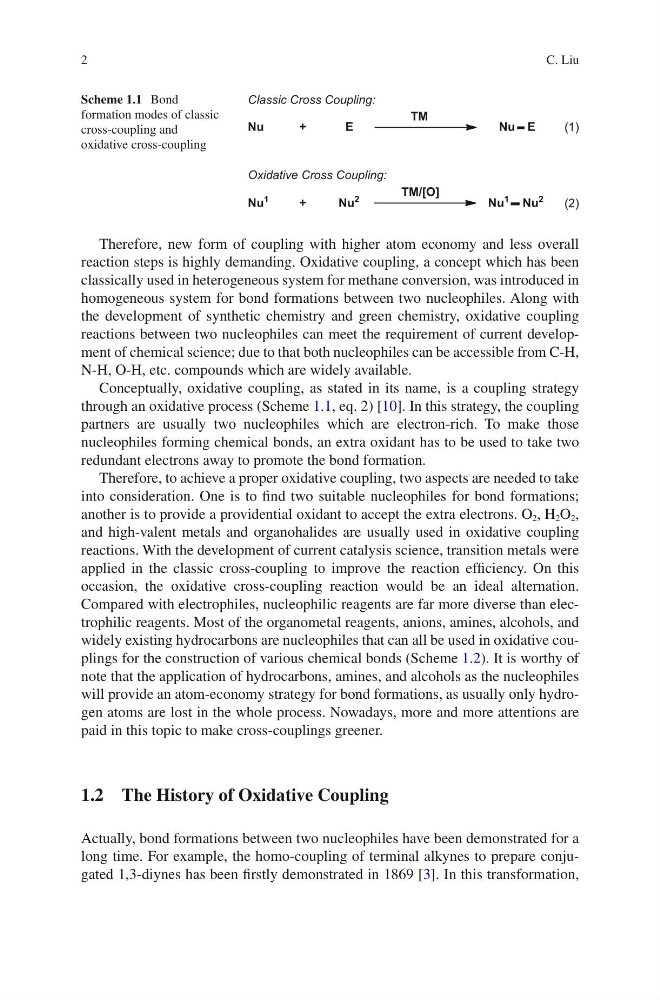
Conceptually, oxidative coupling, as stated in its name, is a coupling strategy
through an oxidative process (Scheme 1.1, eq. 2) [10]. In this strategy, the coupling
partners are usually two nucleophiles which are electron-rich. To make those
nucleophiles forming chemical bonds, an extra oxidant has to be used to take two
redundant electrons away to promote the bond formation.
Therefore, to achieve a proper oxidative coupling, two aspects are needed to take
into consideration. One is to find two suitable nucleophiles for bond formations;
another is to provide a providential oxidant to accept the extra electrons. O 2 , H 2 O 2 ,
and high-valent metals and organohalides are usually used in oxidative coupling
reactions. With the development of current catalysis science, transition metals were
applied in the classic cross-coupling to improve the reaction efficiency. On this
occasion, the oxidative cross-coupling reaction would be an ideal alternation.
Compared with electrophiles, nucleophilic reagents are far more diverse than electrophilic reagents. Most of the organometal reagents, anions, amines, alcohols, and
widely existing hydrocarbons are nucleophiles that can all be used in oxidative couplings for the construction of various chemical bonds (Scheme 1.2). It is worthy of
note that the application of hydrocarbons, amines, and alcohols as the nucleophiles
will provide an atom-economy strategy for bond formations, as usually only hydrogen atoms are lost in the whole process. Nowadays, more and more attentions are
paid in this topic to make cross-couplings greener.
1.2 The History of Oxidative Coupling
Actually, bond formations between two nucleophiles have been demonstrated for a
long time. For example, the homo-coupling of terminal alkynes to prepare conjugated 1,3-diynes has been firstly demonstrated in 1869 [3]. In this transformation,
Nu
+
E
TM
Nu E
(1)
Classic Cross Coupling:
Oxidative Cross Coupling:
Nu
1
+
N u
2
TM/[O]
Nu
1
Nu
2
(2)
Scheme 1.1 Bond
formation modes of classic
cross- coupling and
oxidative cross-coupling
C. Liu
Therefore, new form of coupling with higher atom economy and less overall
reaction steps is highly demanding. Oxidative coupling, a concept which has been
classically used in heterogeneous system for methane conversion, was introduced in
homogeneous system for bond formations between two nucleophiles. Along with
the development of synthetic chemistry and green chemistry, oxidative coupling
reactions between two nucleophiles can meet the requirement of current development of chemical science; due to that both nucleophiles can be accessible from C-H,
N-H, O-H, etc. compounds which are widely available.
Conceptually, oxidative coupling, as stated in its name, is a coupling strategy
through an oxidative process (Scheme 1.1, eq. 2) [10]. In this strategy, the coupling
partners are usually two nucleophiles which are electron-rich. To make those
nucleophiles forming chemical bonds, an extra oxidant has to be used to take two
redundant electrons away to promote the bond formation.
Therefore, to achieve a proper oxidative coupling, two aspects are needed to take
into consideration. One is to find two suitable nucleophiles for bond formations;
another is to provide a providential oxidant to accept the extra electrons. O 2 , H 2 O 2 ,
and high-valent metals and organohalides are usually used in oxidative coupling
reactions. With the development of current catalysis science, transition metals were
applied in the classic cross-coupling to improve the reaction efficiency. On this
occasion, the oxidative cross-coupling reaction would be an ideal alternation.
Compared with electrophiles, nucleophilic reagents are far more diverse than electrophilic reagents. Most of the organometal reagents, anions, amines, alcohols, and
widely existing hydrocarbons are nucleophiles that can all be used in oxidative couplings for the construction of various chemical bonds (Scheme 1.2). It is worthy of
note that the application of hydrocarbons, amines, and alcohols as the nucleophiles
will provide an atom-economy strategy for bond formations, as usually only hydrogen atoms are lost in the whole process. Nowadays, more and more attentions are
paid in this topic to make cross-couplings greener.
1.2 The History of Oxidative Coupling
Actually, bond formations between two nucleophiles have been demonstrated for a
long time. For example, the homo-coupling of terminal alkynes to prepare conjugated 1,3-diynes has been firstly demonstrated in 1869 [3]. In this transformation,
Nu
+
E
TM
Nu E
(1)
Classic Cross Coupling:
Oxidative Cross Coupling:
Nu
1
+
N u
2
TM/[O]
Nu
1
Nu
2
(2)
Scheme 1.1 Bond
formation modes of classic
cross- coupling and
oxidative cross-coupling
C. Liu