

82
tion achieves α-C–H arylation of THF or dioxane with arylboronic acids in the
presence of Ni(acac) 2 as the catalyst and DTBP as the oxidant. Notably, the condition is also suitable for Csp
3
–H bonds adjacent to a nitrogen atom such as the
N-methyl group of N,N-dimethylaniline, N,N-dimethylacetamide, and N-methyl
pyrrole, affording the desired products in moderate to good yields.
Generally, the α-C–H bonds are easily able to form their corresponding carboncentered radical through homolytic cleavage by a hydrogen abstractor, while arylboronic acids could also generate their relevant aryl radicals in the presence of
oxidant. Both radicals were trapped by adding 1,1-diphenylethene in the reaction,
clearly indicating the participation of both radicals (Scheme 3.60). However, both
aryl and THF radicals are considered to be transient radicals. It is always a challenge
N
H
Ph
(HO) 2 B
CuBr (20 mol%)
TBHP (1.6 equiv)
DME, 95 °C
or
CuBr (20 mol%)
TBHP (20 mol%), O 2
DME (5 mL H 2 O), 95 °C
N Ph
90%
80%
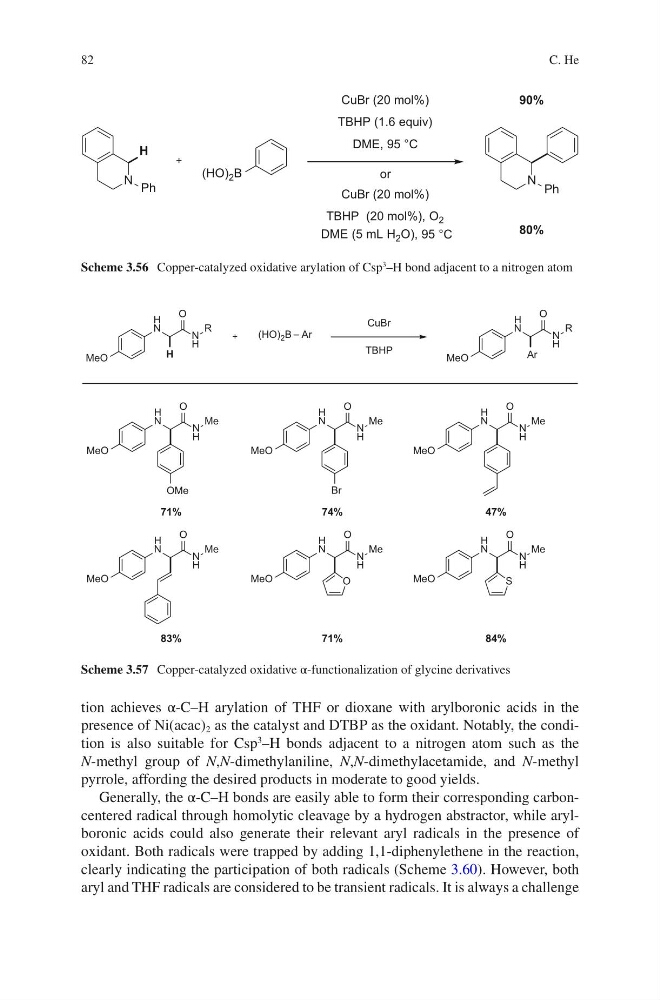
Scheme 3.56 Copper-catalyzed oxidative arylation of Csp
3
–H bond adjacent to a nitrogen atom
H
N
N
H
O
R
MeO
H
(HO) 2 B Ar
CuBr
TBHP
H
N
N
H
O
R
MeO
Ar
H
N
N
H
O
Me
MeO
H
N
N
H
O
Me
MeO
H
N
N
H
O
Me
MeO
Br
OMe
71%
74%
47%
H
N
N
H
O
Me
MeO
H
N
N
H
O
Me
MeO
H
N
N
H
O
Me
MeO
83%
71%
84%
O
S
Scheme 3.57 Copper-catalyzed oxidative α-functionalization of glycine derivatives
C. He
tion achieves α-C–H arylation of THF or dioxane with arylboronic acids in the
presence of Ni(acac) 2 as the catalyst and DTBP as the oxidant. Notably, the condition is also suitable for Csp
3
–H bonds adjacent to a nitrogen atom such as the
N-methyl group of N,N-dimethylaniline, N,N-dimethylacetamide, and N-methyl
pyrrole, affording the desired products in moderate to good yields.
Generally, the α-C–H bonds are easily able to form their corresponding carboncentered radical through homolytic cleavage by a hydrogen abstractor, while arylboronic acids could also generate their relevant aryl radicals in the presence of
oxidant. Both radicals were trapped by adding 1,1-diphenylethene in the reaction,
clearly indicating the participation of both radicals (Scheme 3.60). However, both
aryl and THF radicals are considered to be transient radicals. It is always a challenge
N
H
Ph
(HO) 2 B
CuBr (20 mol%)
TBHP (1.6 equiv)
DME, 95 °C
or
CuBr (20 mol%)
TBHP (20 mol%), O 2
DME (5 mL H 2 O), 95 °C
N Ph
90%
80%
Scheme 3.56 Copper-catalyzed oxidative arylation of Csp
3
–H bond adjacent to a nitrogen atom
H
N
N
H
O
R
MeO
H
(HO) 2 B Ar
CuBr
TBHP
H
N
N
H
O
R
MeO
Ar
H
N
N
H
O
Me
MeO
H
N
N
H
O
Me
MeO
H
N
N
H
O
Me
MeO
Br
OMe
71%
74%
47%
H
N
N
H
O
Me
MeO
H
N
N
H
O
Me
MeO
H
N
N
H
O
Me
MeO
83%
71%
84%
O
S
Scheme 3.57 Copper-catalyzed oxidative α-functionalization of glycine derivatives
C. He