

81
3.4.2 Organoboron Reagents as Nucleophiles
Organoboron reagents are probably one of the most widely studied classes of
reagent to be used as coupling partners in oxidative cross-coupling reactions. This
section generally covers the development of new oxidative cross-couplings between
C(sp
3
)−H bonds and organoboron reagents in recent years by focusing on two major
types of strategies for the selective C(sp
3
)−H bond functionalization.
The first strategy is the direct functionalization of Csp
3
–H bond adjacent to a
heteroatom like N or O via radical process [133, 134]. In general, this type of
Csp
3
–H bond is relatively active, which can be in situ oxidized to produce cation
radical in the presence of copper, iron, or nickel catalysts with oxidants. Then the
formed cationic intermediate can further react with nucleophiles such as organoboron reagents to furnish the C–C bond formation.
In 2008, Li and co-workers reported the oxidative arylation of Csp
3
–H bond
adjacent to a nitrogen atom using arylboronic acid (Scheme 3.56) [135]. In this
transformation, CuBr was used as the catalyst and TBHP (70 wt % of t-butyl hydroperoxide in water), or molecular oxygen was used as the oxidant. Moreover, this
method was applied to the α-functionalization of glycine derivatives with arylboronic acids (Scheme 3.57) [136]. In the presence of 10 mol% CuBr with oxidant
TBHP, the reaction proceeded smoothly to provide the arylated glycine derivatives
in moderate to good yields. Electron-rich arylboronic acids and alkenylboronic
acids gave good results, while electron-poor arylboronic acids were ineffective.
Simple dipeptides and tripeptides also proceeded in good yields affording the corresponding arylation products (Scheme 3.58). The PMP protecting group played a
crucial role in this reaction, while other protecting groups, such as Boc, Benzyl, and
Ts, did not give any desired product.
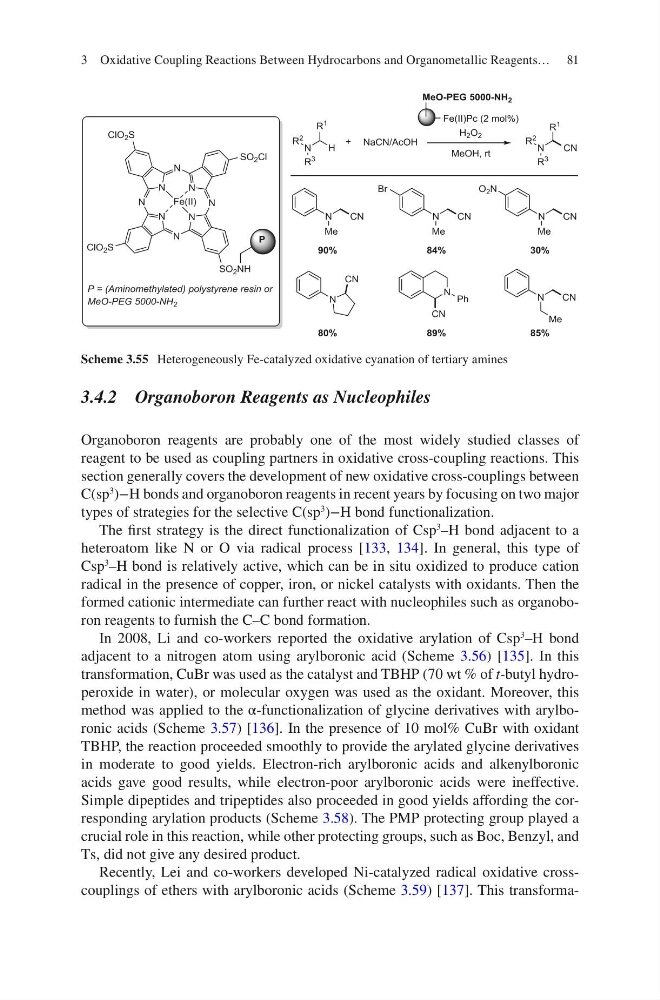
Recently, Lei and co-workers developed Ni-catalyzed radical oxidative crosscouplings of ethers with arylboronic acids (Scheme 3.59) [137]. This transformaScheme 3.55 Heterogeneously Fe-catalyzed oxidative cyanation of tertiary amines
3 Oxidative Coupling Reactions Between Hydrocarbons and Organometallic Reagents…
3.4.2 Organoboron Reagents as Nucleophiles
Organoboron reagents are probably one of the most widely studied classes of
reagent to be used as coupling partners in oxidative cross-coupling reactions. This
section generally covers the development of new oxidative cross-couplings between
C(sp
3
)−H bonds and organoboron reagents in recent years by focusing on two major
types of strategies for the selective C(sp
3
)−H bond functionalization.
The first strategy is the direct functionalization of Csp
3
–H bond adjacent to a
heteroatom like N or O via radical process [133, 134]. In general, this type of
Csp
3
–H bond is relatively active, which can be in situ oxidized to produce cation
radical in the presence of copper, iron, or nickel catalysts with oxidants. Then the
formed cationic intermediate can further react with nucleophiles such as organoboron reagents to furnish the C–C bond formation.
In 2008, Li and co-workers reported the oxidative arylation of Csp
3
–H bond
adjacent to a nitrogen atom using arylboronic acid (Scheme 3.56) [135]. In this
transformation, CuBr was used as the catalyst and TBHP (70 wt % of t-butyl hydroperoxide in water), or molecular oxygen was used as the oxidant. Moreover, this
method was applied to the α-functionalization of glycine derivatives with arylboronic acids (Scheme 3.57) [136]. In the presence of 10 mol% CuBr with oxidant
TBHP, the reaction proceeded smoothly to provide the arylated glycine derivatives
in moderate to good yields. Electron-rich arylboronic acids and alkenylboronic
acids gave good results, while electron-poor arylboronic acids were ineffective.
Simple dipeptides and tripeptides also proceeded in good yields affording the corresponding arylation products (Scheme 3.58). The PMP protecting group played a
crucial role in this reaction, while other protecting groups, such as Boc, Benzyl, and
Ts, did not give any desired product.
Recently, Lei and co-workers developed Ni-catalyzed radical oxidative crosscouplings of ethers with arylboronic acids (Scheme 3.59) [137]. This transformaScheme 3.55 Heterogeneously Fe-catalyzed oxidative cyanation of tertiary amines
3 Oxidative Coupling Reactions Between Hydrocarbons and Organometallic Reagents…