

80
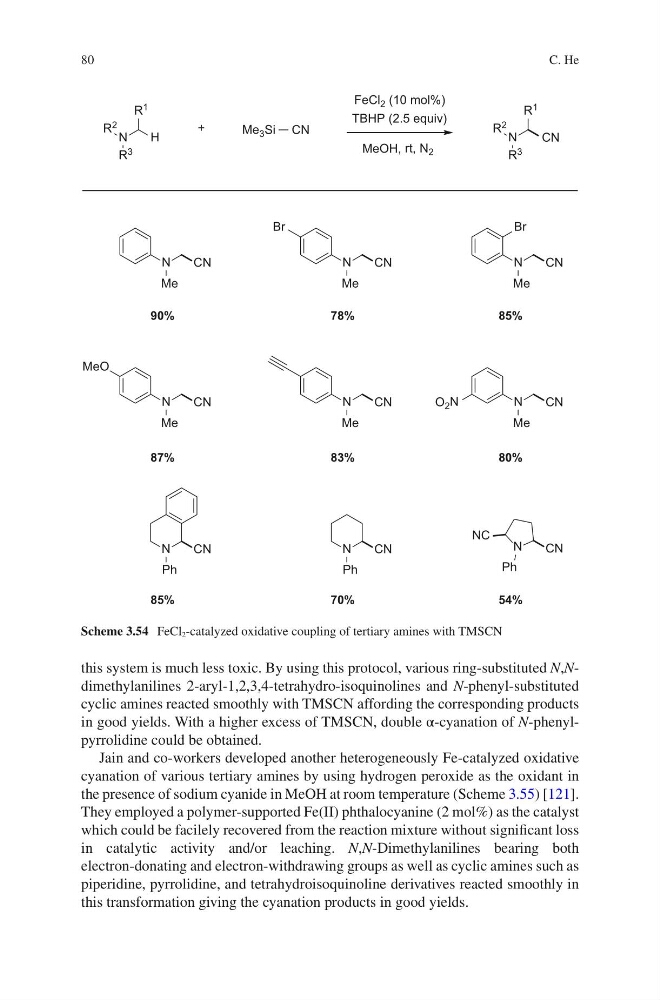
this system is much less toxic. By using this protocol, various ring-substituted N,Ndimethylanilines 2-aryl-1,2,3,4-tetrahydro-isoquinolines and N-phenyl-substituted
cyclic amines reacted smoothly with TMSCN affording the corresponding products
in good yields. With a higher excess of TMSCN, double α-cyanation of N-phenylpyrrolidine could be obtained.
Jain and co-workers developed another heterogeneously Fe-catalyzed oxidative
cyanation of various tertiary amines by using hydrogen peroxide as the oxidant in
the presence of sodium cyanide in MeOH at room temperature (Scheme 3.55) [121].
They employed a polymer-supported Fe(II) phthalocyanine (2 mol%) as the catalyst
which could be facilely recovered from the reaction mixture without significant loss
in catalytic activity and/or leaching. N,N-Dimethylanilines bearing both
electron- donating and electron-withdrawing groups as well as cyclic amines such as
piperidine, pyrrolidine, and tetrahydroisoquinoline derivatives reacted smoothly in
this transformation giving the cyanation products in good yields.
N
R 2
R 3
H
R 1
N
R 2
R 3
CN
R 1
+
FeCl 2 (10 mol%)
MeOH, rt, N 2
Me 3 Si CN
TBHP (2.5 equiv)
N
Me
CN
N
Me
CN
N
Me
CN
N
Me
CN
N
Me
CN
Br
N
Me
CN
O 2 N
90%
Br
MeO
78%
85%
87%
83%
80%
85%
70%
54%
N
CN
Ph
N
CN
Ph
N
Ph
CN
NC
Scheme 3.54 FeCl 2 -catalyzed oxidative coupling of tertiary amines with TMSCN
C. He
this system is much less toxic. By using this protocol, various ring-substituted N,Ndimethylanilines 2-aryl-1,2,3,4-tetrahydro-isoquinolines and N-phenyl-substituted
cyclic amines reacted smoothly with TMSCN affording the corresponding products
in good yields. With a higher excess of TMSCN, double α-cyanation of N-phenylpyrrolidine could be obtained.
Jain and co-workers developed another heterogeneously Fe-catalyzed oxidative
cyanation of various tertiary amines by using hydrogen peroxide as the oxidant in
the presence of sodium cyanide in MeOH at room temperature (Scheme 3.55) [121].
They employed a polymer-supported Fe(II) phthalocyanine (2 mol%) as the catalyst
which could be facilely recovered from the reaction mixture without significant loss
in catalytic activity and/or leaching. N,N-Dimethylanilines bearing both
electron- donating and electron-withdrawing groups as well as cyclic amines such as
piperidine, pyrrolidine, and tetrahydroisoquinoline derivatives reacted smoothly in
this transformation giving the cyanation products in good yields.
N
R 2
R 3
H
R 1
N
R 2
R 3
CN
R 1
+
FeCl 2 (10 mol%)
MeOH, rt, N 2
Me 3 Si CN
TBHP (2.5 equiv)
N
Me
CN
N
Me
CN
N
Me
CN
N
Me
CN
N
Me
CN
Br
N
Me
CN
O 2 N
90%
Br
MeO
78%
85%
87%
83%
80%
85%
70%
54%
N
CN
Ph
N
CN
Ph
N
Ph
CN
NC
Scheme 3.54 FeCl 2 -catalyzed oxidative coupling of tertiary amines with TMSCN
C. He