

73
Cl 2 CHCHCl 2 served as the halogen source. The author proposed a radical mechanism that a single-electron transfer from the aryl ring to the coordinated Cu(II) leading to the cation–radical intermediate is the rate-limiting step. The observed
ortho-selectivity is explained by an intramolecular anion transfer from a nitrogenbound Cu(I) complex.
Meantime, a Pd-catalyzed oxidative ortho-selective C–H chlorination and bromination of acetanilides was developed by Shi and co-workers (Scheme 3.47) [101].
Cu(OAc) 2 and copper halides were employed as the oxidant and halo resources,
respectively. The regioselectivity of chlorination of meta-substituted acetanilides was
dominated by steric effects, that only less-hindered ortho-chlorinated acetanilides
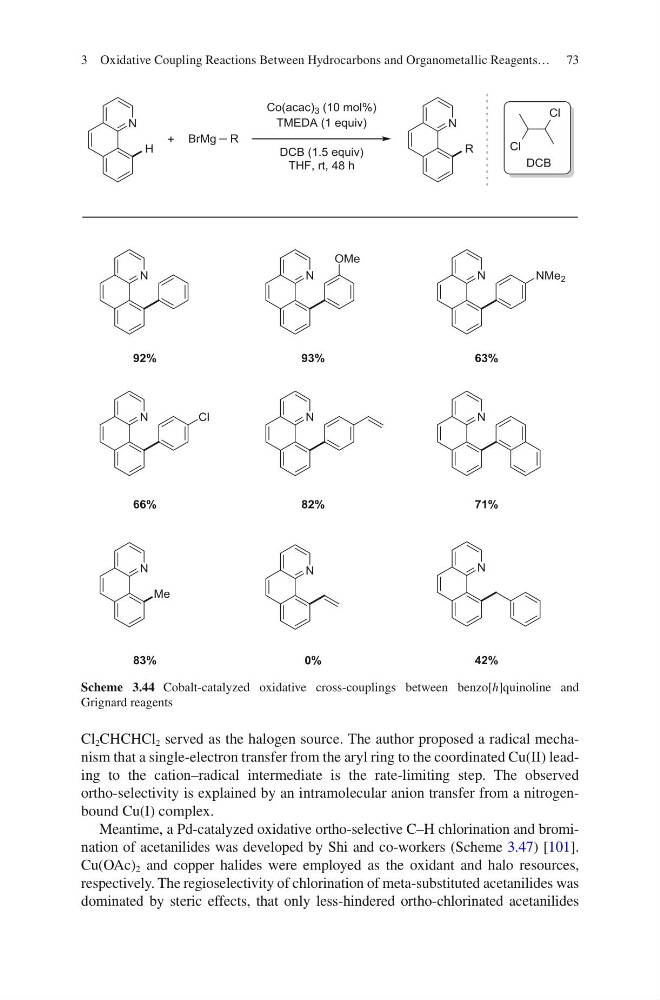
Scheme 3.44 Cobalt-catalyzed oxidative cross-couplings between benzo[h]quinoline and
Grignard reagents
3 Oxidative Coupling Reactions Between Hydrocarbons and Organometallic Reagents…
Cl 2 CHCHCl 2 served as the halogen source. The author proposed a radical mechanism that a single-electron transfer from the aryl ring to the coordinated Cu(II) leading to the cation–radical intermediate is the rate-limiting step. The observed
ortho-selectivity is explained by an intramolecular anion transfer from a nitrogenbound Cu(I) complex.
Meantime, a Pd-catalyzed oxidative ortho-selective C–H chlorination and bromination of acetanilides was developed by Shi and co-workers (Scheme 3.47) [101].
Cu(OAc) 2 and copper halides were employed as the oxidant and halo resources,
respectively. The regioselectivity of chlorination of meta-substituted acetanilides was
dominated by steric effects, that only less-hindered ortho-chlorinated acetanilides
Scheme 3.44 Cobalt-catalyzed oxidative cross-couplings between benzo[h]quinoline and
Grignard reagents
3 Oxidative Coupling Reactions Between Hydrocarbons and Organometallic Reagents…