

72
sources. However, most of these transformations require the existence of strong
electron-donating groups on the aromatic ring and display low regioselectivity [99].
In 2006, Yu and co-workers developed a Cu(II)-catalyzed aerobic oxidative
ortho-selective C–H chlorination of 2-arylpyridines (Scheme 3.46) [100].
Experimental analysis indicated that the HCl originated from the solvent
R
N
R
N
Ar
THF, rt
1-bromo-2-chloroethane
(2.0 equiv)
Fe(acac) 3 (10 mol%)
Ar 2 Zn
+
Si
Me 2
N
Si
Me 2
N
Si
Me 2
N
Me
Me
Si
Me 2
N
Si
Me 2
N
N
F
Me
89%
90%
79%
39%
54%
68%
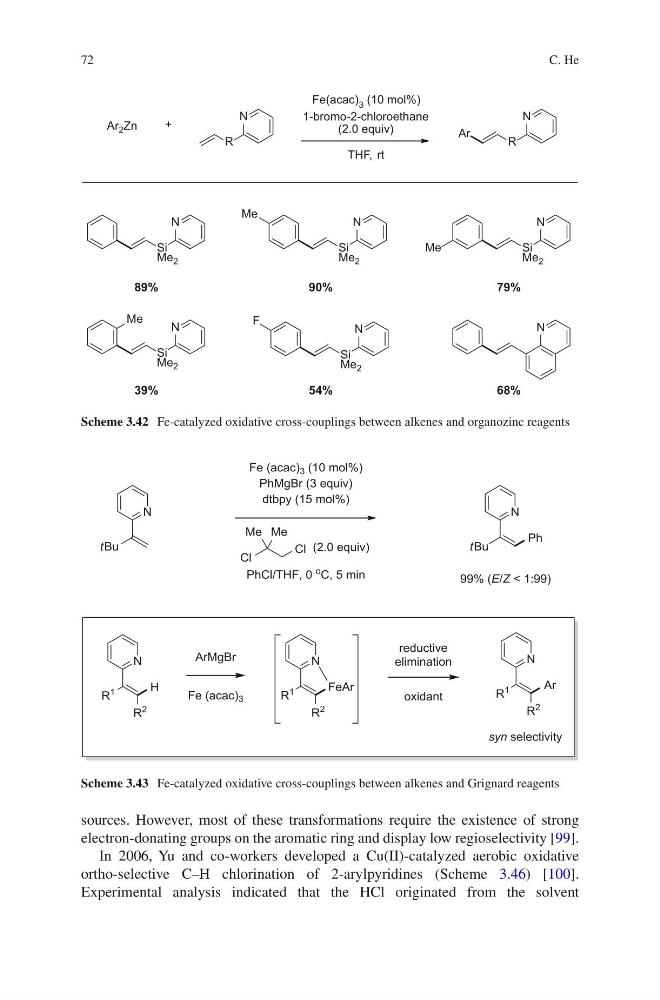
Scheme 3.42 Fe-catalyzed oxidative cross-couplings between alkenes and organozinc reagents
Scheme 3.43 Fe-catalyzed oxidative cross-couplings between alkenes and Grignard reagents
C. He
sources. However, most of these transformations require the existence of strong
electron-donating groups on the aromatic ring and display low regioselectivity [99].
In 2006, Yu and co-workers developed a Cu(II)-catalyzed aerobic oxidative
ortho-selective C–H chlorination of 2-arylpyridines (Scheme 3.46) [100].
Experimental analysis indicated that the HCl originated from the solvent
R
N
R
N
Ar
THF, rt
1-bromo-2-chloroethane
(2.0 equiv)
Fe(acac) 3 (10 mol%)
Ar 2 Zn
+
Si
Me 2
N
Si
Me 2
N
Si
Me 2
N
Me
Me
Si
Me 2
N
Si
Me 2
N
N
F
Me
89%
90%
79%
39%
54%
68%
Scheme 3.42 Fe-catalyzed oxidative cross-couplings between alkenes and organozinc reagents
Scheme 3.43 Fe-catalyzed oxidative cross-couplings between alkenes and Grignard reagents
C. He