

71
and a heteroatom nucleophile has attracted continuous interests and become one of
the most efficient tools for the construction of carbon–heteroatom bond [97, 98].
3.3.7.1 C–H and Halo–M as Nucleophiles
The oxidative halogenation of electron-rich arenes such as toluene, phenols, anisoles, and anilines has been extensively developed by employing H 2 O 2 or O 2 as oxidant and alkali halides as halogen sources in the presence of vanadium(V),
molybdenum(VI), tungsten(VI), copper(II) catalysts, etc. In addition, various
transition- metal-catalyzed aerobic oxidative halogenations of simple arenes have
also been realized, in which hydrogen halides were usually employed as halogen
PhMgBr (6.0 equiv)
THF, 0 °C
ZnCl
. TMEDA (3.0 equiv)
Fe(acac) 3 (10 mol%)
dtbpy (10 mol%)
Cl
Cl
Me
Me
(2.0 equiv)
N
R 2
R 3
R 1
N
R 2
R 3
R 1
H
+
O
R 2
R 1
Ph
Ph
O
Me
Ph
O
Et
Ph
O
Ph
O
Me
O
H
Ph
O
H
Ph
O
Me
Ph
O
Me
Ph
O
Me
Ph
TfO
TsO
MeO
O
Me
Ph
O
Me
Ph
I
S
Ph
Br
Ph
O
Me
Ph
NC
89%
89%
94%
57%
6%+58%
88%
14%
91%
99%
93%
96%
H
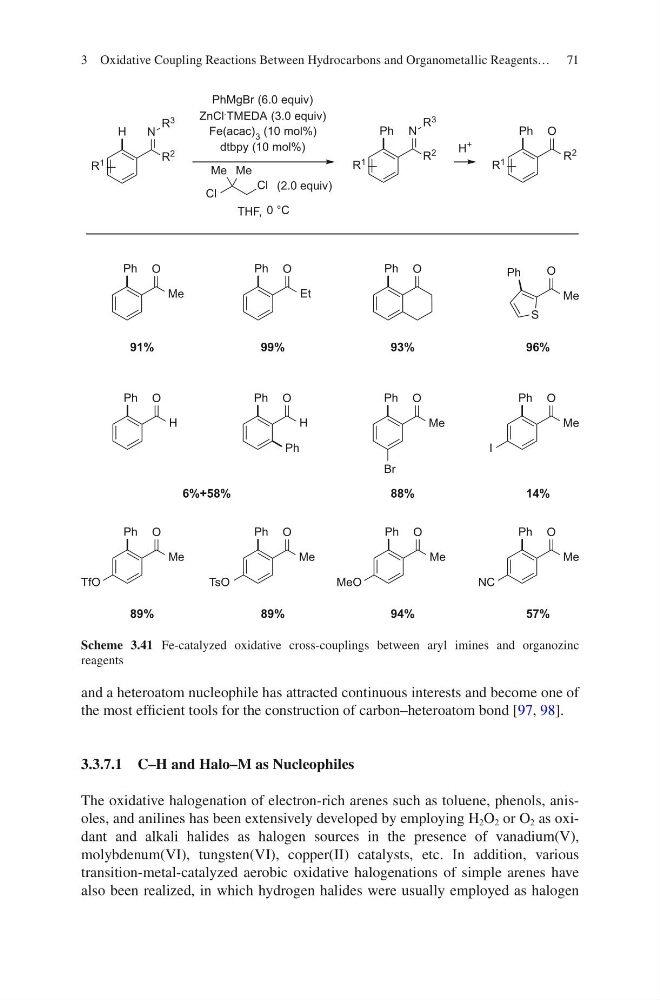
Scheme 3.41 Fe-catalyzed oxidative cross-couplings between aryl imines and organozinc
reagents
3 Oxidative Coupling Reactions Between Hydrocarbons and Organometallic Reagents…
and a heteroatom nucleophile has attracted continuous interests and become one of
the most efficient tools for the construction of carbon–heteroatom bond [97, 98].
3.3.7.1 C–H and Halo–M as Nucleophiles
The oxidative halogenation of electron-rich arenes such as toluene, phenols, anisoles, and anilines has been extensively developed by employing H 2 O 2 or O 2 as oxidant and alkali halides as halogen sources in the presence of vanadium(V),
molybdenum(VI), tungsten(VI), copper(II) catalysts, etc. In addition, various
transition- metal-catalyzed aerobic oxidative halogenations of simple arenes have
also been realized, in which hydrogen halides were usually employed as halogen
PhMgBr (6.0 equiv)
THF, 0 °C
ZnCl
. TMEDA (3.0 equiv)
Fe(acac) 3 (10 mol%)
dtbpy (10 mol%)
Cl
Cl
Me
Me
(2.0 equiv)
N
R 2
R 3
R 1
N
R 2
R 3
R 1
H
+
O
R 2
R 1
Ph
Ph
O
Me
Ph
O
Et
Ph
O
Ph
O
Me
O
H
Ph
O
H
Ph
O
Me
Ph
O
Me
Ph
O
Me
Ph
TfO
TsO
MeO
O
Me
Ph
O
Me
Ph
I
S
Ph
Br
Ph
O
Me
Ph
NC
89%
89%
94%
57%
6%+58%
88%
14%
91%
99%
93%
96%
H
Scheme 3.41 Fe-catalyzed oxidative cross-couplings between aryl imines and organozinc
reagents
3 Oxidative Coupling Reactions Between Hydrocarbons and Organometallic Reagents…