

70
medicinal, agrochemical, and material science. In 2010, Daugulis and co-workers
developed a regioselective oxidative cyanation of heterocycles using CuCN as the
catalyst, NaCN as the nucleophile, and iodine as the oxidant. A number of aromatic
heterocycles as well as azulene can be cyanated in reasonable to good yields
(Scheme 3.45) [93].
3.3.7 C(sp
2
)–H and X–M as Nucleophiles
The construction of C(sp
2
)–X bonds is of great importance, as heteroatoms exist in
many aromatic organic molecules especially natural products, pharmaceuticals, and
materials. In the past century, numerous transformations including many classical
name reactions (e.g., Ullmann–Goldberg coupling, Chan–Evans–Lam coupling,
Buchwald–Hartwig coupling) have been developed toward the bond formations
involving heteroatoms [94–96]. In recent years, with the rapid development of C–H
bond functionalization, oxidative cross-coupling between a C–H bond nucleophile
N
H
R
ArMgBr (6.0 equiv)
THF, 0 °C
ZnCl . TMEDA (3.0 equiv)
Fe(acac) 3 (10 mol%)
1,10-phenanthroline (10 mol%)
Cl
Cl
Me
Me
(2.0 equiv)
N
Ar
R
N
Ph
N
Ph
Ph
82% +12%
N
Ph
Me
N
Me
F
N
Ph
N
N
Ph
N
N
Ph
Ph
N
Ph
N
Ph
Ph
N
N
89%
78%
99%
81% +9%
59% +10%
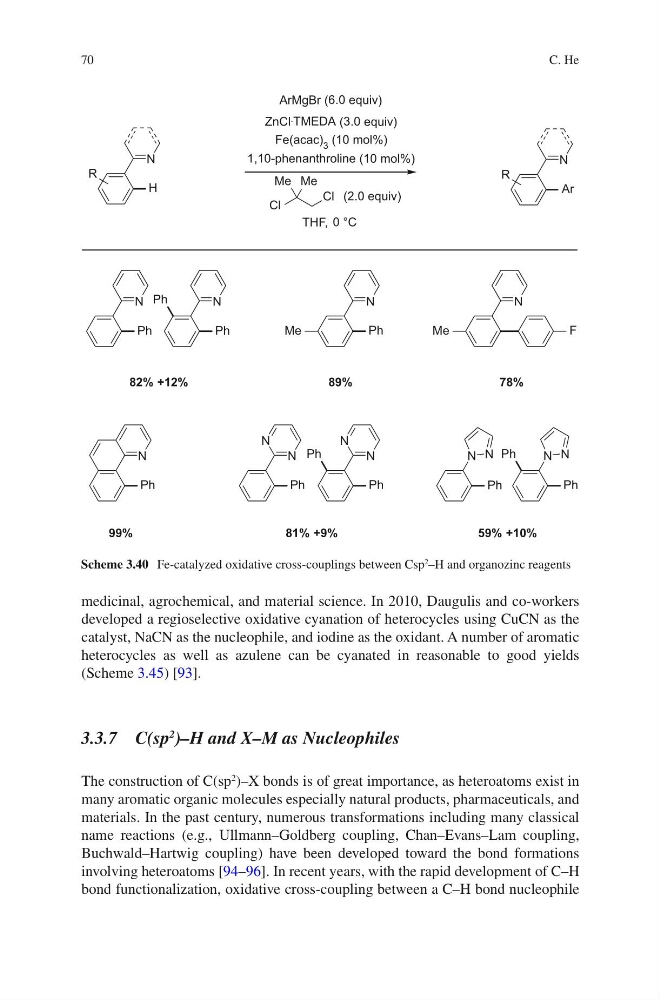
Scheme 3.40 Fe-catalyzed oxidative cross-couplings between Csp
2
–H and organozinc reagents
C. He
medicinal, agrochemical, and material science. In 2010, Daugulis and co-workers
developed a regioselective oxidative cyanation of heterocycles using CuCN as the
catalyst, NaCN as the nucleophile, and iodine as the oxidant. A number of aromatic
heterocycles as well as azulene can be cyanated in reasonable to good yields
(Scheme 3.45) [93].
3.3.7 C(sp
2
)–H and X–M as Nucleophiles
The construction of C(sp
2
)–X bonds is of great importance, as heteroatoms exist in
many aromatic organic molecules especially natural products, pharmaceuticals, and
materials. In the past century, numerous transformations including many classical
name reactions (e.g., Ullmann–Goldberg coupling, Chan–Evans–Lam coupling,
Buchwald–Hartwig coupling) have been developed toward the bond formations
involving heteroatoms [94–96]. In recent years, with the rapid development of C–H
bond functionalization, oxidative cross-coupling between a C–H bond nucleophile
N
H
R
ArMgBr (6.0 equiv)
THF, 0 °C
ZnCl . TMEDA (3.0 equiv)
Fe(acac) 3 (10 mol%)
1,10-phenanthroline (10 mol%)
Cl
Cl
Me
Me
(2.0 equiv)
N
Ar
R
N
Ph
N
Ph
Ph
82% +12%
N
Ph
Me
N
Me
F
N
Ph
N
N
Ph
N
N
Ph
Ph
N
Ph
N
Ph
Ph
N
N
89%
78%
99%
81% +9%
59% +10%
Scheme 3.40 Fe-catalyzed oxidative cross-couplings between Csp
2
–H and organozinc reagents
C. He