

69
Nakamura and co-workers developed a directed substitution reaction of an olefinic C–H bond with Grignard reagents using iron catalysis (Scheme 3.43) [91]. The
reaction took place in a syn-specific manner without isomerization of the olefin product in the presence of a mild oxidant (1,2-dichloro-2-methylpropane) in an aromatic
co-solvent. Mechanistic studies revealed that the reaction proceeds via an iron-catalyzed olefinic C–H bond activation rather than an oxidative Heck-type reaction.
Meanwhile, Shi and co-workers described the first highly regioselective cobaltcatalyzed oxidative cross-coupling of benzo[h]quinoline and phenylpyridine derivatives with Grignard reagents at room temperature (Scheme 3.44) [92]. Various
substituents on the heterocycles were compatible in the transformation. In addition
to aryl Grignard reagents, alkyl Grignard reagents also showed good reactivity.
Increasing the amount of Grignard reagents and oxidant (DCB) or prolonging the
reaction time from 48 to 72 h, the reaction between arylpyridines and aryl Grignard
reagents could produce the complete bis-arylation products.
3.3.6 Cyano Anions as Nucleophiles
Although cyanide salts are usually not considered as organometallic reagents, the
direct oxidative cyanation of Csp
2
–H bonds provides an elegant approach for the
construction of cyanoalkyne motifs, which are versatile building blocks in
Cu(OAc) 2 , Ag 2 CO 3
KF, NMO
DMSO, 100 °C
H
O
N
H
N
O
Ar
CF 3 SiMe 3
CF 3
O
N
H
N
O
Ar
CF 3
O
N
H
N
O
CF 3
O
N
H
N
O
CF 3
O
N
H
N
O
N
Me
65%
I
60%
(mono/di = 35:25)
F
62%
CF 3
O
N
H
N
O
CF 3
O
N
H
N
O
CF 3
O
N
H
N
O
N
80%
61%
40%
N
Me
O
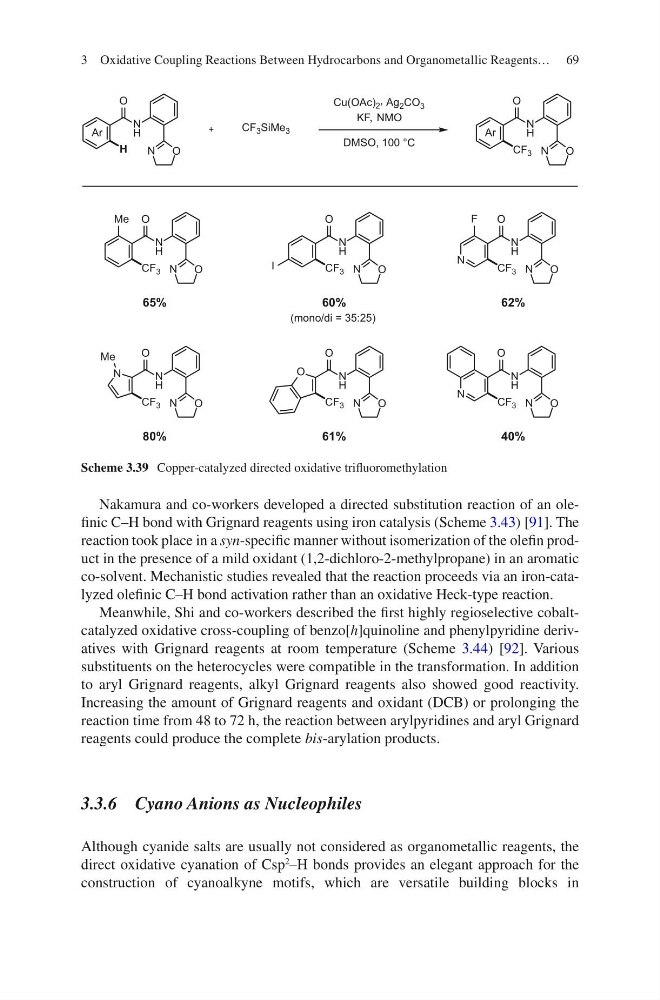
Scheme 3.39 Copper-catalyzed directed oxidative trifluoromethylation
3 Oxidative Coupling Reactions Between Hydrocarbons and Organometallic Reagents…
Nakamura and co-workers developed a directed substitution reaction of an olefinic C–H bond with Grignard reagents using iron catalysis (Scheme 3.43) [91]. The
reaction took place in a syn-specific manner without isomerization of the olefin product in the presence of a mild oxidant (1,2-dichloro-2-methylpropane) in an aromatic
co-solvent. Mechanistic studies revealed that the reaction proceeds via an iron-catalyzed olefinic C–H bond activation rather than an oxidative Heck-type reaction.
Meanwhile, Shi and co-workers described the first highly regioselective cobaltcatalyzed oxidative cross-coupling of benzo[h]quinoline and phenylpyridine derivatives with Grignard reagents at room temperature (Scheme 3.44) [92]. Various
substituents on the heterocycles were compatible in the transformation. In addition
to aryl Grignard reagents, alkyl Grignard reagents also showed good reactivity.
Increasing the amount of Grignard reagents and oxidant (DCB) or prolonging the
reaction time from 48 to 72 h, the reaction between arylpyridines and aryl Grignard
reagents could produce the complete bis-arylation products.
3.3.6 Cyano Anions as Nucleophiles
Although cyanide salts are usually not considered as organometallic reagents, the
direct oxidative cyanation of Csp
2
–H bonds provides an elegant approach for the
construction of cyanoalkyne motifs, which are versatile building blocks in
Cu(OAc) 2 , Ag 2 CO 3
KF, NMO
DMSO, 100 °C
H
O
N
H
N
O
Ar
CF 3 SiMe 3
CF 3
O
N
H
N
O
Ar
CF 3
O
N
H
N
O
CF 3
O
N
H
N
O
CF 3
O
N
H
N
O
N
Me
65%
I
60%
(mono/di = 35:25)
F
62%
CF 3
O
N
H
N
O
CF 3
O
N
H
N
O
CF 3
O
N
H
N
O
N
80%
61%
40%
N
Me
O
Scheme 3.39 Copper-catalyzed directed oxidative trifluoromethylation
3 Oxidative Coupling Reactions Between Hydrocarbons and Organometallic Reagents…