

63
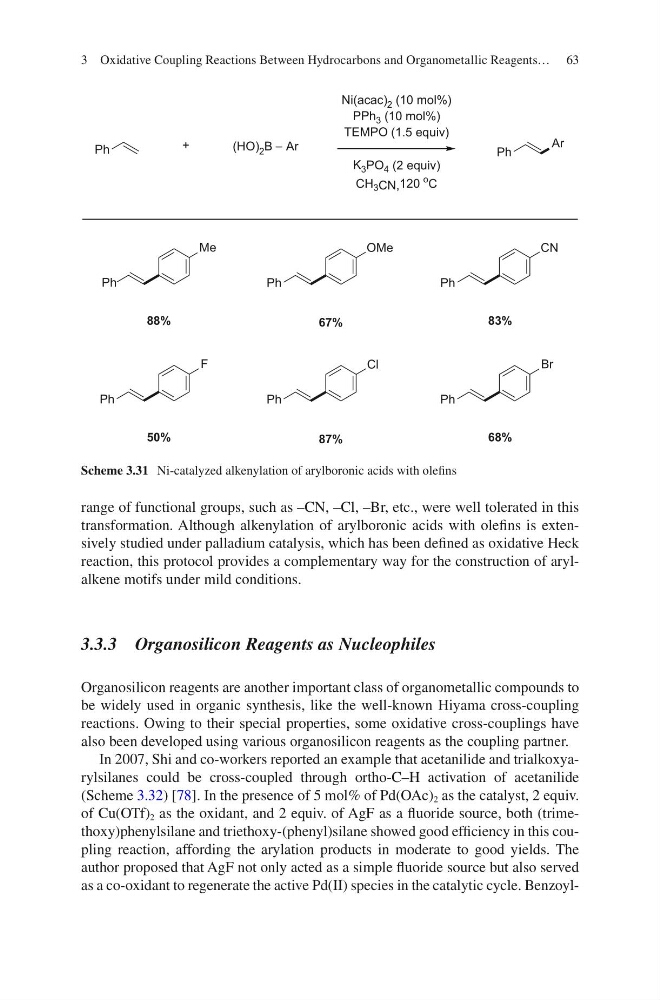
range of functional groups, such as –CN, –Cl, –Br, etc., were well tolerated in this
transformation. Although alkenylation of arylboronic acids with olefins is extensively studied under palladium catalysis, which has been defined as oxidative Heck
reaction, this protocol provides a complementary way for the construction of arylalkene motifs under mild conditions.
3.3.3 Organosilicon Reagents as Nucleophiles
Organosilicon reagents are another important class of organometallic compounds to
be widely used in organic synthesis, like the well-known Hiyama cross-coupling
reactions. Owing to their special properties, some oxidative cross-couplings have
also been developed using various organosilicon reagents as the coupling partner.
In 2007, Shi and co-workers reported an example that acetanilide and trialkoxyarylsilanes could be cross-coupled through ortho-C–H activation of acetanilide
(Scheme 3.32) [78]. In the presence of 5 mol% of Pd(OAc) 2 as the catalyst, 2 equiv.
of Cu(OTf) 2 as the oxidant, and 2 equiv. of AgF as a fluoride source, both (trimethoxy)phenylsilane and triethoxy-(phenyl)silane showed good efficiency in this coupling reaction, affording the arylation products in moderate to good yields. The
author proposed that AgF not only acted as a simple fluoride source but also served
as a co-oxidant to regenerate the active Pd(II) species in the catalytic cycle. BenzoylPh
+
(HO) 2 B Ar
Ni(acac) 2 (10 mol%)
PPh 3 (10 mol%)
TEMPO (1.5 equiv)
K 3 PO 4 (2 equiv)
CH 3CN, 120
o
C
Ph
Ar
Ph
88%
Me
Ph
67%
OMe
Ph
83%
CN
Ph
50%
F
Ph
87%
Cl
Ph
68%
Br
Scheme 3.31 Ni-catalyzed alkenylation of arylboronic acids with olefins
3 Oxidative Coupling Reactions Between Hydrocarbons and Organometallic Reagents…
range of functional groups, such as –CN, –Cl, –Br, etc., were well tolerated in this
transformation. Although alkenylation of arylboronic acids with olefins is extensively studied under palladium catalysis, which has been defined as oxidative Heck
reaction, this protocol provides a complementary way for the construction of arylalkene motifs under mild conditions.
3.3.3 Organosilicon Reagents as Nucleophiles
Organosilicon reagents are another important class of organometallic compounds to
be widely used in organic synthesis, like the well-known Hiyama cross-coupling
reactions. Owing to their special properties, some oxidative cross-couplings have
also been developed using various organosilicon reagents as the coupling partner.
In 2007, Shi and co-workers reported an example that acetanilide and trialkoxyarylsilanes could be cross-coupled through ortho-C–H activation of acetanilide
(Scheme 3.32) [78]. In the presence of 5 mol% of Pd(OAc) 2 as the catalyst, 2 equiv.
of Cu(OTf) 2 as the oxidant, and 2 equiv. of AgF as a fluoride source, both (trimethoxy)phenylsilane and triethoxy-(phenyl)silane showed good efficiency in this coupling reaction, affording the arylation products in moderate to good yields. The
author proposed that AgF not only acted as a simple fluoride source but also served
as a co-oxidant to regenerate the active Pd(II) species in the catalytic cycle. BenzoylPh
+
(HO) 2 B Ar
Ni(acac) 2 (10 mol%)
PPh 3 (10 mol%)
TEMPO (1.5 equiv)
K 3 PO 4 (2 equiv)
CH 3CN, 120
o
C
Ph
Ar
Ph
88%
Me
Ph
67%
OMe
Ph
83%
CN
Ph
50%
F
Ph
87%
Cl
Ph
68%
Br
Scheme 3.31 Ni-catalyzed alkenylation of arylboronic acids with olefins
3 Oxidative Coupling Reactions Between Hydrocarbons and Organometallic Reagents…