

64
and formyl-protected aniline and N-alkylated and free anilines were not suitable for
this transformation.
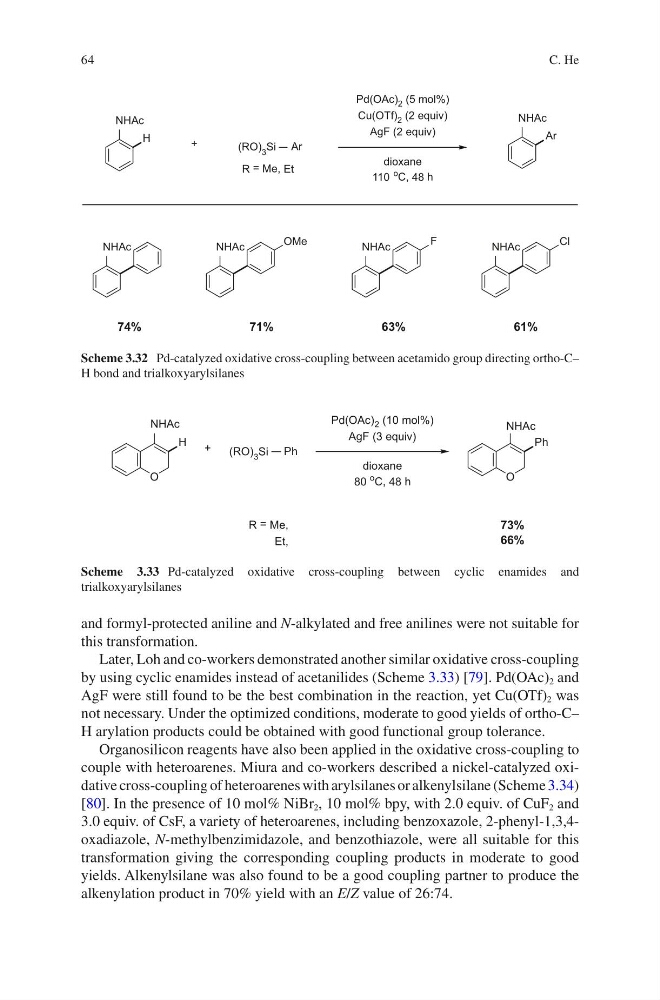
Later, Loh and co-workers demonstrated another similar oxidative cross- coupling
by using cyclic enamides instead of acetanilides (Scheme 3.33) [79]. Pd(OAc) 2 and
AgF were still found to be the best combination in the reaction, yet Cu(OTf) 2 was
not necessary. Under the optimized conditions, moderate to good yields of ortho-C–
H arylation products could be obtained with good functional group tolerance.
Organosilicon reagents have also been applied in the oxidative cross-coupling to
couple with heteroarenes. Miura and co-workers described a nickel-catalyzed oxidative cross-coupling of heteroarenes with arylsilanes or alkenylsilane (Scheme 3.34)
[80]. In the presence of 10 mol% NiBr 2 , 10 mol% bpy, with 2.0 equiv. of CuF 2 and
3.0 equiv. of CsF, a variety of heteroarenes, including benzoxazole, 2-phenyl-1,3,4oxadiazole, N-methylbenzimidazole, and benzothiazole, were all suitable for this
transformation giving the corresponding coupling products in moderate to good
yields. Alkenylsilane was also found to be a good coupling partner to produce the
alkenylation product in 70% yield with an E/Z value of 26:74.
H
Pd(OAc) 2 (5 mol%)
Cu(OTf) 2 (2 equiv)
AgF (2 equiv)
dioxane
110
o C, 48 h
+
(RO) 3 Si Ar
NHAc
R = Me, Et
Ar
NHAc
NHAc
74%
NHAc
71%
OMe
NHAc
63%
F
NHAc
61%
Cl
Scheme 3.32 Pd-catalyzed oxidative cross-coupling between acetamido group directing ortho-C–
H bond and trialkoxyarylsilanes
O
H
Pd(OAc) 2 (10 mol%)
AgF (3 equiv)
dioxane
80
o C, 48 h
+
(RO) 3 Si Ph
NHAc
R = Me,
O
Ph
NHAc
73%
66%
Et,
Scheme 3.33 Pd-catalyzed oxidative cross-coupling between cyclic enamides and
trialkoxyarylsilanes
C. He
and formyl-protected aniline and N-alkylated and free anilines were not suitable for
this transformation.
Later, Loh and co-workers demonstrated another similar oxidative cross- coupling
by using cyclic enamides instead of acetanilides (Scheme 3.33) [79]. Pd(OAc) 2 and
AgF were still found to be the best combination in the reaction, yet Cu(OTf) 2 was
not necessary. Under the optimized conditions, moderate to good yields of ortho-C–
H arylation products could be obtained with good functional group tolerance.
Organosilicon reagents have also been applied in the oxidative cross-coupling to
couple with heteroarenes. Miura and co-workers described a nickel-catalyzed oxidative cross-coupling of heteroarenes with arylsilanes or alkenylsilane (Scheme 3.34)
[80]. In the presence of 10 mol% NiBr 2 , 10 mol% bpy, with 2.0 equiv. of CuF 2 and
3.0 equiv. of CsF, a variety of heteroarenes, including benzoxazole, 2-phenyl-1,3,4oxadiazole, N-methylbenzimidazole, and benzothiazole, were all suitable for this
transformation giving the corresponding coupling products in moderate to good
yields. Alkenylsilane was also found to be a good coupling partner to produce the
alkenylation product in 70% yield with an E/Z value of 26:74.
H
Pd(OAc) 2 (5 mol%)
Cu(OTf) 2 (2 equiv)
AgF (2 equiv)
dioxane
110
o C, 48 h
+
(RO) 3 Si Ar
NHAc
R = Me, Et
Ar
NHAc
NHAc
74%
NHAc
71%
OMe
NHAc
63%
F
NHAc
61%
Cl
Scheme 3.32 Pd-catalyzed oxidative cross-coupling between acetamido group directing ortho-C–
H bond and trialkoxyarylsilanes
O
H
Pd(OAc) 2 (10 mol%)
AgF (3 equiv)
dioxane
80
o C, 48 h
+
(RO) 3 Si Ph
NHAc
R = Me,
O
Ph
NHAc
73%
66%
Et,
Scheme 3.33 Pd-catalyzed oxidative cross-coupling between cyclic enamides and
trialkoxyarylsilanes
C. He