

61
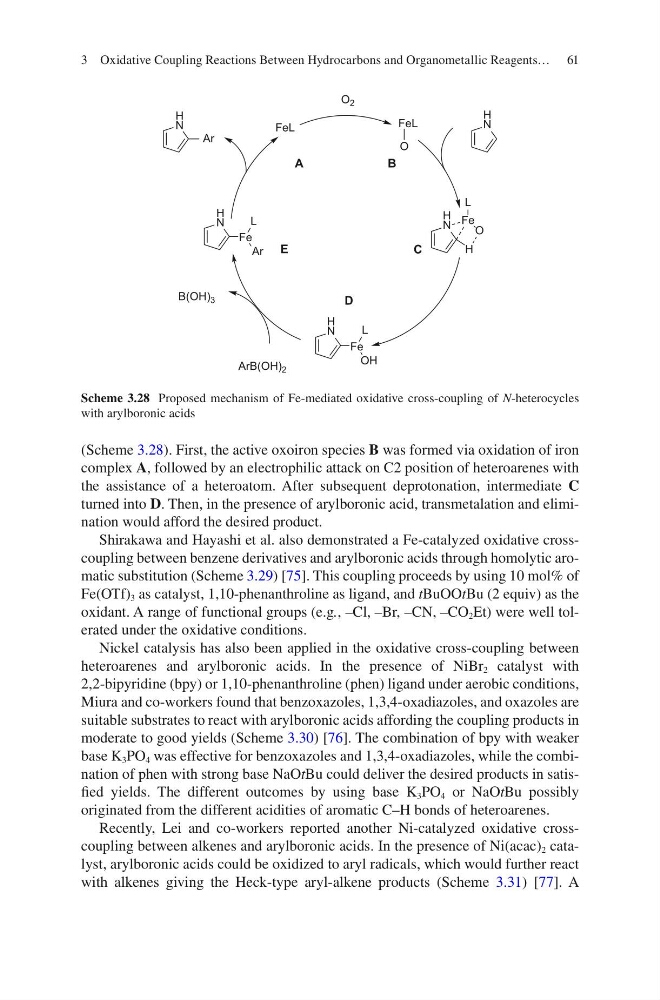
(Scheme 3.28). First, the active oxoiron species B was formed via oxidation of iron
complex A, followed by an electrophilic attack on C2 position of heteroarenes with
the assistance of a heteroatom. After subsequent deprotonation, intermediate C
turned into D. Then, in the presence of arylboronic acid, transmetalation and elimination would afford the desired product.
Shirakawa and Hayashi et al. also demonstrated a Fe-catalyzed oxidative crosscoupling between benzene derivatives and arylboronic acids through homolytic aromatic substitution (Scheme 3.29) [75]. This coupling proceeds by using 10 mol% of
Fe(OTf) 3 as catalyst, 1,10-phenanthroline as ligand, and tBuOOtBu (2 equiv) as the
oxidant. A range of functional groups (e.g., –Cl, –Br, –CN, –CO 2 Et) were well tolerated under the oxidative conditions.
Nickel catalysis has also been applied in the oxidative cross-coupling between
heteroarenes and arylboronic acids. In the presence of NiBr 2 catalyst with
2,2- bipyridine (bpy) or 1,10-phenanthroline (phen) ligand under aerobic conditions,
Miura and co-workers found that benzoxazoles, 1,3,4-oxadiazoles, and oxazoles are
suitable substrates to react with arylboronic acids affording the coupling products in
moderate to good yields (Scheme 3.30) [76]. The combination of bpy with weaker
base K 3 PO 4 was effective for benzoxazoles and 1,3,4-oxadiazoles, while the combination of phen with strong base NaOtBu could deliver the desired products in satisfied yields. The different outcomes by using base K 3 PO 4 or NaOtBu possibly
originated from the different acidities of aromatic C–H bonds of heteroarenes.
Recently, Lei and co-workers reported another Ni-catalyzed oxidative crosscoupling between alkenes and arylboronic acids. In the presence of Ni(acac) 2 catalyst, arylboronic acids could be oxidized to aryl radicals, which would further react
with alkenes giving the Heck-type aryl-alkene products (Scheme 3.31) [77]. A
H
N
O 2
FeL
FeL
O
B
A
H
N Fe
H
L
O
C
H
N
Fe
L
OH
D
H
N
Fe
L
Ar
E
ArB(OH) 2
B(OH) 3
H
N
Ar
Scheme 3.28 Proposed mechanism of Fe-mediated oxidative cross-coupling of N-heterocycles
with arylboronic acids
3 Oxidative Coupling Reactions Between Hydrocarbons and Organometallic Reagents…
(Scheme 3.28). First, the active oxoiron species B was formed via oxidation of iron
complex A, followed by an electrophilic attack on C2 position of heteroarenes with
the assistance of a heteroatom. After subsequent deprotonation, intermediate C
turned into D. Then, in the presence of arylboronic acid, transmetalation and elimination would afford the desired product.
Shirakawa and Hayashi et al. also demonstrated a Fe-catalyzed oxidative crosscoupling between benzene derivatives and arylboronic acids through homolytic aromatic substitution (Scheme 3.29) [75]. This coupling proceeds by using 10 mol% of
Fe(OTf) 3 as catalyst, 1,10-phenanthroline as ligand, and tBuOOtBu (2 equiv) as the
oxidant. A range of functional groups (e.g., –Cl, –Br, –CN, –CO 2 Et) were well tolerated under the oxidative conditions.
Nickel catalysis has also been applied in the oxidative cross-coupling between
heteroarenes and arylboronic acids. In the presence of NiBr 2 catalyst with
2,2- bipyridine (bpy) or 1,10-phenanthroline (phen) ligand under aerobic conditions,
Miura and co-workers found that benzoxazoles, 1,3,4-oxadiazoles, and oxazoles are
suitable substrates to react with arylboronic acids affording the coupling products in
moderate to good yields (Scheme 3.30) [76]. The combination of bpy with weaker
base K 3 PO 4 was effective for benzoxazoles and 1,3,4-oxadiazoles, while the combination of phen with strong base NaOtBu could deliver the desired products in satisfied yields. The different outcomes by using base K 3 PO 4 or NaOtBu possibly
originated from the different acidities of aromatic C–H bonds of heteroarenes.
Recently, Lei and co-workers reported another Ni-catalyzed oxidative crosscoupling between alkenes and arylboronic acids. In the presence of Ni(acac) 2 catalyst, arylboronic acids could be oxidized to aryl radicals, which would further react
with alkenes giving the Heck-type aryl-alkene products (Scheme 3.31) [77]. A
H
N
O 2
FeL
FeL
O
B
A
H
N Fe
H
L
O
C
H
N
Fe
L
OH
D
H
N
Fe
L
Ar
E
ArB(OH) 2
B(OH) 3
H
N
Ar
Scheme 3.28 Proposed mechanism of Fe-mediated oxidative cross-coupling of N-heterocycles
with arylboronic acids
3 Oxidative Coupling Reactions Between Hydrocarbons and Organometallic Reagents…