

59
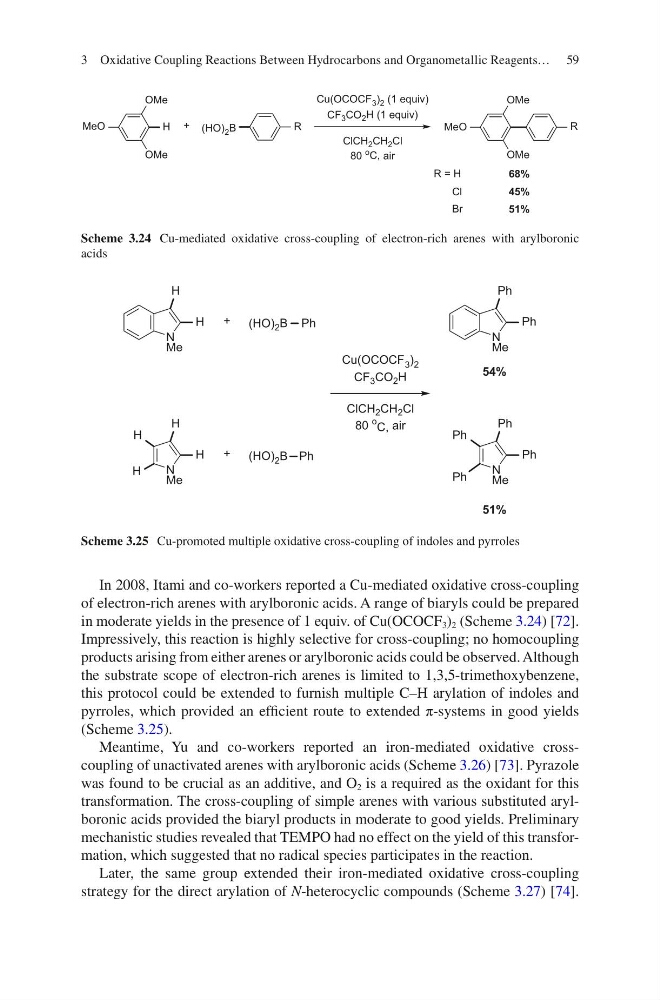
In 2008, Itami and co-workers reported a Cu-mediated oxidative cross-coupling
of electron-rich arenes with arylboronic acids. A range of biaryls could be prepared
in moderate yields in the presence of 1 equiv. of Cu(OCOCF 3 ) 2 (Scheme 3.24) [72].
Impressively, this reaction is highly selective for cross-coupling; no homocoupling
products arising from either arenes or arylboronic acids could be observed. Although
the substrate scope of electron-rich arenes is limited to 1,3,5-trimethoxybenzene,
this protocol could be extended to furnish multiple C–H arylation of indoles and
pyrroles, which provided an efficient route to extended π-systems in good yields
(Scheme 3.25).
Meantime, Yu and co-workers reported an iron-mediated oxidative crosscoupling of unactivated arenes with arylboronic acids (Scheme 3.26) [73]. Pyrazole
was found to be crucial as an additive, and O 2 is a required as the oxidant for this
transformation. The cross-coupling of simple arenes with various substituted arylboronic acids provided the biaryl products in moderate to good yields. Preliminary
mechanistic studies revealed that TEMPO had no effect on the yield of this transformation, which suggested that no radical species participates in the reaction.
Later, the same group extended their iron-mediated oxidative cross-coupling
strategy for the direct arylation of N-heterocyclic compounds (Scheme 3.27) [74].
+ (HO) 2 B
Cu(OCOCF 3 ) 2 (1 equiv)
CF 3 CO 2 H (1 equiv)
ClCH 2 CH 2 Cl
80
o C, air
OMe
MeO
OMe
H
OMe
MeO
OMe
68%
45%
51%
R
R
R = H
Cl
Br
Scheme 3.24 Cu-mediated oxidative cross-coupling of electron-rich arenes with arylboronic
acids
+
(HO) 2 B Ph
N
Me
H
H
N
Me
Ph
Ph
54%
+
(HO) 2 B Ph
N
Me
H
H
N
Me
Ph
Ph
Cu(OCOCF 3 ) 2
CF 3 CO 2 H
ClCH 2 CH 2 Cl
80
o C, air
H
51%
H
Ph
Ph
Scheme 3.25 Cu-promoted multiple oxidative cross-coupling of indoles and pyrroles
3 Oxidative Coupling Reactions Between Hydrocarbons and Organometallic Reagents…
In 2008, Itami and co-workers reported a Cu-mediated oxidative cross-coupling
of electron-rich arenes with arylboronic acids. A range of biaryls could be prepared
in moderate yields in the presence of 1 equiv. of Cu(OCOCF 3 ) 2 (Scheme 3.24) [72].
Impressively, this reaction is highly selective for cross-coupling; no homocoupling
products arising from either arenes or arylboronic acids could be observed. Although
the substrate scope of electron-rich arenes is limited to 1,3,5-trimethoxybenzene,
this protocol could be extended to furnish multiple C–H arylation of indoles and
pyrroles, which provided an efficient route to extended π-systems in good yields
(Scheme 3.25).
Meantime, Yu and co-workers reported an iron-mediated oxidative crosscoupling of unactivated arenes with arylboronic acids (Scheme 3.26) [73]. Pyrazole
was found to be crucial as an additive, and O 2 is a required as the oxidant for this
transformation. The cross-coupling of simple arenes with various substituted arylboronic acids provided the biaryl products in moderate to good yields. Preliminary
mechanistic studies revealed that TEMPO had no effect on the yield of this transformation, which suggested that no radical species participates in the reaction.
Later, the same group extended their iron-mediated oxidative cross-coupling
strategy for the direct arylation of N-heterocyclic compounds (Scheme 3.27) [74].
+ (HO) 2 B
Cu(OCOCF 3 ) 2 (1 equiv)
CF 3 CO 2 H (1 equiv)
ClCH 2 CH 2 Cl
80
o C, air
OMe
MeO
OMe
H
OMe
MeO
OMe
68%
45%
51%
R
R
R = H
Cl
Br
Scheme 3.24 Cu-mediated oxidative cross-coupling of electron-rich arenes with arylboronic
acids
+
(HO) 2 B Ph
N
Me
H
H
N
Me
Ph
Ph
54%
+
(HO) 2 B Ph
N
Me
H
H
N
Me
Ph
Ph
Cu(OCOCF 3 ) 2
CF 3 CO 2 H
ClCH 2 CH 2 Cl
80
o C, air
H
51%
H
Ph
Ph
Scheme 3.25 Cu-promoted multiple oxidative cross-coupling of indoles and pyrroles
3 Oxidative Coupling Reactions Between Hydrocarbons and Organometallic Reagents…