

58
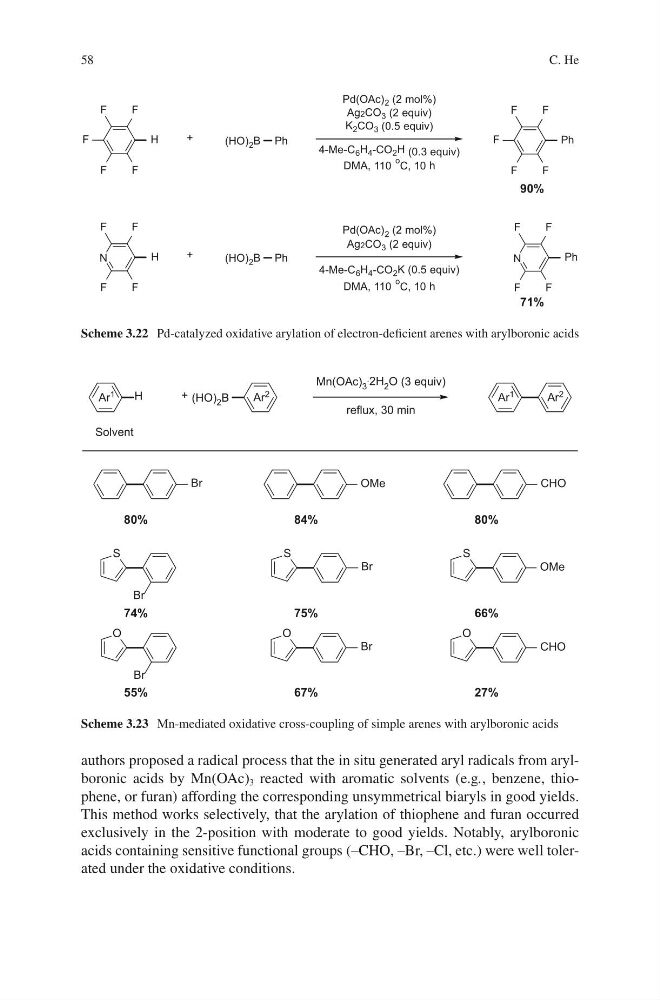
authors proposed a radical process that the in situ generated aryl radicals from arylboronic acids by Mn(OAc) 3 reacted with aromatic solvents (e.g., benzene, thiophene, or furan) affording the corresponding unsymmetrical biaryls in good yields.
This method works selectively, that the arylation of thiophene and furan occurred
exclusively in the 2-position with moderate to good yields. Notably, arylboronic
acids containing sensitive functional groups (–CHO, –Br, –Cl, etc.) were well tolerated under the oxidative conditions.
+
(HO) 2 B Ph
F
F
F
H
F
F
F
F
F
Ph
F
F
90%
+
(HO) 2 B Ph
N
F
F
H
F
F
N
F
F
Ph
F
F
71%
Pd(OAc) 2 (2 mol%)
Ag2CO 3 (2 equiv)
K 2 CO 3 (0.5 equiv)
DMA, 110
o C, 10 h
Pd(OAc) 2 (2 mol%)
Ag2CO 3 (2 equiv)
DMA, 110
o C, 10 h
4-Me-C 6 H 4 -CO 2 H (0.3 equiv)
4-Me-C 6 H 4 -CO 2 K (0.5 equiv)
Scheme 3.22 Pd-catalyzed oxidative arylation of electron-deficient arenes with arylboronic acids
+ (HO) 2 B
Mn(OAc) 3
. 2H 2 O (3 equiv)
reflux, 30 min
80%
84%
80%
H
Br
OMe
CHO
74%
75%
66%
Br
Br
OMe
S
S
S
55%
67%
27%
Br
Br
CHO
O
O
O
Solvent
Ar 1
Ar 2
Ar 1
Ar 2
Scheme 3.23 Mn-mediated oxidative cross-coupling of simple arenes with arylboronic acids
C. He
authors proposed a radical process that the in situ generated aryl radicals from arylboronic acids by Mn(OAc) 3 reacted with aromatic solvents (e.g., benzene, thiophene, or furan) affording the corresponding unsymmetrical biaryls in good yields.
This method works selectively, that the arylation of thiophene and furan occurred
exclusively in the 2-position with moderate to good yields. Notably, arylboronic
acids containing sensitive functional groups (–CHO, –Br, –Cl, etc.) were well tolerated under the oxidative conditions.
+
(HO) 2 B Ph
F
F
F
H
F
F
F
F
F
Ph
F
F
90%
+
(HO) 2 B Ph
N
F
F
H
F
F
N
F
F
Ph
F
F
71%
Pd(OAc) 2 (2 mol%)
Ag2CO 3 (2 equiv)
K 2 CO 3 (0.5 equiv)
DMA, 110
o C, 10 h
Pd(OAc) 2 (2 mol%)
Ag2CO 3 (2 equiv)
DMA, 110
o C, 10 h
4-Me-C 6 H 4 -CO 2 H (0.3 equiv)
4-Me-C 6 H 4 -CO 2 K (0.5 equiv)
Scheme 3.22 Pd-catalyzed oxidative arylation of electron-deficient arenes with arylboronic acids
+ (HO) 2 B
Mn(OAc) 3
. 2H 2 O (3 equiv)
reflux, 30 min
80%
84%
80%
H
Br
OMe
CHO
74%
75%
66%
Br
Br
OMe
S
S
S
55%
67%
27%
Br
Br
CHO
O
O
O
Solvent
Ar 1
Ar 2
Ar 1
Ar 2
Scheme 3.23 Mn-mediated oxidative cross-coupling of simple arenes with arylboronic acids
C. He