

55
oxidative cross-couplings of arenes with arylboronic acids by using different directing groups [65, 66].
Besides the directing group oriented strategy for the selective oxidative crosscouplings of arenes and organoboron reagents, the direct oxidative cross-coupling
between simple arenes and arylboronic acids has also been reported in recent years.
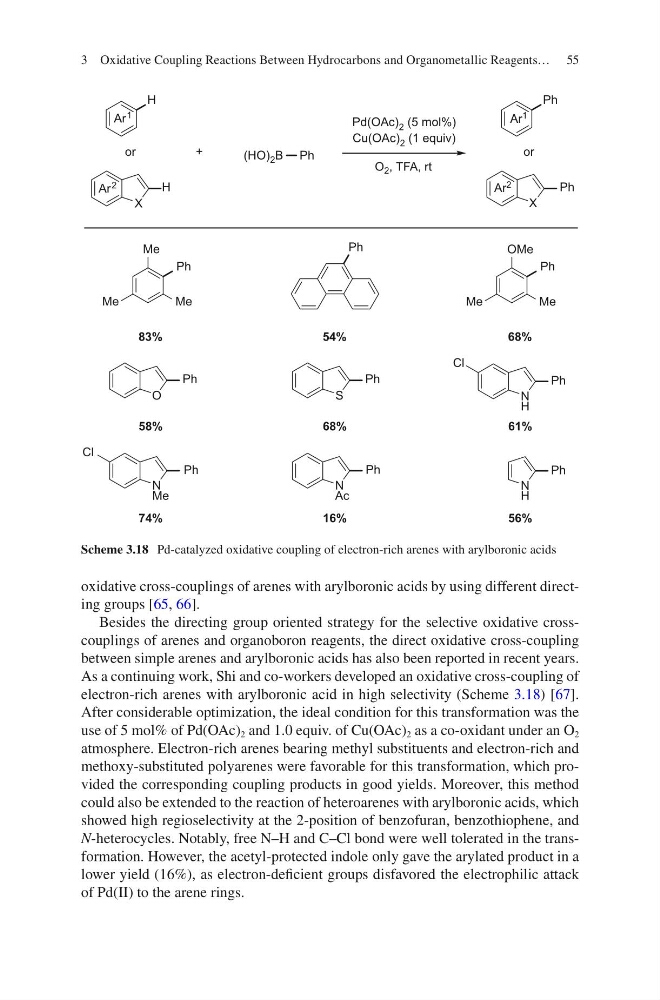
As a continuing work, Shi and co-workers developed an oxidative cross-coupling of
electron-rich arenes with arylboronic acid in high selectivity (Scheme 3.18) [67].
After considerable optimization, the ideal condition for this transformation was the
use of 5 mol% of Pd(OAc) 2 and 1.0 equiv. of Cu(OAc) 2 as a co-oxidant under an O 2
atmosphere. Electron-rich arenes bearing methyl substituents and electron-rich and
methoxy-substituted polyarenes were favorable for this transformation, which provided the corresponding coupling products in good yields. Moreover, this method
could also be extended to the reaction of heteroarenes with arylboronic acids, which
showed high regioselectivity at the 2-position of benzofuran, benzothiophene, and
N-heterocycles. Notably, free N–H and C–Cl bond were well tolerated in the transformation. However, the acetyl-protected indole only gave the arylated product in a
lower yield (16%), as electron-deficient groups disfavored the electrophilic attack
of Pd(II) to the arene rings.
83%
54%
68%
H
+
(HO) 2 B Ph
Pd(OAc) 2 (5 mol%)
Cu(OAc) 2 (1 equiv)
O 2 , TFA, rt
Ph
Ph
Ph
Me
Me
Me
Ph
OMe
Me
Me
X
H
X
Ph
O
Ph
58%
S
Ph
68%
N
H
Ph
61%
Cl
N
Me
Ph
74%
Cl
N
Ac
Ph
16%
N
H
Ph
56%
or
or
Ar 1
Ar 2
Ar 1
Ar 2
Scheme 3.18 Pd-catalyzed oxidative coupling of electron-rich arenes with arylboronic acids
3 Oxidative Coupling Reactions Between Hydrocarbons and Organometallic Reagents…
oxidative cross-couplings of arenes with arylboronic acids by using different directing groups [65, 66].
Besides the directing group oriented strategy for the selective oxidative crosscouplings of arenes and organoboron reagents, the direct oxidative cross-coupling
between simple arenes and arylboronic acids has also been reported in recent years.
As a continuing work, Shi and co-workers developed an oxidative cross-coupling of
electron-rich arenes with arylboronic acid in high selectivity (Scheme 3.18) [67].
After considerable optimization, the ideal condition for this transformation was the
use of 5 mol% of Pd(OAc) 2 and 1.0 equiv. of Cu(OAc) 2 as a co-oxidant under an O 2
atmosphere. Electron-rich arenes bearing methyl substituents and electron-rich and
methoxy-substituted polyarenes were favorable for this transformation, which provided the corresponding coupling products in good yields. Moreover, this method
could also be extended to the reaction of heteroarenes with arylboronic acids, which
showed high regioselectivity at the 2-position of benzofuran, benzothiophene, and
N-heterocycles. Notably, free N–H and C–Cl bond were well tolerated in the transformation. However, the acetyl-protected indole only gave the arylated product in a
lower yield (16%), as electron-deficient groups disfavored the electrophilic attack
of Pd(II) to the arene rings.
83%
54%
68%
H
+
(HO) 2 B Ph
Pd(OAc) 2 (5 mol%)
Cu(OAc) 2 (1 equiv)
O 2 , TFA, rt
Ph
Ph
Ph
Me
Me
Me
Ph
OMe
Me
Me
X
H
X
Ph
O
Ph
58%
S
Ph
68%
N
H
Ph
61%
Cl
N
Me
Ph
74%
Cl
N
Ac
Ph
16%
N
H
Ph
56%
or
or
Ar 1
Ar 2
Ar 1
Ar 2
Scheme 3.18 Pd-catalyzed oxidative coupling of electron-rich arenes with arylboronic acids
3 Oxidative Coupling Reactions Between Hydrocarbons and Organometallic Reagents…