

56
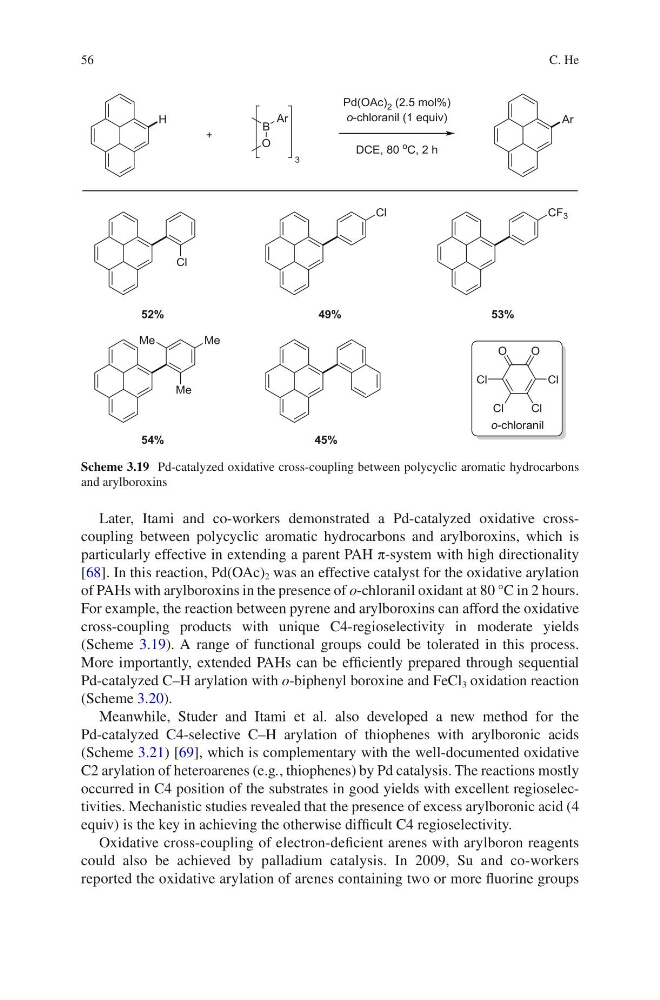
Later, Itami and co-workers demonstrated a Pd-catalyzed oxidative crosscoupling between polycyclic aromatic hydrocarbons and arylboroxins, which is
particularly effective in extending a parent PAH π-system with high directionality
[68]. In this reaction, Pd(OAc) 2 was an effective catalyst for the oxidative arylation
of PAHs with arylboroxins in the presence of o-chloranil oxidant at 80 °C in 2 hours.
For example, the reaction between pyrene and arylboroxins can afford the oxidative
cross-coupling products with unique C4-regioselectivity in moderate yields
(Scheme 3.19). A range of functional groups could be tolerated in this process.
More importantly, extended PAHs can be efficiently prepared through sequential
Pd-catalyzed C–H arylation with o-biphenyl boroxine and FeCl 3 oxidation reaction
(Scheme 3.20).
Meanwhile, Studer and Itami et al. also developed a new method for the
Pd-catalyzed C4-selective C–H arylation of thiophenes with arylboronic acids
(Scheme 3.21) [69], which is complementary with the well-documented oxidative
C2 arylation of heteroarenes (e.g., thiophenes) by Pd catalysis. The reactions mostly
occurred in C4 position of the substrates in good yields with excellent regioselectivities. Mechanistic studies revealed that the presence of excess arylboronic acid (4
equiv) is the key in achieving the otherwise difficult C4 regioselectivity.
Oxidative cross-coupling of electron-deficient arenes with arylboron reagents
could also be achieved by palladium catalysis. In 2009, Su and co-workers
reported the oxidative arylation of arenes containing two or more fluorine groups
Scheme 3.19 Pd-catalyzed oxidative cross-coupling between polycyclic aromatic hydrocarbons
and arylboroxins
C. He
Later, Itami and co-workers demonstrated a Pd-catalyzed oxidative crosscoupling between polycyclic aromatic hydrocarbons and arylboroxins, which is
particularly effective in extending a parent PAH π-system with high directionality
[68]. In this reaction, Pd(OAc) 2 was an effective catalyst for the oxidative arylation
of PAHs with arylboroxins in the presence of o-chloranil oxidant at 80 °C in 2 hours.
For example, the reaction between pyrene and arylboroxins can afford the oxidative
cross-coupling products with unique C4-regioselectivity in moderate yields
(Scheme 3.19). A range of functional groups could be tolerated in this process.
More importantly, extended PAHs can be efficiently prepared through sequential
Pd-catalyzed C–H arylation with o-biphenyl boroxine and FeCl 3 oxidation reaction
(Scheme 3.20).
Meanwhile, Studer and Itami et al. also developed a new method for the
Pd-catalyzed C4-selective C–H arylation of thiophenes with arylboronic acids
(Scheme 3.21) [69], which is complementary with the well-documented oxidative
C2 arylation of heteroarenes (e.g., thiophenes) by Pd catalysis. The reactions mostly
occurred in C4 position of the substrates in good yields with excellent regioselectivities. Mechanistic studies revealed that the presence of excess arylboronic acid (4
equiv) is the key in achieving the otherwise difficult C4 regioselectivity.
Oxidative cross-coupling of electron-deficient arenes with arylboron reagents
could also be achieved by palladium catalysis. In 2009, Su and co-workers
reported the oxidative arylation of arenes containing two or more fluorine groups
Scheme 3.19 Pd-catalyzed oxidative cross-coupling between polycyclic aromatic hydrocarbons
and arylboroxins
C. He