

54
gave the best ee, and the 2,3,5,6-tetrafluoro-4-cyanophenylamino directing group
also played a crucial role in the reaction.
In 2007, Shi and co-workers reported another oxidative cross-coupling between
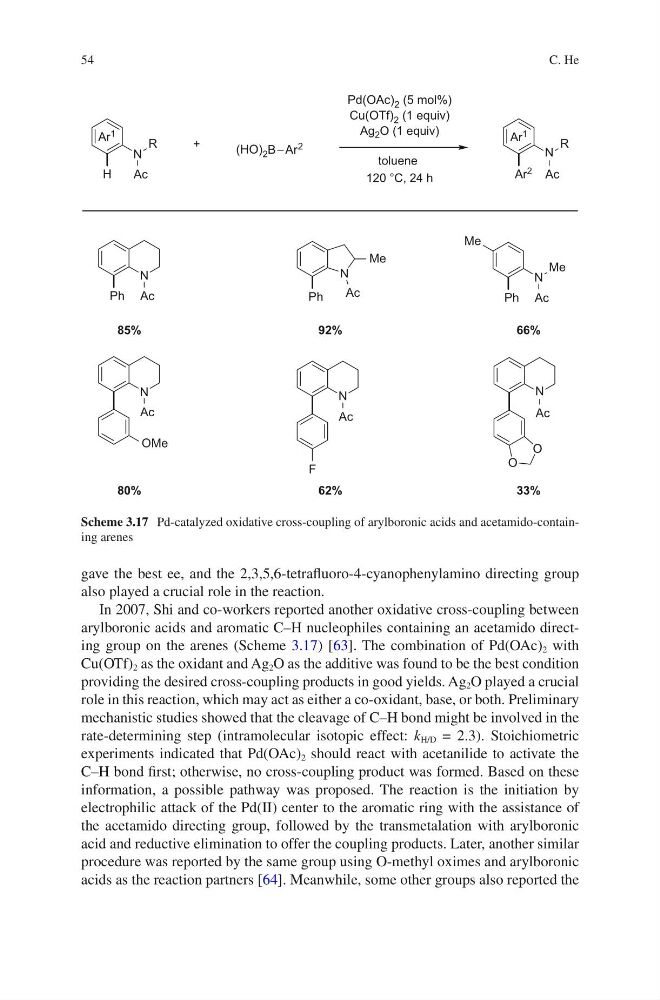
arylboronic acids and aromatic C–H nucleophiles containing an acetamido directing group on the arenes (Scheme 3.17) [63]. The combination of Pd(OAc) 2 with
Cu(OTf) 2 as the oxidant and Ag 2 O as the additive was found to be the best condition
providing the desired cross-coupling products in good yields. Ag 2 O played a crucial
role in this reaction, which may act as either a co-oxidant, base, or both. Preliminary
mechanistic studies showed that the cleavage of C–H bond might be involved in the
rate-determining step (intramolecular isotopic effect: k H/D = 2.3). Stoichiometric
experiments indicated that Pd(OAc) 2 should react with acetanilide to activate the
C–H bond first; otherwise, no cross-coupling product was formed. Based on these
information, a possible pathway was proposed. The reaction is the initiation by
electrophilic attack of the Pd(II) center to the aromatic ring with the assistance of
the acetamido directing group, followed by the transmetalation with arylboronic
acid and reductive elimination to offer the coupling products. Later, another similar
procedure was reported by the same group using O-methyl oximes and arylboronic
acids as the reaction partners [64]. Meanwhile, some other groups also reported the
H
Pd(OAc) 2 (5 mol%)
Cu(OTf) 2 (1 equiv)
Ag 2 O (1 equiv)
toluene
120 °C, 24 h
+
(HO) 2 B Ar 2
N
R
Ac
Ar 2
N
R
Ac
Ar 1
Ar 1
85%
92%
66%
80%
62%
33%
Ph
N
Ac
Ph
N
Ac
Me
Ph
N
Me
Ac
Me
N
Ac
N
Ac
N
Ac
OMe
F
O
O
Scheme 3.17 Pd-catalyzed oxidative cross-coupling of arylboronic acids and acetamido-containing arenes
C. He
gave the best ee, and the 2,3,5,6-tetrafluoro-4-cyanophenylamino directing group
also played a crucial role in the reaction.
In 2007, Shi and co-workers reported another oxidative cross-coupling between
arylboronic acids and aromatic C–H nucleophiles containing an acetamido directing group on the arenes (Scheme 3.17) [63]. The combination of Pd(OAc) 2 with
Cu(OTf) 2 as the oxidant and Ag 2 O as the additive was found to be the best condition
providing the desired cross-coupling products in good yields. Ag 2 O played a crucial
role in this reaction, which may act as either a co-oxidant, base, or both. Preliminary
mechanistic studies showed that the cleavage of C–H bond might be involved in the
rate-determining step (intramolecular isotopic effect: k H/D = 2.3). Stoichiometric
experiments indicated that Pd(OAc) 2 should react with acetanilide to activate the
C–H bond first; otherwise, no cross-coupling product was formed. Based on these
information, a possible pathway was proposed. The reaction is the initiation by
electrophilic attack of the Pd(II) center to the aromatic ring with the assistance of
the acetamido directing group, followed by the transmetalation with arylboronic
acid and reductive elimination to offer the coupling products. Later, another similar
procedure was reported by the same group using O-methyl oximes and arylboronic
acids as the reaction partners [64]. Meanwhile, some other groups also reported the
H
Pd(OAc) 2 (5 mol%)
Cu(OTf) 2 (1 equiv)
Ag 2 O (1 equiv)
toluene
120 °C, 24 h
+
(HO) 2 B Ar 2
N
R
Ac
Ar 2
N
R
Ac
Ar 1
Ar 1
85%
92%
66%
80%
62%
33%
Ph
N
Ac
Ph
N
Ac
Me
Ph
N
Me
Ac
Me
N
Ac
N
Ac
N
Ac
OMe
F
O
O
Scheme 3.17 Pd-catalyzed oxidative cross-coupling of arylboronic acids and acetamido-containing arenes
C. He