

51
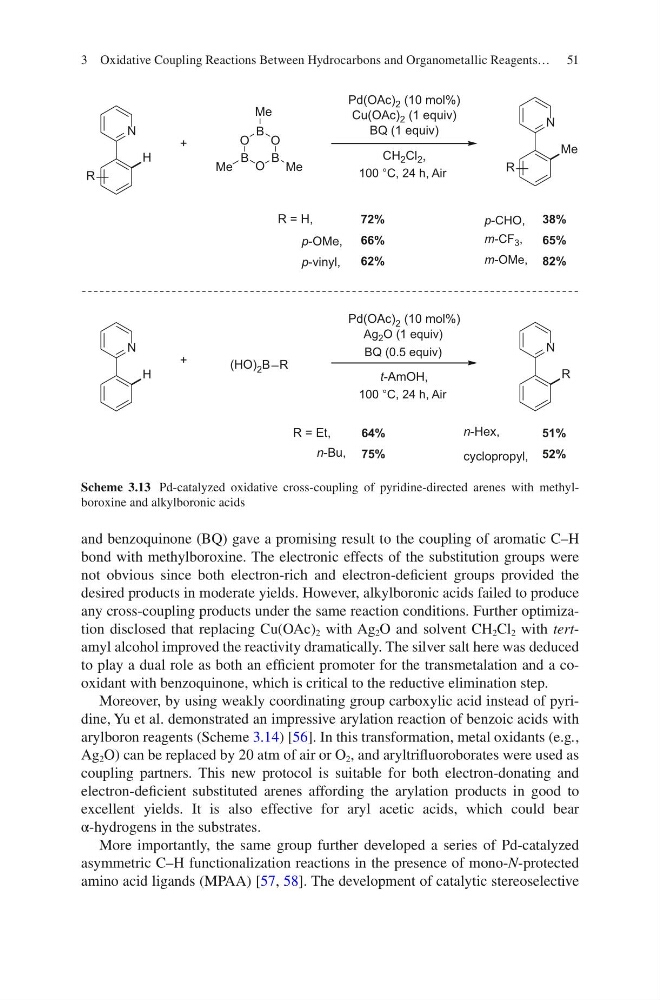
and benzoquinone (BQ) gave a promising result to the coupling of aromatic C–H
bond with methylboroxine. The electronic effects of the substitution groups were
not obvious since both electron-rich and electron-deficient groups provided the
desired products in moderate yields. However, alkylboronic acids failed to produce
any cross-coupling products under the same reaction conditions. Further optimization disclosed that replacing Cu(OAc) 2 with Ag 2 O and solvent CH 2 Cl 2 with tertamyl alcohol improved the reactivity dramatically. The silver salt here was deduced
to play a dual role as both an efficient promoter for the transmetalation and a cooxidant with benzoquinone, which is critical to the reductive elimination step.
Moreover, by using weakly coordinating group carboxylic acid instead of pyridine, Yu et al. demonstrated an impressive arylation reaction of benzoic acids with
arylboron reagents (Scheme 3.14) [56]. In this transformation, metal oxidants (e.g.,
Ag 2 O) can be replaced by 20 atm of air or O 2 , and aryltrifluoroborates were used as
coupling partners. This new protocol is suitable for both electron-donating and
electron- deficient substituted arenes affording the arylation products in good to
excellent yields. It is also effective for aryl acetic acids, which could bear
α-hydrogens in the substrates.
More importantly, the same group further developed a series of Pd-catalyzed
asymmetric C–H functionalization reactions in the presence of mono-N-protected
amino acid ligands (MPAA) [57, 58]. The development of catalytic stereoselective
Pd(OAc) 2 (10 mol%)
Cu(OAc) 2 (1 equiv)
BQ (1 equiv)
CH 2 Cl 2 ,
100 °C, 24 h, Air
N
H
+
N
Me
O
B O
B
O
B
Me
Me
Me
Pd(OAc) 2 (10 mol%)
Ag 2 O (1 equiv)
BQ (0.5 equiv)
t-AmOH,
100 °C, 24 h, Air
N
H
+
N
R
(HO) 2 B R
R
R
R = H,
p-OMe,
p-vinyl,
p-CHO,
m-CF 3 ,
m-OMe,
72%
66%
62%
38%
65%
82%
R = Et,
n-Bu,
n-Hex,
cyclopropyl,
64%
75%
51%
52%
Scheme 3.13 Pd-catalyzed oxidative cross-coupling of pyridine-directed arenes with methylboroxine and alkylboronic acids
3 Oxidative Coupling Reactions Between Hydrocarbons and Organometallic Reagents…
and benzoquinone (BQ) gave a promising result to the coupling of aromatic C–H
bond with methylboroxine. The electronic effects of the substitution groups were
not obvious since both electron-rich and electron-deficient groups provided the
desired products in moderate yields. However, alkylboronic acids failed to produce
any cross-coupling products under the same reaction conditions. Further optimization disclosed that replacing Cu(OAc) 2 with Ag 2 O and solvent CH 2 Cl 2 with tertamyl alcohol improved the reactivity dramatically. The silver salt here was deduced
to play a dual role as both an efficient promoter for the transmetalation and a cooxidant with benzoquinone, which is critical to the reductive elimination step.
Moreover, by using weakly coordinating group carboxylic acid instead of pyridine, Yu et al. demonstrated an impressive arylation reaction of benzoic acids with
arylboron reagents (Scheme 3.14) [56]. In this transformation, metal oxidants (e.g.,
Ag 2 O) can be replaced by 20 atm of air or O 2 , and aryltrifluoroborates were used as
coupling partners. This new protocol is suitable for both electron-donating and
electron- deficient substituted arenes affording the arylation products in good to
excellent yields. It is also effective for aryl acetic acids, which could bear
α-hydrogens in the substrates.
More importantly, the same group further developed a series of Pd-catalyzed
asymmetric C–H functionalization reactions in the presence of mono-N-protected
amino acid ligands (MPAA) [57, 58]. The development of catalytic stereoselective
Pd(OAc) 2 (10 mol%)
Cu(OAc) 2 (1 equiv)
BQ (1 equiv)
CH 2 Cl 2 ,
100 °C, 24 h, Air
N
H
+
N
Me
O
B O
B
O
B
Me
Me
Me
Pd(OAc) 2 (10 mol%)
Ag 2 O (1 equiv)
BQ (0.5 equiv)
t-AmOH,
100 °C, 24 h, Air
N
H
+
N
R
(HO) 2 B R
R
R
R = H,
p-OMe,
p-vinyl,
p-CHO,
m-CF 3 ,
m-OMe,
72%
66%
62%
38%
65%
82%
R = Et,
n-Bu,
n-Hex,
cyclopropyl,
64%
75%
51%
52%
Scheme 3.13 Pd-catalyzed oxidative cross-coupling of pyridine-directed arenes with methylboroxine and alkylboronic acids
3 Oxidative Coupling Reactions Between Hydrocarbons and Organometallic Reagents…