

52
C–H functionalization has historically been challenging due to its own inert nature.
Many of the C–H functionalization reactions require relatively high temperatures
and harsh conditions, which are detrimental to stereo-recognition during C–H bond
cleavage. By utilizing the (−)-Men-L-Leu-OH as the optimal ligand, the C–H
activation/C–C oxidative coupling of the prochiral pyridine-directed arenes with
boronic acids produced an array of desymmetrized coupling products in up to 96%
yield with 95% ee (Scheme 3.15) [59]. Further mechanistic investigation and computational calculation indicate that the amino acid ligand plays multiple roles in the
Pd-catalyzed C–H bond activation by acting as (1) a weakly coordinating ligand to
stabilize the Pd(II) precatalyst, (2) a soft proton donor (from the N-terminal) and
bidentately coordinated dianionic ligand to facilitate the formation of the catalytically active Pd(II) intermediate, and (3) a proton acceptor from the C–H bond via
the concerted metallation deprotonation (CMD) mechanism. It is thought that the
Pd-center acts as a coordinatively and electronically flexible metal center which
holds the substrate and amino acid ligand in close vicinity to achieve enantioselectivity. Later, they published another N-nosyl-directed C–H functionalization/oxidative cross-coupling between diarylmethylamines and arylboronic pinacol esters,
providing the desymmetrized arylation products in high ee (Scheme 3.15) [60].
Replacement of the typical MPAA ligand carboxylic acid moiety with
N-methoxyamide and of the N-Boc protecting group with Fmoc both proved
beneficial.
The similar catalytic system comprised of Pd(OAc) 2 and mono-N-protected
amino acid ligands (MPAA) has recently been employed for the construction of
planar–chiral ferrocene derivatives [61] and P-stereogenic phosphinamides [62],
respectively, via Pd(II)-catalyzed direct asymmetric C–H functionalization
(Scheme 3.16). For the enantioselective arylation between N,Ndialkylaminomethylferrocenes and arylboronic acids, Boc-L-Val-OH was found to
be the optimal ligand, and adding a catalytic amount of tetrabutylammonium bromide (TBAB) was critical to result in reasonable yields, while for the desymmetrized arylation of phosphinamides with boronic esters, the tyrosine-derived ligand
CO 2 H
Me
Br
H
+
KF 3 B Ph
CO 2 H
Me
Br
Ph
85%
H
Pd(OAc) 2 (10 mol%)
BQ (0.5 equiv)
K 2 HPO 4 (1.5 equiv)
O 2 /air (20 atm)
t-BuOH,
100 °C, 24 h
+
91%
Me
CO 2 H
MeO
Ph
Me
CO 2 H
MeO
KF 3 B Ph
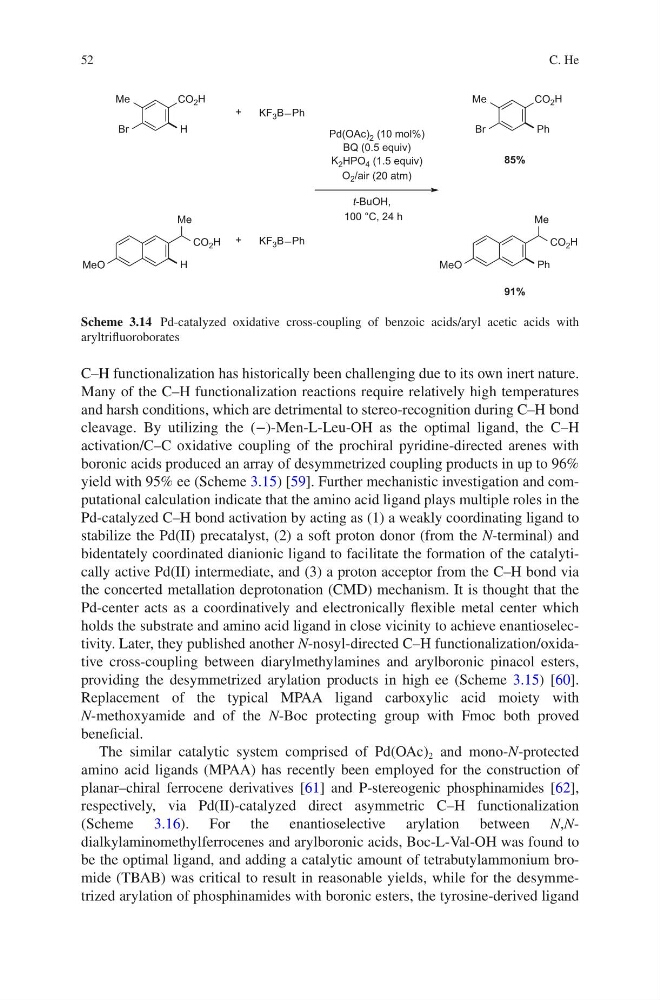
Scheme 3.14 Pd-catalyzed oxidative cross-coupling of benzoic acids/aryl acetic acids with
aryltrifluoroborates
C. He
C–H functionalization has historically been challenging due to its own inert nature.
Many of the C–H functionalization reactions require relatively high temperatures
and harsh conditions, which are detrimental to stereo-recognition during C–H bond
cleavage. By utilizing the (−)-Men-L-Leu-OH as the optimal ligand, the C–H
activation/C–C oxidative coupling of the prochiral pyridine-directed arenes with
boronic acids produced an array of desymmetrized coupling products in up to 96%
yield with 95% ee (Scheme 3.15) [59]. Further mechanistic investigation and computational calculation indicate that the amino acid ligand plays multiple roles in the
Pd-catalyzed C–H bond activation by acting as (1) a weakly coordinating ligand to
stabilize the Pd(II) precatalyst, (2) a soft proton donor (from the N-terminal) and
bidentately coordinated dianionic ligand to facilitate the formation of the catalytically active Pd(II) intermediate, and (3) a proton acceptor from the C–H bond via
the concerted metallation deprotonation (CMD) mechanism. It is thought that the
Pd-center acts as a coordinatively and electronically flexible metal center which
holds the substrate and amino acid ligand in close vicinity to achieve enantioselectivity. Later, they published another N-nosyl-directed C–H functionalization/oxidative cross-coupling between diarylmethylamines and arylboronic pinacol esters,
providing the desymmetrized arylation products in high ee (Scheme 3.15) [60].
Replacement of the typical MPAA ligand carboxylic acid moiety with
N-methoxyamide and of the N-Boc protecting group with Fmoc both proved
beneficial.
The similar catalytic system comprised of Pd(OAc) 2 and mono-N-protected
amino acid ligands (MPAA) has recently been employed for the construction of
planar–chiral ferrocene derivatives [61] and P-stereogenic phosphinamides [62],
respectively, via Pd(II)-catalyzed direct asymmetric C–H functionalization
(Scheme 3.16). For the enantioselective arylation between N,Ndialkylaminomethylferrocenes and arylboronic acids, Boc-L-Val-OH was found to
be the optimal ligand, and adding a catalytic amount of tetrabutylammonium bromide (TBAB) was critical to result in reasonable yields, while for the desymmetrized arylation of phosphinamides with boronic esters, the tyrosine-derived ligand
CO 2 H
Me
Br
H
+
KF 3 B Ph
CO 2 H
Me
Br
Ph
85%
H
Pd(OAc) 2 (10 mol%)
BQ (0.5 equiv)
K 2 HPO 4 (1.5 equiv)
O 2 /air (20 atm)
t-BuOH,
100 °C, 24 h
+
91%
Me
CO 2 H
MeO
Ph
Me
CO 2 H
MeO
KF 3 B Ph
Scheme 3.14 Pd-catalyzed oxidative cross-coupling of benzoic acids/aryl acetic acids with
aryltrifluoroborates
C. He