

49
3.3.2 Organoboron Reagents as Nucleophiles
Considering the diverse reactivity profiles, nontoxic nature, excellent functional
group, and moisture tolerance properties, organoboron reagents are one of the most
diverse classes of reagent in organic synthesis. In the field of oxidative crosscouplings, organoboron reagents are also widely used as the coupling partner which
provide access to a range of valuable and indispensable transformations.
The first oxidative coupling reaction between arenes and organoboron reagents
was reported by Kakiuchi et al. in 2003 (Scheme 3.11) [53]. This ruthenium-catalyzed ortho-arylation of aromatic ketones with arylboronates provides a new method
to C–C bond formation for the synthesis of biaryl compounds. Other organoboron
reagents such as arylboronic acids, arylboronic acid anhydrides, and sodium tetraphenylborate were ineffective in the reaction [54]. Further NMR experiment and
GC-MS results showed that the trialkoxyborane E was formed during the coupling
reaction, which suggested that half of the aryl ketone acted as the oxidant. The proposed mechanism is shown in Scheme 3.12. The ortho C–H bond is activated by
ruthenium(0) complex A via oxidative addition to give the ortho-metalated intermediate B. The addition of a Ru–H bond of intermediate B to the ketone carbonyl
group leads to the production of an (alkoxy)-ruthenium intermediate C. Then transmetalation between the phenylboronate and intermediate C results in the formation
of the (diaryl)ruthenium complex D and the trialkoxyborane (borinate) E. Finally,
reductive elimination furnishes the C–C bond formation and provides the arylation
product as well as the regeneration of the active catalyst species A.
Later, by using pyridine as the directing group, Yu and co-workers developed a
Pd-catalyzed oxidative cross-coupling of arenes with both methylboroxine and
alkylboronic acids (Scheme 3.13) [55]. The combination of Pd(OAc) 2 , Cu(OAc) 2 ,
OMe
N
R 1 R 2
FeCl 3
. 6H 2 O (10 mol%)
MeCN, rt, 30 min
T-HYDRO
Sn(nBu)3
+
OMe
N
R 1 R 2
OMe
N
Bn
OMe
N
OMe
N
Bn
Bn
70%
80%
50%
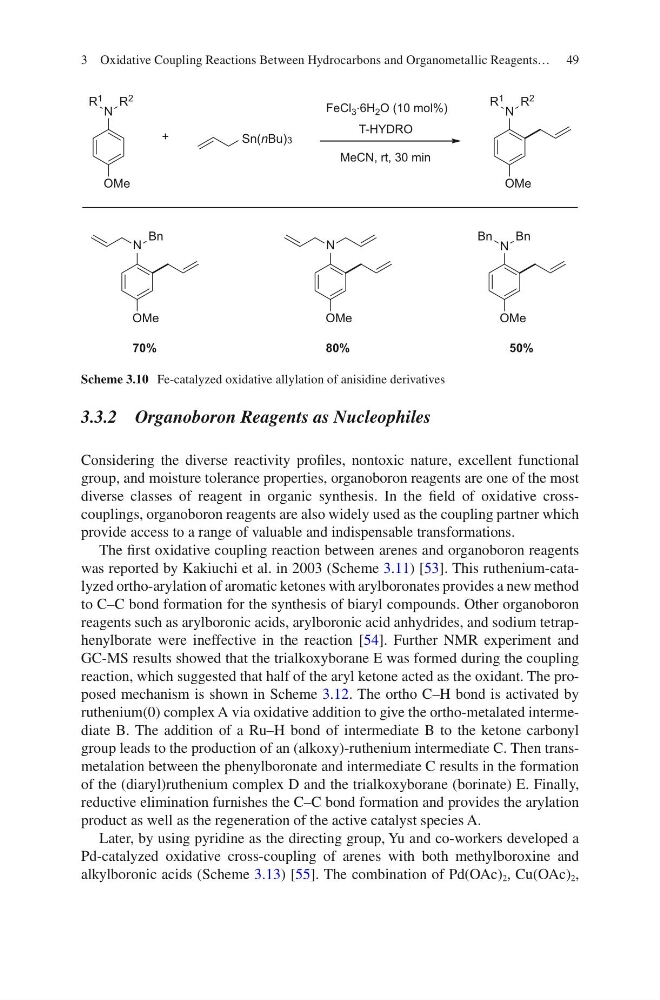
Scheme 3.10 Fe-catalyzed oxidative allylation of anisidine derivatives
3 Oxidative Coupling Reactions Between Hydrocarbons and Organometallic Reagents…
3.3.2 Organoboron Reagents as Nucleophiles
Considering the diverse reactivity profiles, nontoxic nature, excellent functional
group, and moisture tolerance properties, organoboron reagents are one of the most
diverse classes of reagent in organic synthesis. In the field of oxidative crosscouplings, organoboron reagents are also widely used as the coupling partner which
provide access to a range of valuable and indispensable transformations.
The first oxidative coupling reaction between arenes and organoboron reagents
was reported by Kakiuchi et al. in 2003 (Scheme 3.11) [53]. This ruthenium-catalyzed ortho-arylation of aromatic ketones with arylboronates provides a new method
to C–C bond formation for the synthesis of biaryl compounds. Other organoboron
reagents such as arylboronic acids, arylboronic acid anhydrides, and sodium tetraphenylborate were ineffective in the reaction [54]. Further NMR experiment and
GC-MS results showed that the trialkoxyborane E was formed during the coupling
reaction, which suggested that half of the aryl ketone acted as the oxidant. The proposed mechanism is shown in Scheme 3.12. The ortho C–H bond is activated by
ruthenium(0) complex A via oxidative addition to give the ortho-metalated intermediate B. The addition of a Ru–H bond of intermediate B to the ketone carbonyl
group leads to the production of an (alkoxy)-ruthenium intermediate C. Then transmetalation between the phenylboronate and intermediate C results in the formation
of the (diaryl)ruthenium complex D and the trialkoxyborane (borinate) E. Finally,
reductive elimination furnishes the C–C bond formation and provides the arylation
product as well as the regeneration of the active catalyst species A.
Later, by using pyridine as the directing group, Yu and co-workers developed a
Pd-catalyzed oxidative cross-coupling of arenes with both methylboroxine and
alkylboronic acids (Scheme 3.13) [55]. The combination of Pd(OAc) 2 , Cu(OAc) 2 ,
OMe
N
R 1 R 2
FeCl 3
. 6H 2 O (10 mol%)
MeCN, rt, 30 min
T-HYDRO
Sn(nBu)3
+
OMe
N
R 1 R 2
OMe
N
Bn
OMe
N
OMe
N
Bn
Bn
70%
80%
50%
Scheme 3.10 Fe-catalyzed oxidative allylation of anisidine derivatives
3 Oxidative Coupling Reactions Between Hydrocarbons and Organometallic Reagents…