

48
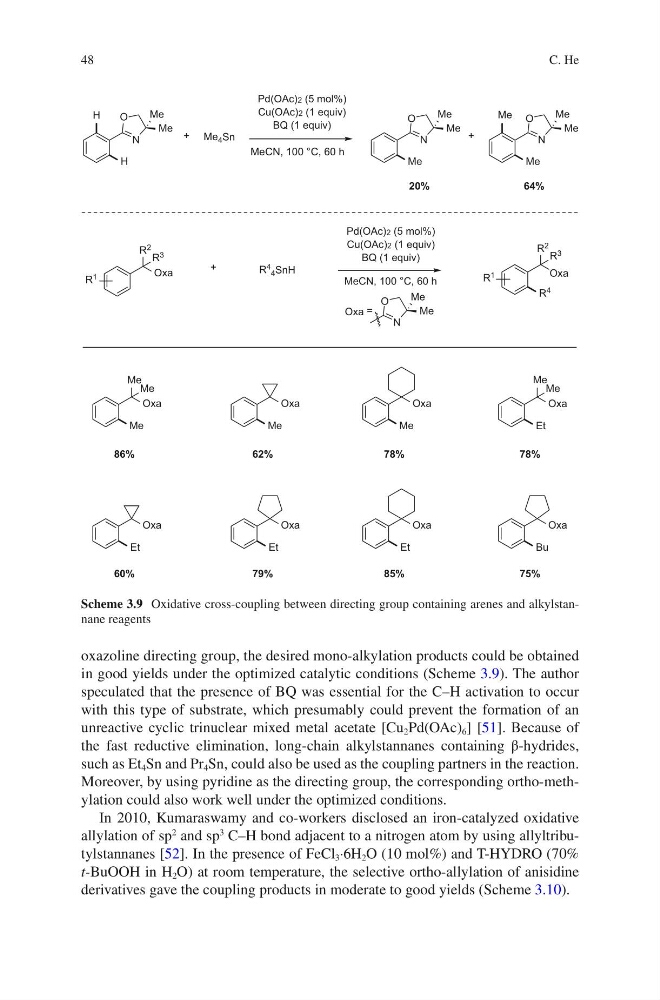
oxazoline directing group, the desired mono-alkylation products could be obtained
in good yields under the optimized catalytic conditions (Scheme 3.9). The author
speculated that the presence of BQ was essential for the C–H activation to occur
with this type of substrate, which presumably could prevent the formation of an
unreactive cyclic trinuclear mixed metal acetate [Cu 2 Pd(OAc) 6 ] [51]. Because of
the fast reductive elimination, long-chain alkylstannanes containing β-hydrides,
such as Et 4 Sn and Pr 4 Sn, could also be used as the coupling partners in the reaction.
Moreover, by using pyridine as the directing group, the corresponding ortho-methylation could also work well under the optimized conditions.
In 2010, Kumaraswamy and co-workers disclosed an iron-catalyzed oxidative
allylation of sp
2
and sp
3
C–H bond adjacent to a nitrogen atom by using allyltributylstannanes [52]. In the presence of FeCl 3 ·6H 2 O (10 mol%) and T-HYDRO (70%
t-BuOOH in H 2 O) at room temperature, the selective ortho-allylation of anisidine
derivatives gave the coupling products in moderate to good yields (Scheme 3.10).
Pd(OAc)2 (5 mol%)
Cu(OAc)2 (1 equiv)
BQ (1 equiv)
MeCN, 100 °C, 60 h
N
O
Me
Me
+ Me 4 Sn
N
O
Me
Me
Me
+
N
O
Me
Me
Me
Me
20%
64%
+
R 4 4 SnH
N
O
Me
Me
Oxa =
Oxa
R 2
R 3
R 1
Oxa
R 2
R 3
R 1
R 4
Oxa
Me
Me
Me
86%
Oxa
Me
62%
Oxa
Me
78%
Oxa
Me
Me
Et
78%
Oxa
Et
60%
Oxa
Et
85%
Oxa
Et
79%
Oxa
Bu
75%
H
H
Pd(OAc)2 (5 mol%)
Cu(OAc)2 (1 equiv)
BQ (1 equiv)
MeCN, 100 °C, 60 h
Scheme 3.9 Oxidative cross-coupling between directing group containing arenes and alkylstannane reagents
C. He
oxazoline directing group, the desired mono-alkylation products could be obtained
in good yields under the optimized catalytic conditions (Scheme 3.9). The author
speculated that the presence of BQ was essential for the C–H activation to occur
with this type of substrate, which presumably could prevent the formation of an
unreactive cyclic trinuclear mixed metal acetate [Cu 2 Pd(OAc) 6 ] [51]. Because of
the fast reductive elimination, long-chain alkylstannanes containing β-hydrides,
such as Et 4 Sn and Pr 4 Sn, could also be used as the coupling partners in the reaction.
Moreover, by using pyridine as the directing group, the corresponding ortho-methylation could also work well under the optimized conditions.
In 2010, Kumaraswamy and co-workers disclosed an iron-catalyzed oxidative
allylation of sp
2
and sp
3
C–H bond adjacent to a nitrogen atom by using allyltributylstannanes [52]. In the presence of FeCl 3 ·6H 2 O (10 mol%) and T-HYDRO (70%
t-BuOOH in H 2 O) at room temperature, the selective ortho-allylation of anisidine
derivatives gave the coupling products in moderate to good yields (Scheme 3.10).
Pd(OAc)2 (5 mol%)
Cu(OAc)2 (1 equiv)
BQ (1 equiv)
MeCN, 100 °C, 60 h
N
O
Me
Me
+ Me 4 Sn
N
O
Me
Me
Me
+
N
O
Me
Me
Me
Me
20%
64%
+
R 4 4 SnH
N
O
Me
Me
Oxa =
Oxa
R 2
R 3
R 1
Oxa
R 2
R 3
R 1
R 4
Oxa
Me
Me
Me
86%
Oxa
Me
62%
Oxa
Me
78%
Oxa
Me
Me
Et
78%
Oxa
Et
60%
Oxa
Et
85%
Oxa
Et
79%
Oxa
Bu
75%
H
H
Pd(OAc)2 (5 mol%)
Cu(OAc)2 (1 equiv)
BQ (1 equiv)
MeCN, 100 °C, 60 h
Scheme 3.9 Oxidative cross-coupling between directing group containing arenes and alkylstannane reagents
C. He